UBT Co-Leads

Help Video

How to Find UBT Basics on the LMP Website

Learn how to use the LMP website:

LMP Website Overview

Learn how to use the LMP website:

How to Find How-To Guides

This short animated video explains how to find and use our powerful how-to guides

Learn how to use the LMP website:

How to Find and Use Team-Tested Practices

Does your team want to improve service? Or clinical quality? If you don't know where to start, check out the team-tested practices on the LMP website. This short video shows you how. 

Learn how to use the LMP website:

How to Use the Search Function on the LMP Website

Having trouble using the search function? Check out this short video to help you search like a pro!

Learn how to use the LMP website:

How to Find the Tools on the LMP Website

Need to find a checklist, template or puzzle? Don't know where to start? Check out this short video to find the tools you need on the LMP website with just a few clicks. 

Learn how to use the LMP website:

Comprehensive Level Attendance Toolkit

The Comprehensive Attendance Toolkit is for teams with deep or complex issues with attendance that require external support to address. Contact your UBT consultant to find the right person to help.

This level may be appropriate for your team if you feel your team needs support from an objective party to identify root causes and address attendance issues.

Solutions from the Comprehensive Attendance Toolkit are delivered by third party or facilitator to help guide the team.

Check out the full Attendance Toolkit.


Intermediate Level Attendance Toolkit

The Intermediate Attendance Toolkit provides managers and employees with additional guidance to address their attendance issues. This toolkit aims to help teams that work well together to address attendance issues.

Teams that use this toolkit should have good established practices for resolving issues. They should display healthy engagement and morale.  

After completing a root cause analysis, this toolkit level provides guidance for projects that assist with attendance issues (UBT, LMP Leadership Teams).

Refresher Level Attendance Toolkit

The Refresher Attendance Toolkit helps groups review basic attendance concepts and best practices. Suggested icebreakers provide an easy way to get the dialog going. The Refresher Attendance Toolkit is for teams with healthy attendance who need some basic attendance support reminders. Employees can learn about the value of reducing absenteeism and get general information about time off. They can also get tools to help maintain ongoing attendance conversations.

Check out the full Attendance Toolkit.

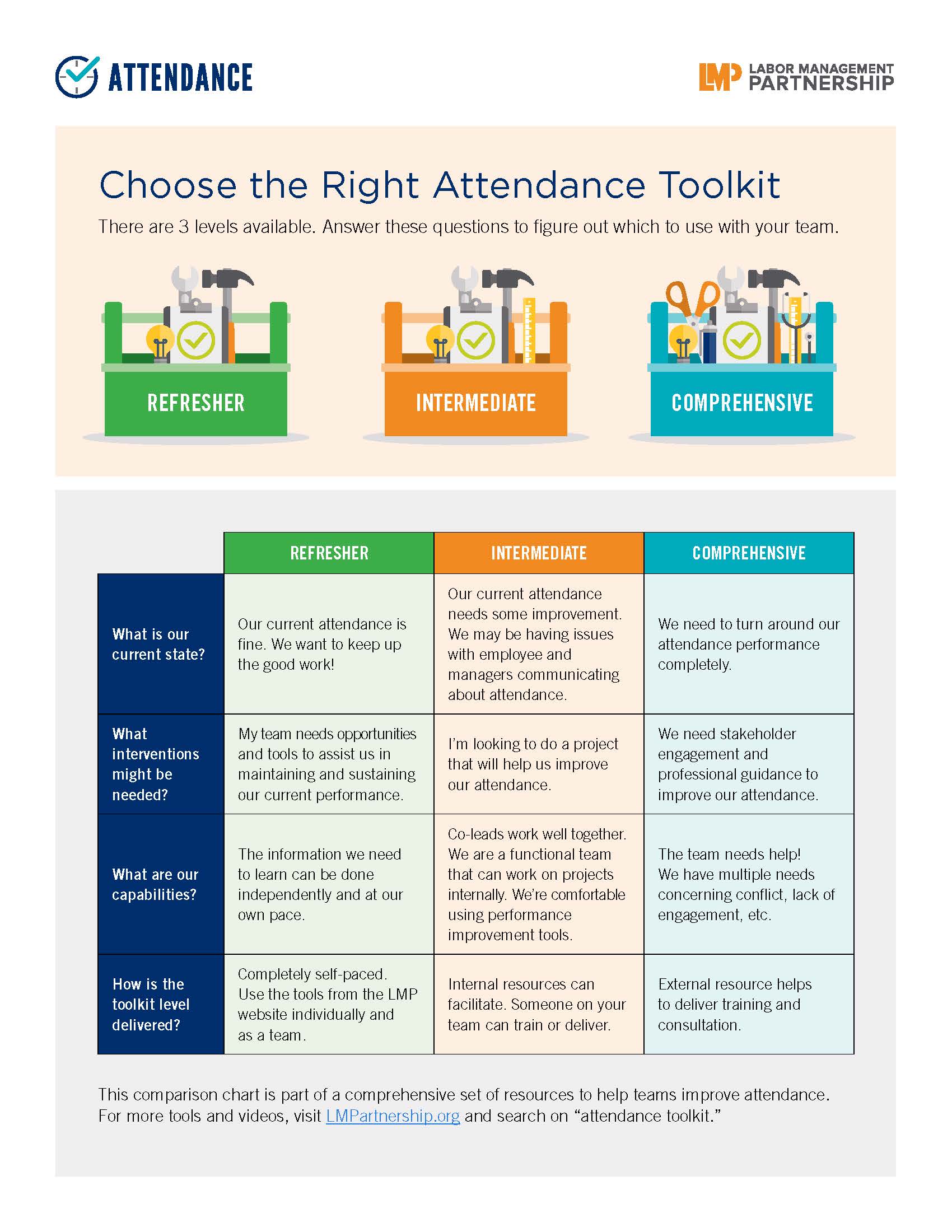
Comparing the Levels of the Attendance Toolkit

Deck: 
Use this chart to figure out which toolkit to use with your team

Story body part 1: 
 
  RefresherIntermediateComprehensive
What is our current state?Our current attendance is fine. We want to keep up the good work!Our current attendance needs some improvement. We may be having issues with employees and managers communicating about attendance.We need to turn around our attendance performance completely.
What interventions might be needed?My team needs opportunities and tools to assist us in maintaining and sustaining our current performance.I’m looking to do a project that will help us improve our attendance.We need stakeholder engagement and professional guidance to improve our attendance.
What are our capabilities?The information we need to learn can be done independently and at our own pace.Co-leads work well together. We are a functional team that can work on projects internally. We’re comfortable using performance improvement tools.The team needs help! We have multiple needs concerning conflict, lack of engagement, etc.
How is the toolkit level delivered?Completely self-paced. Use the tools from the LMP website individually and as a team.Internal resources can facilitate. Someone on your team can train or deliver.External resource helps to deliver training and consultation.


Tool Time

Deck: 
Find help at your fingertips

Story body part 1: 

Does your team need a tune-up on performance improvement tools?

Dust off the old tool belt and dig into all the Labor Management Partnership resources at your fingertips. LMPartnership.org offers more than 700 tools. 

Finding the right tools is easy if you follow these simple steps:

  • Log on to LMPartnership.org (you're here now!)
  • Go to the Library tab and select Tools.
  • Use the filter option on the left to narrow your focus.
  • Want more options? Use the Reset button to change your filters.

Need more help? Check out this cool video!


Equity for All

Deck: 
Teams answer the call to address care gaps

Story body part 1: 

“Everyone must put on their leadership hat. It doesn’t relate to title or overall responsibility —  it’s what you control and influence from where you stand,” said Ronald Copeland, MD, senior vice president and chief equity, inclusion and diversity officer, at the National Equity, Inclusion, and Diversity Virtual Conference Series in October.

The Labor Management Partnership is designed to foster leaders at every level, to encourage everyone to use their voice and add their ideas to solving the challenges at hand. As our nation and our organization seek new ways to advance equity and diversity — including equity in health care — doing the right thing has never been more important.

“Action matters more than passion, and impact matters more than intent,” Dr. Copeland said. “It’s great to say, ‘I want everybody to achieve equity and inclusion,’ but we have to do the actions that make that occur.”

See equity in action in this issue of Hank with inspiring actions taken by 4 unit-based teams from across the organization. Together, their commitment to achieving equitable outcomes in maternal-child health, and in treating diabetes and high blood pressure, is reshaping what culturally sensitive care looks like for thousands of our members and patients.


Videos

LMP Methods Booster Video

Loading the player...

(7:27)

At the Labor Management Partnership, how we make decisions is just as important as the decisions themselves. Interest-based problem solving and consensus decision making are 2 important methods we use to solve problems, improve performance and cultivate good working relationships. View this short video and use the related tools to boost your knowledge and skills.

Pages

Subscribe to RSS - UBT Co-Leads