TOOLS
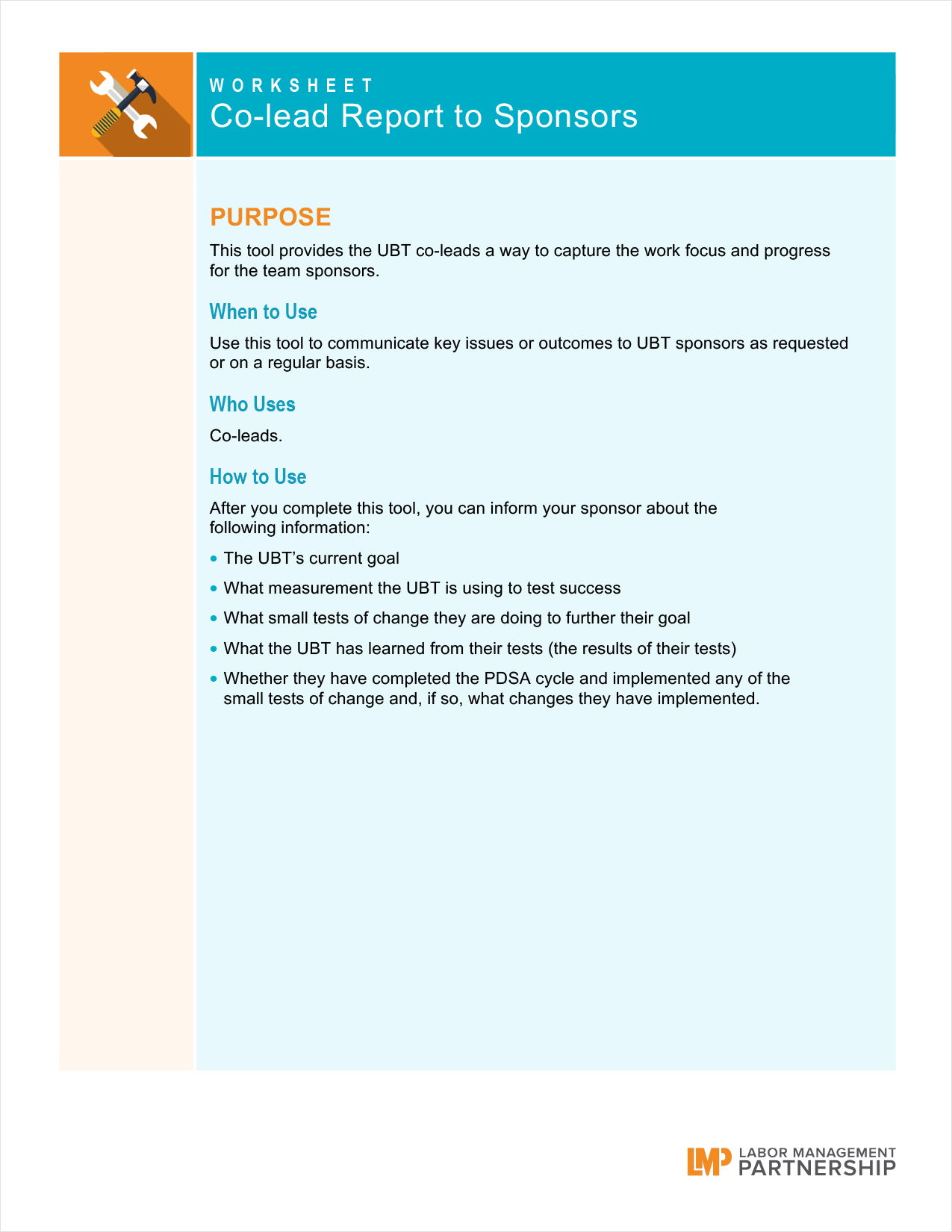
Co-lead Report to Sponsors
Format:
Word document
Size:
8.5" x 11"
Intended audience:
Unit-based team co-leads
Best used:
Use this tool to communicate key issues or outcomes to UBT sponsors on a regular basis or as requested.
This short animated video explains how to find and use our powerful how-to guides
Does your team want to improve service? Or clinical quality? If you don't know where to start, check out the team-tested practices on the LMP website. This short video shows you how.
Having trouble using the search function? Check out this short video to help you search like a pro!
Need to find a checklist, template or puzzle? Don't know where to start? Check out this short video to find the tools you need on the LMP website with just a few clicks.
Format:
Word document
Size:
8.5" x 11"
Intended audience:
Unit-based team co-leads
Best used:
Use this tool to communicate key issues or outcomes to UBT sponsors on a regular basis or as requested.
Format:
Doc
Size:
8.5" x 11"
Intended audience:
Co-leads and their sponsors
Best used:
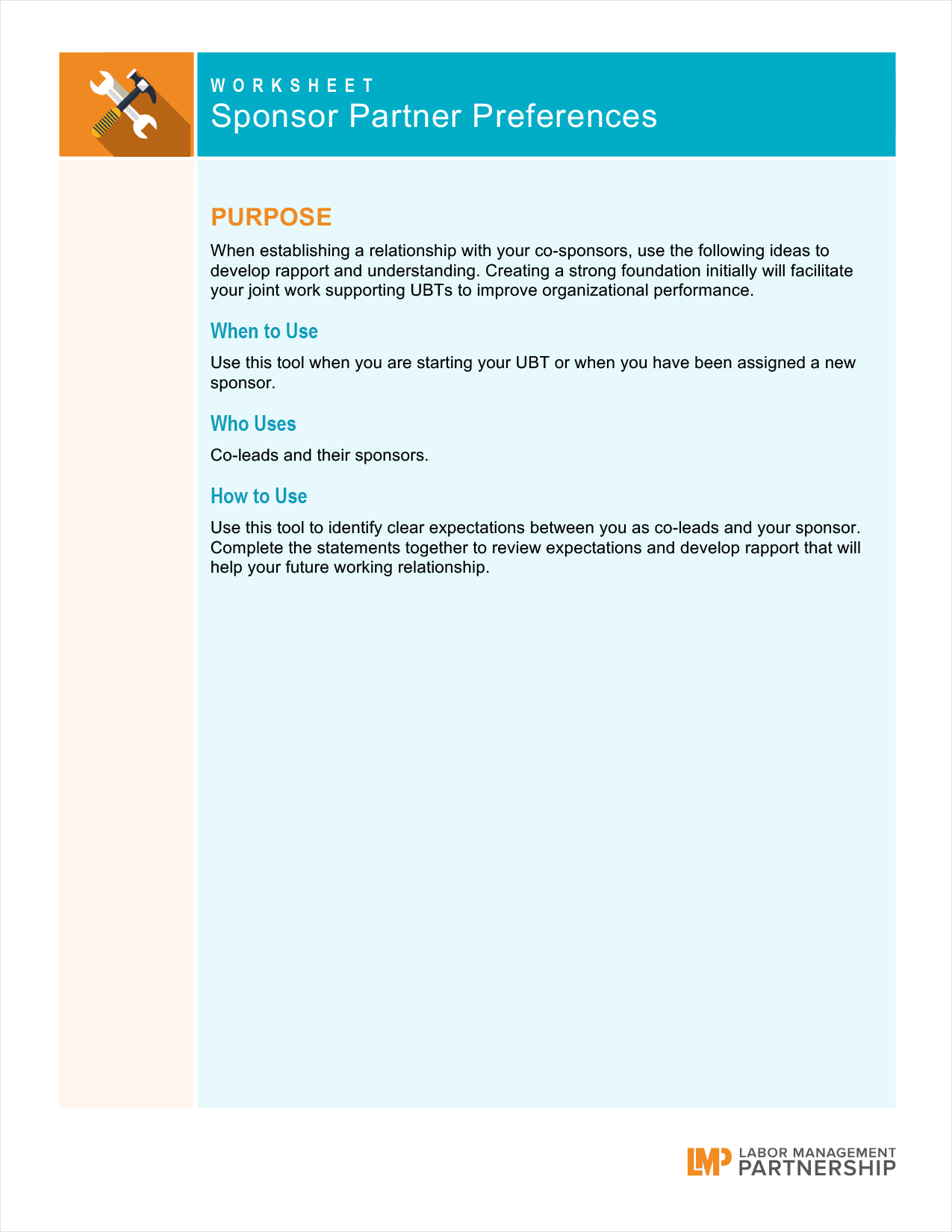
When establishing a relationship with your co-sponsors, try the following ideas to develop rapport and understanding. Creating a strong foundation initially will facilitate your joint work supporting UBTs to improve organizational performance. Use this tool when you are starting your UBT or when you have been assigned a new sponsor.
Format:
Doc
Size:
8.5" x 11"
Intended audience:
Unit-based team co-leads and sponsors
Best used:
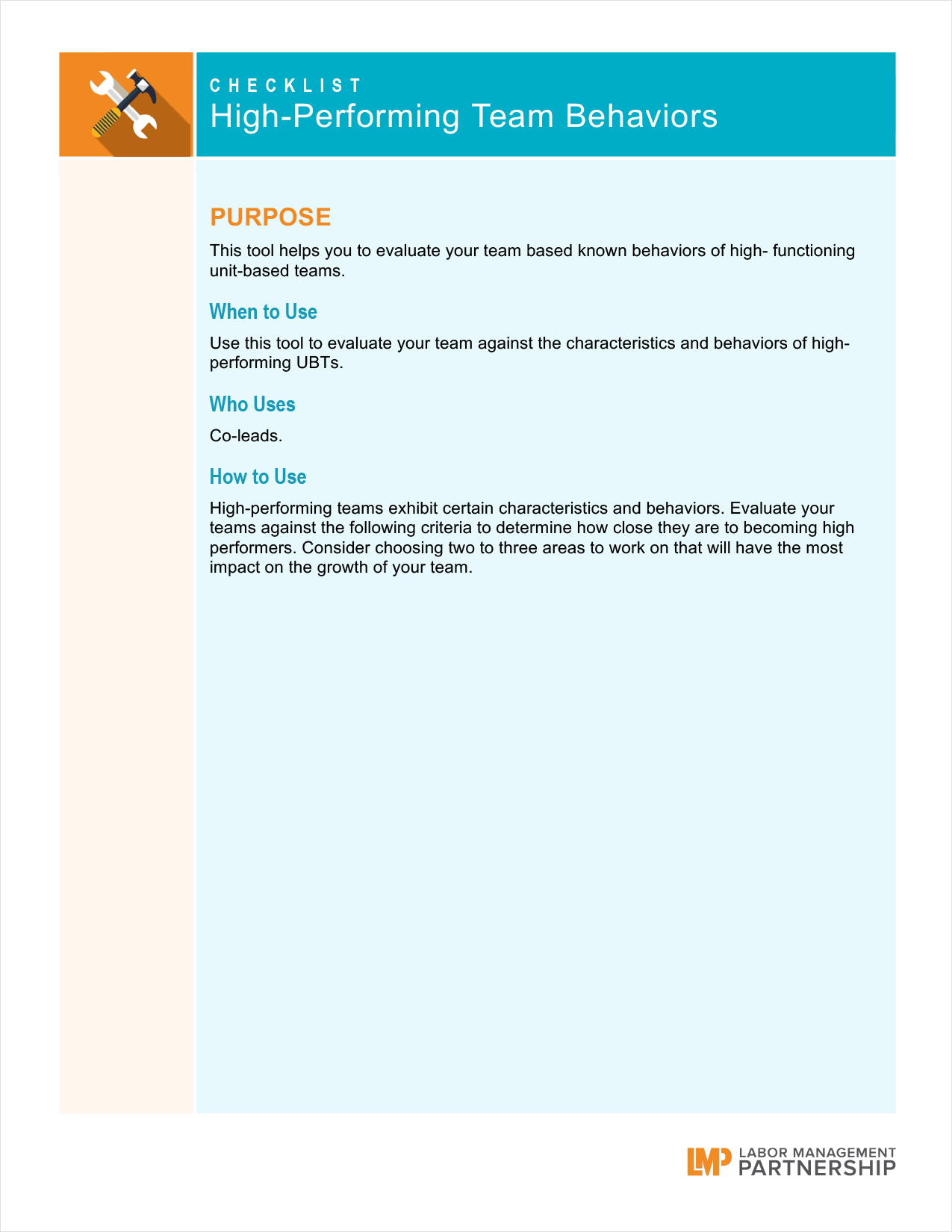
This tool helps you to evaluate your team based on known behaviors of high-functioning unit-based teams. Use this tool to evaluate your team against the characteristics and behaviors of high-performing UBTs.
Format:
Word document
Size:
8.5" x 11"
Intended audience:
UBT co-leads and sponsors
Best used:
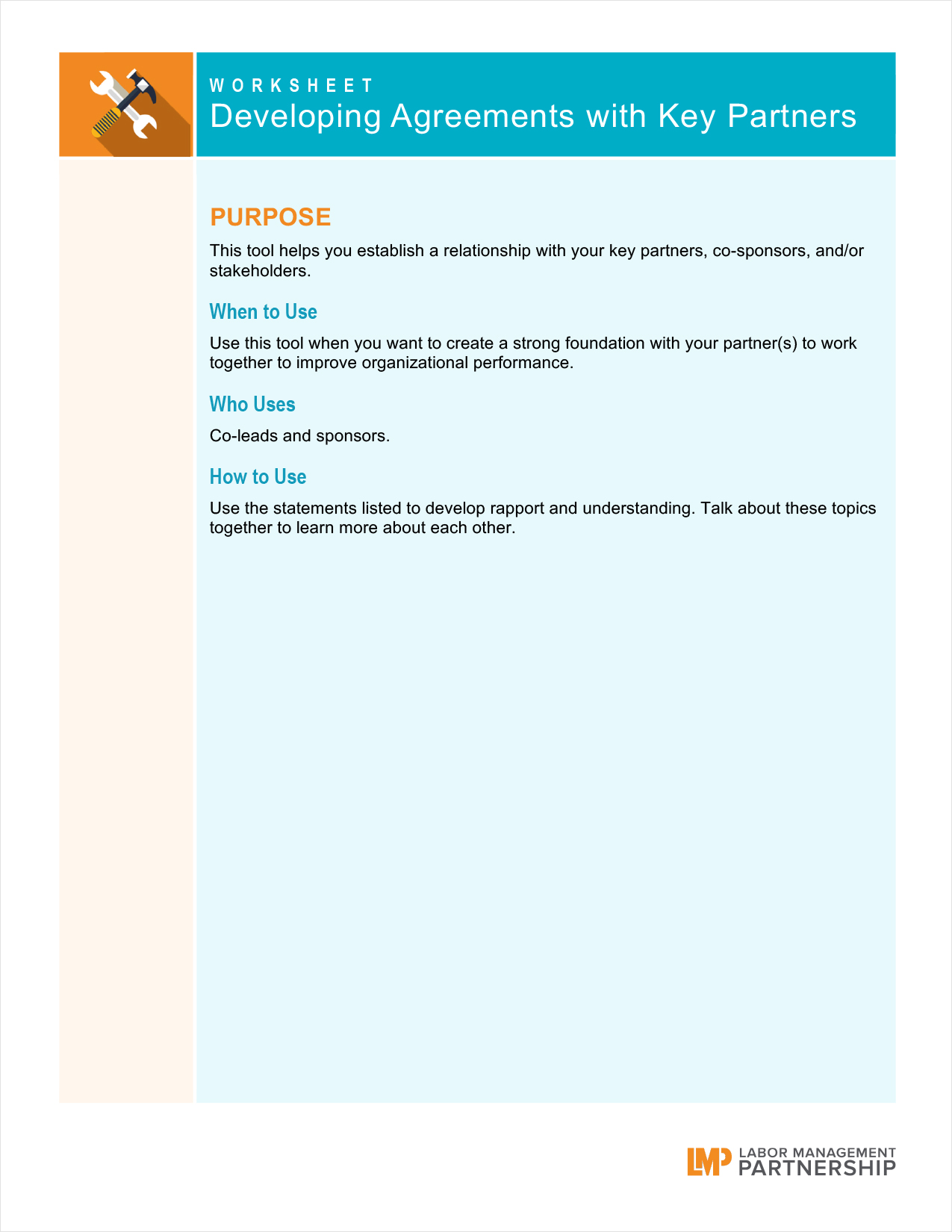
Use this tool when you want to create a strong foundation with your key partners, co-sponsors and/or stakeholders to work together to improve organizational performance.
Format:
PowerPoint slide
Size:
8.5" x 11"
Intended audience:
Frontline teams, UBT-co-leads, UBT sponsors, mid-level managers
Best used:
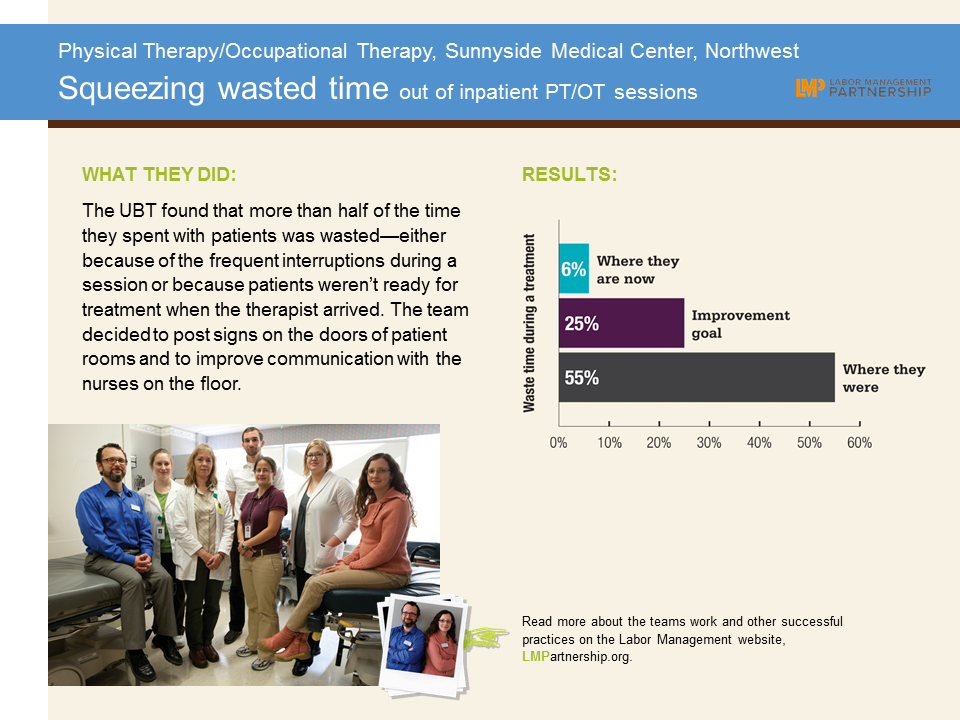
This one-page slide shows how PT/OT team improved work processes to spend more time with patients. Include in meetings or presentations as one example of UBT performance improvement in Northwest region.
When the Anaheim Medical Center Admitting department unit-based team set out to increase its collection of inpatient hospital copayments, it had several hurdles to overcome.
Some staff members had to get comfortable with asking for money from patients. Others had to learn how to calculate copayments. They also needed to notify Admitting of a patient’s pending discharge so copayments could be collected at the point of service.
And since the team goal of collecting copayments didn’t always dovetail nicely with individualized goals, that put some staff members at odds.
“We had created this unhealthy competition,” admitting supervisor/manager and union co-lead David Jarvis says.
They also had the problem of convincing staff members in other departments that collecting copayments from hospitalized patients was not a bad thing.
"They used to think of me as Public Enemy No. 1," says Patti Hinds, a financial counselor and member of SEIU UHW.
To educate and motivate staff members about the importance of collecting copayments, the unit-based team held a kickoff meeting in January 2010.
Staff members who were good at collecting and calculating copayments were deemed “master users” and received training so they could help their peers learn to correctly calculate amounts due. They also got pointers on speaking with patients about the money they owed.
"We wrote scripts, we role-played and, as people did it more, they became more comfortable with asking for money and with knowing when it is appropriate to do so," admitting clerk, SEIU UHW Patricia Hartwig says.
The team also had to teach staff members in other departments about the benefits of copayment collection.
"We showed them the bottom-line connection between revenue collection and their paychecks," Hartwig says.
Better working relationships developed between admitting department staff and the nursing units, prompting nurses to contact admitting staff more consistently before patients are discharged.
"They came to realize we’re not the 'bad guys,' " says financial counselor Marcela Perez, an SEIU-UHW member.
Format:
PDF
Size:
8.5" x 11"
Intended audience:
UBT co-leads and consultants
Best used:
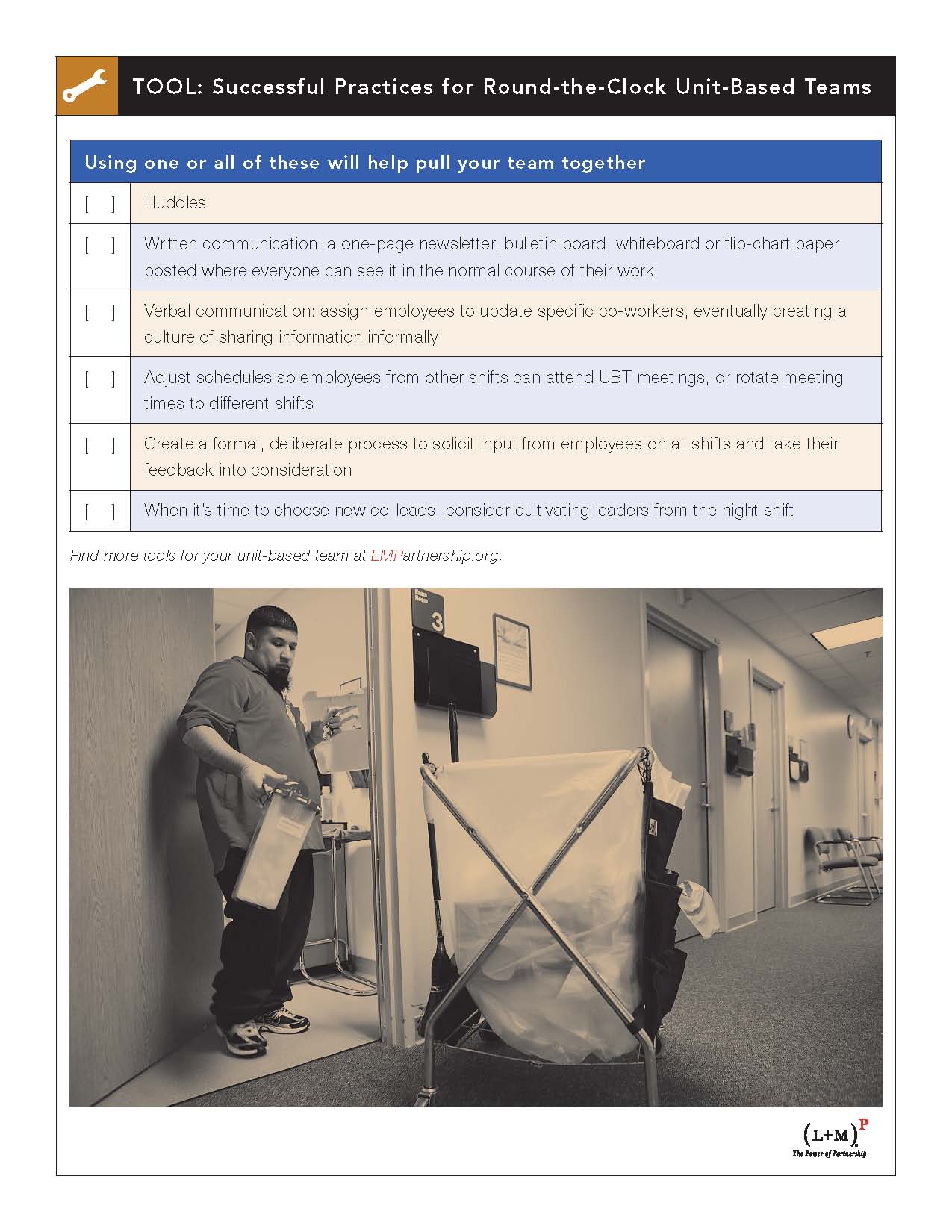
This checklist will give you ideas on how to improve communication across shifts—and improve your team's performance in the process. Use to enhance the functionality of teams that work across multiple shifts.
Format:
PDF and Word DOC
Size:
8.5" x 11"
Intended Audience:
NICUs and maternity wards
Best used:
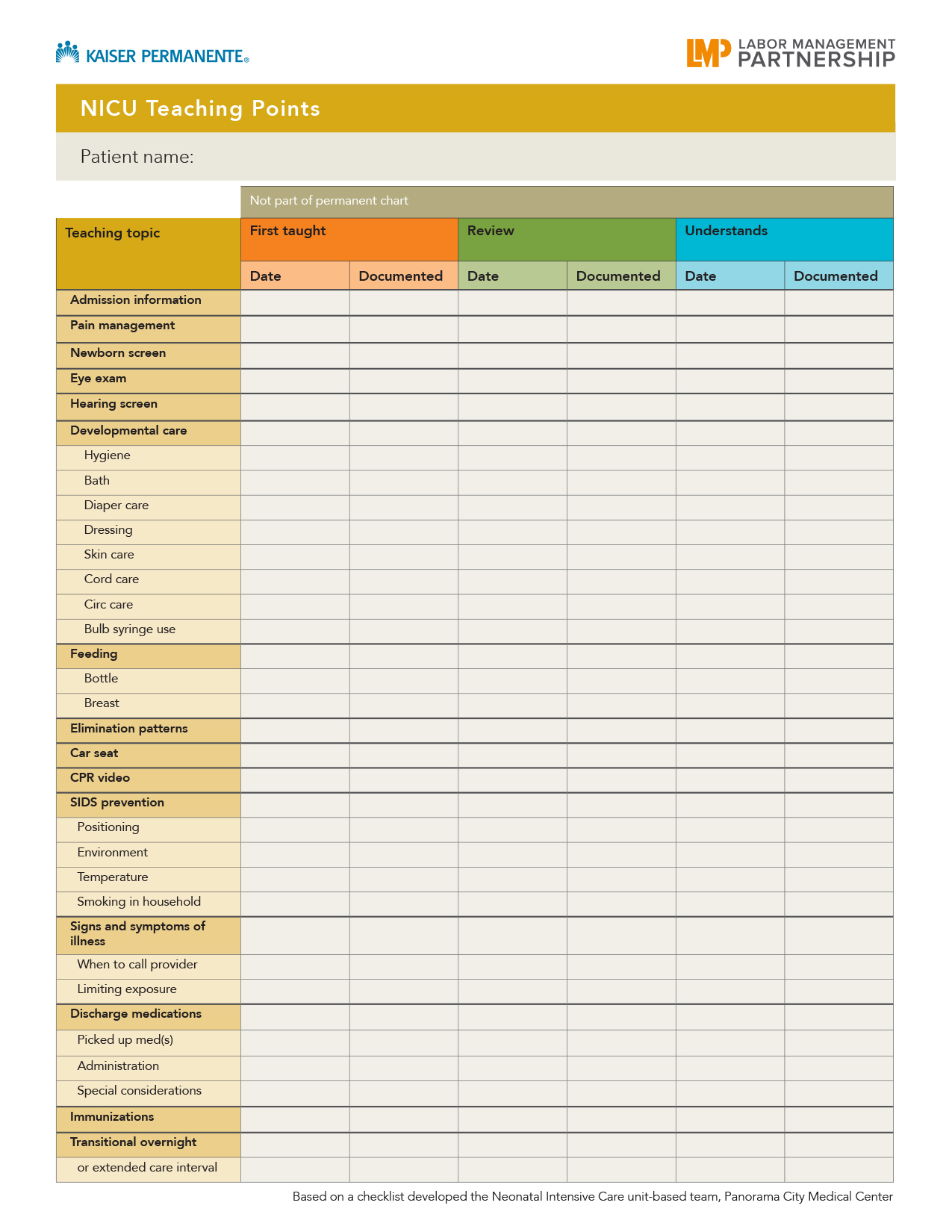
Use this checklist to ensure that information about how to take care of a new infant is gone over consistently with parents of newborns.
What happens when teams truly walk a mile in their patients’ shoes? They often discover their own actions are making that mile a rocky one for patients—and as a result make huge breakthroughs in the way they deliver care.
In the case of South San Francisco’s multidepartmental pre-admission team, observing their processes from the other side of the gurney spurred them to dramatically streamline the pre-surgery and admitting process for patients. With the member at the forefront of their thinking, the team members turned a two-inch-thick packet of confusing, redundant information into a streamlined, one-page checklist. And a funny thing happened—while redesigning the process to help patients, the team improved the way it works.
“Patients would often get confused and weren’t sure what the next step in the process was,” says Brian Tzeng, MD, the Peri-operative Medicine director. “We realized we didn’t have a clear path for the patient to follow.”
Other teams throughout Kaiser Permanente are making similar realizations, framing their performance improvement work by asking the question, “What’s best for the patient?” If a possible solution doesn’t work well for the member and patient, then there’s more brainstorming to be done. These teams are taking the Value Compass to heart—organizing their work not just around the four points but examining what they’re doing from the patient’s perspective.
What does that mean for frontline teams? At the San Diego Medical Center, the Emergency Department sees up to 300 patients every 24 hours. Physicians and staff members are always on the go, delivering on the ultimate bottom line—saved lives. What could be more important? Clinical quality is high; patients are seen in a timely manner and the rate of unscheduled return visits is good.
Yet the results of a recent patient satisfaction survey bothered the team. The department scored well overall, but their patients gave it only 63 percent approval on one question: While you were in the Emergency Department, were you kept informed about how long the treatment would take?
Various interventions have been implemented to increase the rate of colon cancer screenings, including at-home Fecal-Immunochemical Tests or FIT kits. These kits are mailed or handed to patients identified as age- or risk-appropriate and can be completed in the privacy of the member’s own home.
The FIT kit doesn’t require a doctor’s appointment and is returned directly to the lab in a prepaid envelope. Patients who have positive FIT kit results for occult blood are referred for further testing.
“A long time ago, there was no way to track these people,” Kari Russitano, medical assistant, SEIU UHW, says. “Kaiser has done a lot to improve cancer screenings.”
But getting members to take and return the test remains a problem.
In 2009, the Union City Medical Center fell short of its 71 percent return rate goal for colorectal screenings. Kaiser Permanente routinely mass mails the kits to members identified through the electronic medical records database. But many members either don’t return the tests or the ones they return aren’t legible.
“Thirty percent were thrown away because we couldn’t read their name or the medical record number,” Deborah Hennings-Cook, RN, manager, Internal Medicine, says.
Clinical coordinator, Vimi Chand, Department of Internal Medicine, adds, “Obviously mailing alone wasn’t working, so we decided to contact members by phone or secure email. And it worked.”
Of the 1,754 members contacted, more than 63 were referred for further screening.
Having the medical assistants and receptionists make the calls was a hard sell at first, but their peers in the unit-based team stressed the preventive nature of the test.
“It didn’t seem like extra work, because we collaborated together and educated each other to think of it as if ‘this could be your family member,’” Sophia Opfermann, receptionist, OPEIU Local 29, says. “A lot of staff didn’t know what the FIT kits were for, so we educated them about that, too.”
Then frontline staff came up with the idea for the note cards—bright fluorescent notes that read: “This test detects early signs of COLON CANCER.”
“Knowing that many people don’t understand the importance of the test, they made the verbiage strong about ‘saving lives’ and ‘help us help you,’" Hennings-Cook says. "It was something they wanted to do, and it worked.”
One challenge was adding the phone calls and emails to the medical assistants’ existing workload. Lists of patients who hadn’t responded were provided to medical assistants but some had more than others.
“We heard a little bit of flak when the lists first came out and some MAs had huge lists, but they helped each other and just did it,” Chand says.
In the end, the bottom line was helping patients.
“By collaborating together and educating each other, we are helping to saving lives,” Opfermann says.