
LMP Processes
Help Video
How to Find UBT Basics on the LMP Website
LMP Website Overview
How to Find How-To Guides
This short animated video explains how to find and use our powerful how-to guides
How to Find and Use Team-Tested Practices
Does your team want to improve service? Or clinical quality? If you don't know where to start, check out the team-tested practices on the LMP website. This short video shows you how.
How to Use the Search Function on the LMP Website
Having trouble using the search function? Check out this short video to help you search like a pro!
How to Find the Tools on the LMP Website
Need to find a checklist, template or puzzle? Don't know where to start? Check out this short video to find the tools you need on the LMP website with just a few clicks.
TOOLS
The 7 Spreadly Sins
Format:
- PowerPoint (PPT)
- PDF version of the PowerPoint
Size:
- PDF (8.5" x 11")
- 12-slide widescreen PowerPoint (16:9)
- 12-slide PDF version of the PowerPoint (13.3" x 7.5")
Intended audience:
Unit-based team consultants, union partnership representatives, Alliance partnership representatives, sponsors, performance Improvement consultants, and team co-leads
Best used:
Display this colorful poster or show the PowerPoint at your next huddle to spark ideas and help your team avoid common pitfalls when it comes to spreading best practices.

Good Partnering Methods Aren’t Just for the Bargaining Table
Deck: How the interest-based process keeps potential problems from becoming real problems
Deck:
How the interest-based process keeps potential problems from becoming real problems
Story body part 1:
A former KP administrator, Michael Belmont now works for Restructuring Associates Inc., the consulting firm that helped during the creation and initial implementation of the Labor Management Partnership and that now helps facilitate national bargaining. He sees interest-based bargaining as a way to solve the problems of the future, before they arise, instead of getting stuck dealing with the baggage of past grievances.
My time at Kaiser Permanente dates back to the late 1980s. I was assistant hospital administrator in Panorama City, dealing with several unions. We were facing so much discord. It was all-encompassing, and it took the focus off improvement issues. The move toward interest-based bargaining and [the] Labor Management Partnership allowed us to put the focus on improving the member experience instead of continually trying to resolve labor problems.
Partnership, especially interest-based bargaining, gives employees and their unions a chance to have an impact on things they might not otherwise. They have a say beyond wages, hours and working conditions. In 2012, there was a bargaining subgroup on growth, focusing both on growing Kaiser Permanente and the unions. In a traditional setting, that doesn’t happen. For employees and their unions, the other side of the interest-based process is responsibility and accountability to take on and help solve the problems of the organization.
When we do trainings on interest-based problem solving, people will say, “This is how I deal with relationships.” If you are going to be a good partner—and have a successful relationship with a partner, kids, friends—you have to have your partner’s interests in mind as well as your own. Making this connection helps people connect the strategy to their work lives.
After 2000 bargaining, the Southern California region was looking for a change in labor relations, away from traditional, toward partnership. We were trying to move labor relations away from being a wall between the unions and management and toward facilitating a productive relationship between unions and management. I saw a gradual transition toward more of a partnering role. I left KP in 2006. I could come back [with Restructuring Associates] as a neutral [party] in 2010 and 2012 because of the [nature of the previous] relationships with union and management officials.
Interest-based bargaining is focused on solving problems up front rather than on grievances. People have to unlearn a lot of habits and build a lot of trust. There was 50 years of baggage [when the partnership started]. A traditional approach leaves lots of scars. Traditional is the comfort zone for most organizations. Traditional approaches are backwards looking: They are about solving problems from the past that pile up and wait for bargaining. Interest-based bargaining is about solving problems and issues that may come up in the future. Using the interest-based approach in bargaining and in day-to-day work is a much more forward-looking way to solve problems—and so much more effective.
TOOLS
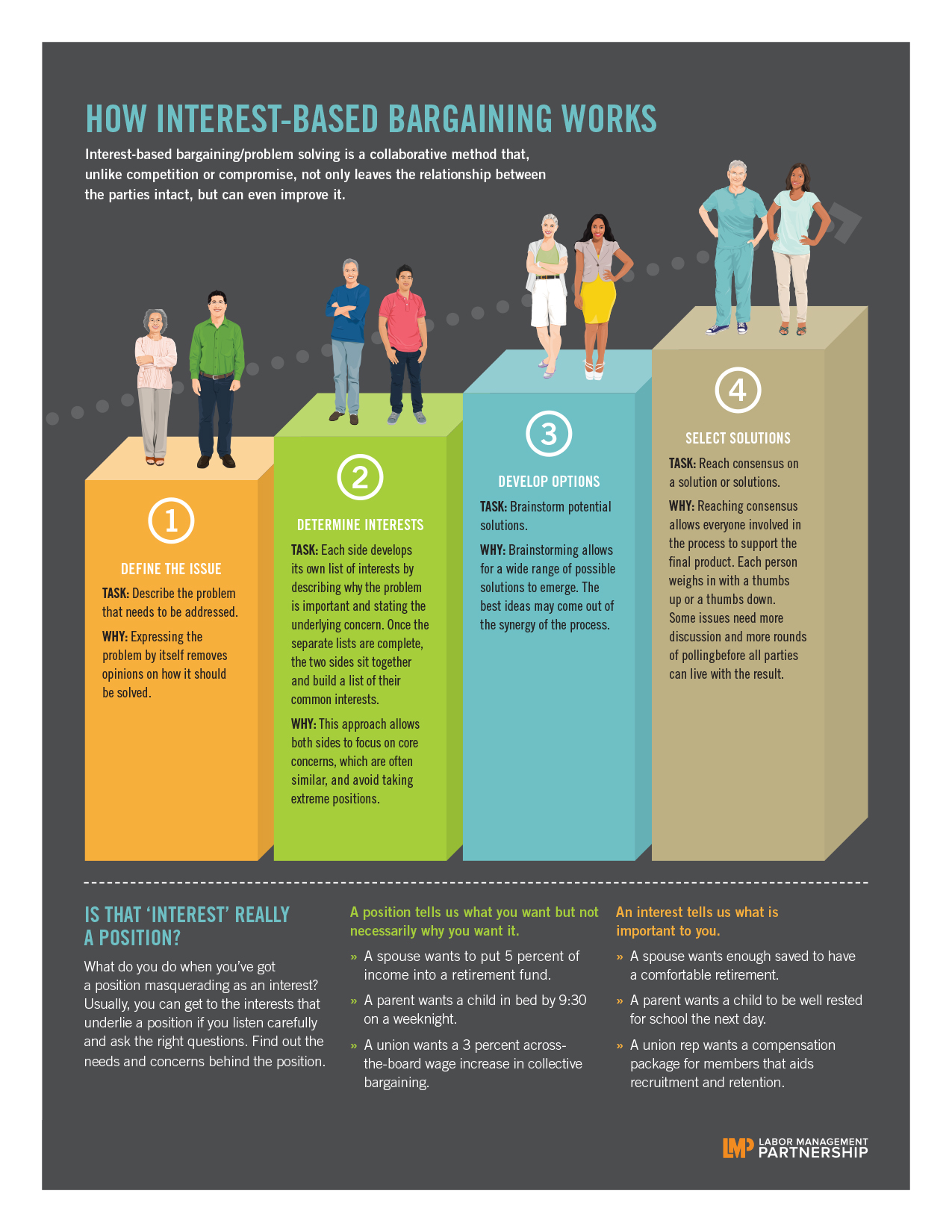
Poster: How Interest-Based Bargaining Works
Format:
PDF (color and black and white)
Size:
8.5” x 11”
Intended audience:
Frontline employees, managers and physicians
Best used:
Help your team learn to effectively solve problems using the four steps of interest-based problem solving.
TOOLS
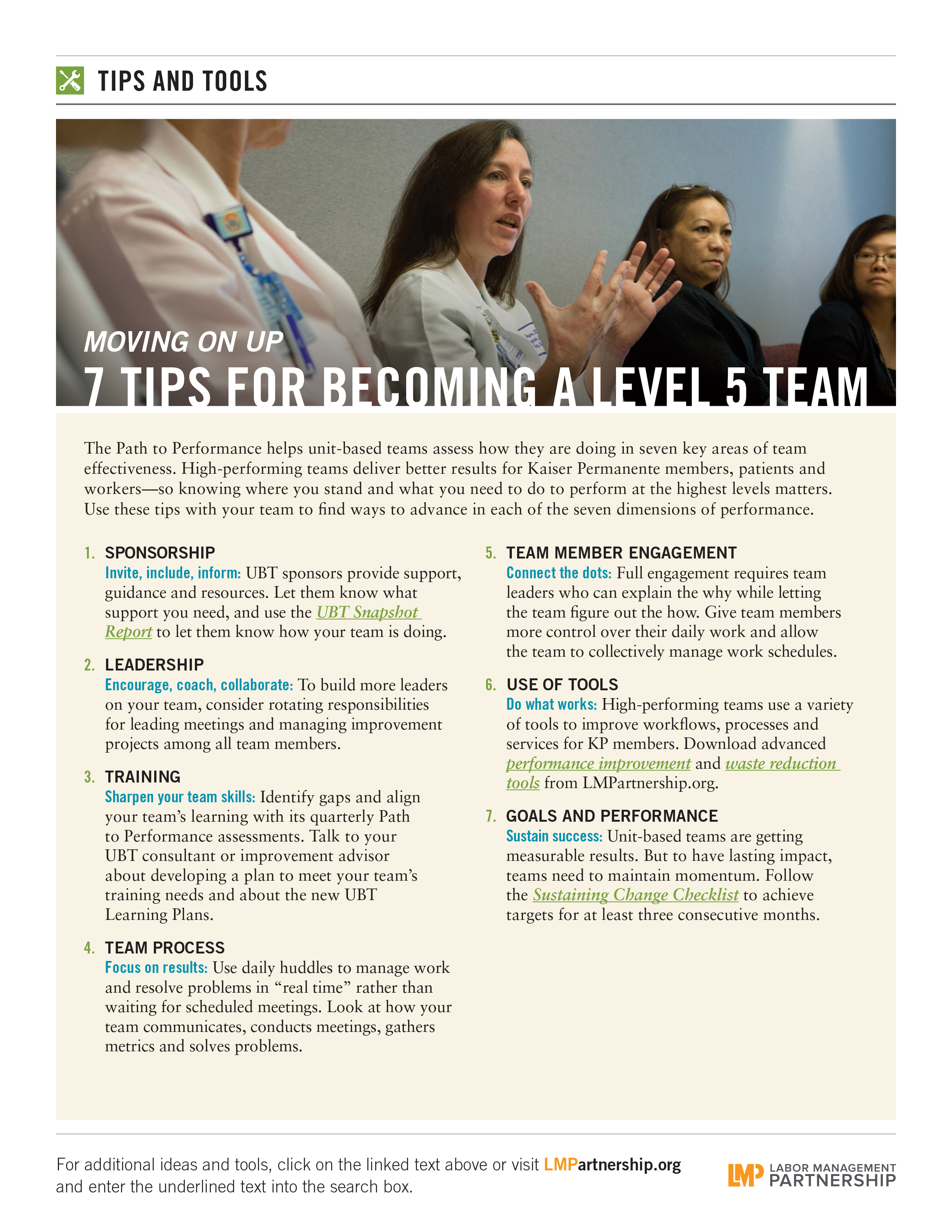
Moving on Up: 7 Tips for Becoming a Level 5 Team
Format:
PDF
Size:
8.5" x 11"
Intended audience:
Unit-based team members, co-leads, sponsors and consultants
Best used:
This tipsheet suggests ways teams can reach Level 4 or Level 5 in each dimension of the Path to Performance. Post on bulletin boards and discuss in team meetings; use these tips to engage your team in specific actions.
Deck: In addition to the training they provide, the events build energy and communicate priorities
Deck:
In addition to the training they provide, the events build energy and communicate priorities
Story body part 1:
Want to supercharge efforts to improve performance and help reach Kaiser Permanente’s strategic goals? Then bring unit-based team leaders together for a summit.
UBT consultants at several facilities in Southern California have organized summits that focused on Performance Sharing Program (PSP) goals, performance improvement strategies and affordability projects. All say they are seeing results in the forms of more robust UBT projects, clearer SMART goals, and stronger alignment between top medical center leadership and the work of UBTs.
After seeing teams improve service scores, reduce workplace injuries and save more than $160,000 in just four months in the San Diego service area, Sue Smith, a senior UBT consultant, concludes, “The overall experience was wonderful. Many teams had an exciting opportunity to network with other teams and learn new skills in a fun way.”
This spring, San Diego Medical Center hosted a UBT affordability summit, which brought together co-leads for a half-day to build the skills to tackle a new PSP goal for 2014 in the region: to increase the percentage of UBTs that successfully complete a project with hard dollar savings or improved revenue capture. (The projects are reviewed by finance departments to ensure they could lead to cost savings.)
Seated around large tables, UBT co-leads played a spirited game of “KP-opoly,” which offered a crash course in the organization’s finances. They heard from a UBT whose work resulted in cost savings. And they had time to work on driver diagrams and process maps for their own team’s affordability projects.
Co-leads gain PI skills
The year before, San Diego leaders—inspired by an event at the Riverside Medical Center—had held a more general, daylong UBT summit. That event brought UBT co-leads together for intensive training on performance improvement tools and created a space for them to refine their existing projects. Deadlines were set for finalizing driver diagrams and process maps, beginning tests of change and formulating sustainability plans.
The effort culminated in a UBT fair that showcased the projects that had begun as mere inklings at the summit: The ultrasound UBT demonstrated how it had gone injury-free for six months (it had been having at least one injury per month); the diagnostic imaging department boosted patient satisfaction scores from 87 percent in May 2013 to 93 percent in December.
Leaders at the Woodland Hills Medical Center followed the same playbook, hosting an LMP summit in April that launched an array of of affordability projects to be showcased at a UBT fair scheduled for mid-July.
Mobilizing on PSP
At Fontana and Ontario medical centers, UBT staff used the summit model to mobilize the workforce around all of the region’s PSP goals. Top leaders from both management and the unions kicked off the day, then gave subject matter experts each 10 minutes to discuss the goal (whether it be service, workplace safety, attendance, etc.) and challenge co-leads to take on a performance improvement project to tackle it. A highlight was an impassioned and dramatic account from Roy Wiles, president of Steelworkers Local 7600, about a union member who did such a good job of saving up unused sick time that he recently retired with a five-figure nest egg in his Health Reimbursement Account.
The key to attracting co-leads to the summits, the consultants say, is to plan well in advance and to enlist top leadership to encourage participation. That lets managers and employees make plans for attending while ensuring their departments’ operational needs are met.
“This is part of their work,” says Priscilla Kania, senior UBT consultant at Ontario. “Your leaders are inviting you. People are excited to be in the room with top leaders.”
Has your facility or region held a summit? Let us know all about it!
TOOLS
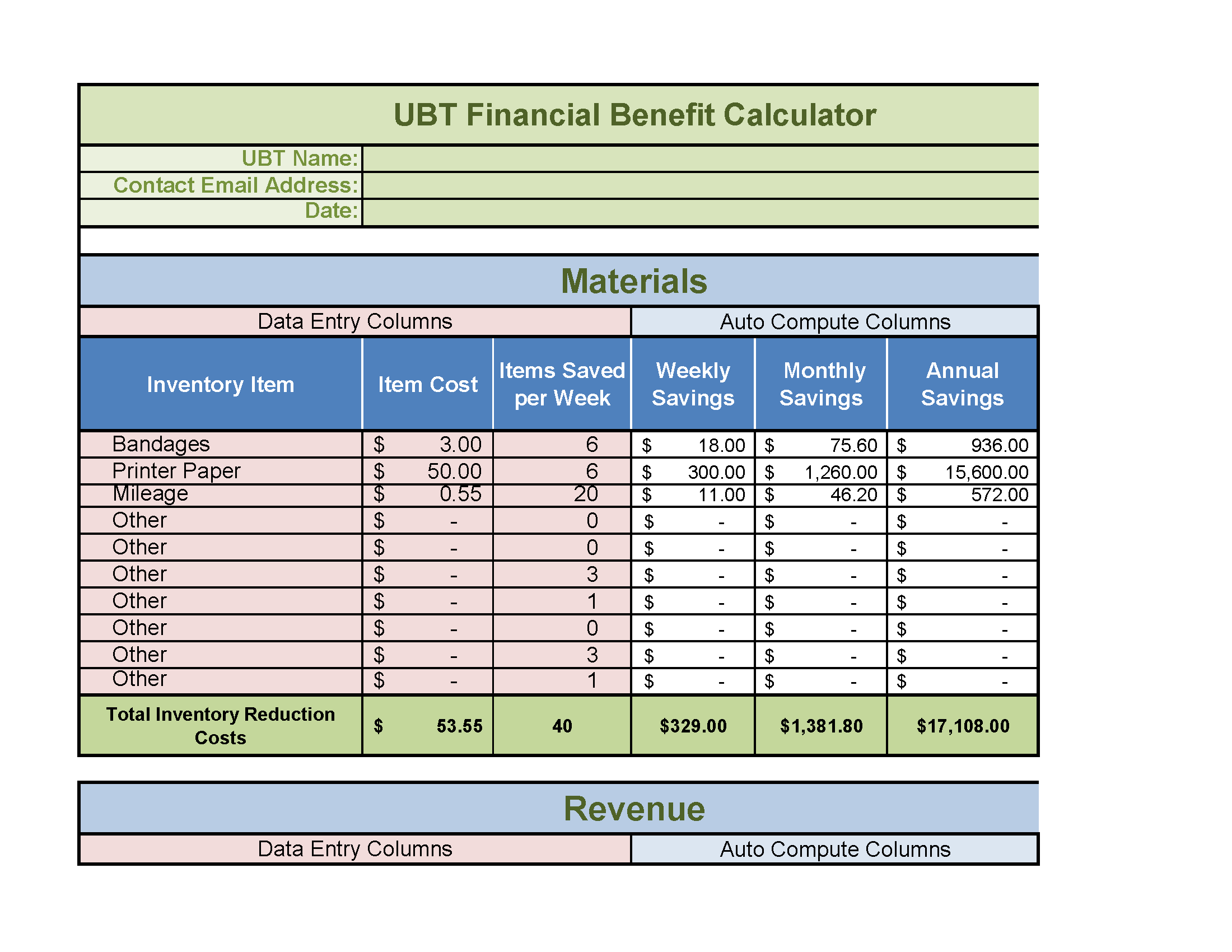
Handy Spreadsheet to Gauge UBT Savings
Format:
XLS (spreadsheet)
Size:
1 page
Intended audience:
UBT co-leads or team members
Best used:
Use this spreadsheet to track and determine the economic benefits of your team's performance improvement projects—you can easily see the impact of your efforts on the bottom line.
Note: Entries are placeholders; delete them and add your own information.
Deck: Key terms to know as you navigate the world of health care reform
Deck:
Key terms to know as you navigate the world of health care reform
Story body part 1:
Affordable Care Act (ACA)
The comprehensive federal health care reform law enacted in March 2010.
Coinsurance
The percentage of charges a member pays when receiving a covered service. The member’s health plan coverage pays the balance up to the health plan’s allowance. Coinsurance amounts vary depending on the member’s plan and the service provided.
Copayment
The fixed dollar amount a member pays when receiving certain covered services or prescriptions. The member’s health insurance pays the rest. Copayments vary depending on the member’s plan and the service provided.
Cost share
The portion of charges for a service or prescription that the member is responsible for paying, such as a copayment, coinsurance or deductible payment.
Deductible
The fixed amount a member must pay in a calendar or contract year for certain health care services before the member’s health insurance begins to pay.
Dependent
A family member, such as a spouse, child or partner, who is covered under a policyholder or subscriber’s plan.
Federal financial assistance (subsidy)
Financial assistance in the form of reduced premiums and reduced out-of-pocket expenses to provide help for some people to pay for health coverage or care. The government will pay part of the premium and the out-of-pocket expenses directly to the health plan issuer. Usually determined by income level and family size.
Grandfathered plan
A group health plan that was created or an individual health insurance policy that was purchased on or before March 23, 2010. Grandfathered plans are exempted from many changes required under the Affordable Care Act.
Health care reform
A general term for the major health policy changes put in place by the federal Affordable Care Act of March 2010 and any state laws passed to put it in place.
Health Insurance Marketplaces
Government-run online markets, formerly called Health Insurance Exchanges, where individuals and small businesses will be able to compare and enroll in health plans, get answers to questions, and find out if they are eligible for financial assistance or special programs.
The marketplace
A common nickname for the Health Insurance Marketplaces, also called “exchanges.”
Medicaid
A government insurance plan for the poor and disabled; in California, it’s known as Medi-Cal.
Out-of-pocket expenses
These include the copayments, coinsurance and/or deductible payments members make for the health care services they receive, as opposed to the premium they pay each month to their insurers.
Pre-existing conditions
Medical conditions that a person has before he or she applies for a new health insurance policy.
Premium
The amount a member and/or the member’s employer pays, usually each month, for health care coverage.
Six Tips for Successful Interest-Based Problem Solving
Story body part 1:
Michael Hurley was the education director for the Coalition of Kaiser Permanente Unions for several years, and he and his team designed many of the LMP programs used to support unit-based team education.
1. Know why we use interest-based problem solving
Interest-based problem solving (IBPS) is a collaborative approach to solving problems, a process for negotiating differences amicably without giving in. When you’re in an ongoing partnership—whether it’s a labor-management partnership or, say, a marriage—you likely have multiple objectives you want to satisfy when resolving differences. Those include not only the desire to solve the problem in a way that meets your needs, but also to solve it in a way that doesn’t cost too much (in time, money or emotional wear and tear), and that leaves the relationship intact or even improves it. Because down the road, you know you’re going to be working together again to solve the next problem that crops up.
2. Understand key terms
Four words are at the heart of the interest-based process. The issue is the problem or subject area to be addressed. A position is a proposed solution. The interest is the underlying need, motivation or concern that may have to be addressed in order to reach a solution; you can tell an interest in part because there is usually more than one way to satisfy it. An option is a potential way to address the issue, in whole or in part.
Your position tells us what you want but not necessarily why you want it.
- A spouse wants to put 5 percent of income into a retirement savings account.
- A parent wants a child in bed by 9:30 on a weeknight.
- A union wants a 3 percent across-the-board wage increase in collective bargaining.
Your interests tell us what is important to you.
- A spouse wants enough saved to have a comfortable retirement.
- A parent wants a child to be well rested for school the next day.
- A union rep wants a compensation package for members that aids recruitment and retention.
3. Ask: Is that ‘interest’ really a position?
What do you do when you’ve got a position masquerading as an interest? Usually, you can get to the interests that underlie a position if you listen carefully and ask the right questions. Find out the needs and concerns behind the position. Here’s an example:
Statement by wife: “I hate living in Los Angeles. We should move to Oregon.”
Reaction to self: “Great, here we go again.”
Question to wife: “Why should we move to Oregon?”
Answer: “We’re in a rut. We’ve lived our whole lives here. I’m tired of it.”
Question: “What else appeals to you about Oregon?”
Answers: “The weather is too hot here, and we spend so much time stuck in traffic. We have to do all our exercising here at the gym. Oregon is cooler and there are prettier roads for biking. We can get to the woods and good hiking faster. People are more relaxed there. “
Interests: Change in weather, less traffic, easier access to uncrowded outdoors, less stress.
By starting with a discussion of interests, the parties can talk about what is important to them without staking out what they want the outcome to be. It opens the door to collaborative problem solving, as opposed to competition or compromise.
4. Agree on the information
Find agreement on what data to collect and how to collect it, vet it and report it—or you’ll just argue about the data.
5. Make an action plan
Create an action plan for turning solutions into reality. Be clear on who’s accountable for what. Establish a timeline.
6. Set ground rules
Remember, interest-based processes don’t always work. In my experience, they have the best chance for success if the parties agree to:
- Focus on the issue, not personalities.
- Share information fully and early.
- Listen actively.
- Work hard to meet interests, not sell positions.
- Be open to options.
- Look for ways to build trust.
TOOLS
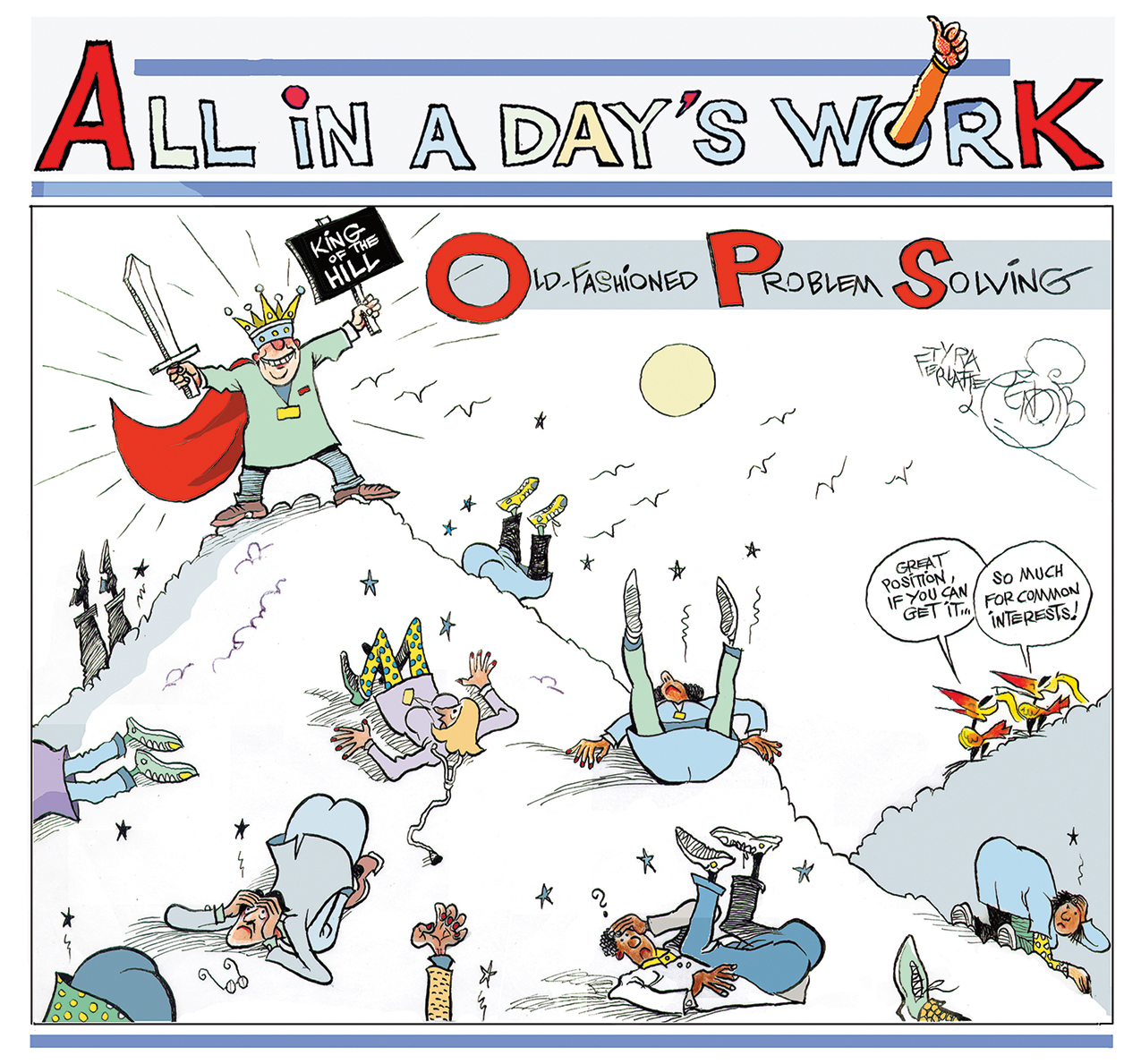
All In a Day's Work: Old-Fashioned Problem Solving
Format:
PDF (color or black and white)
Size:
7.25" x 7.25" (prints out on 8.5" x 11")
Intended audience:
Anyone with a sense of humor
Best used:
Post on bulletin boards, in your cubicle or in emails to share a gently humorous look at how we solve problems—and the value of interest-based problem solving. Have fun!
Pages
