LMP Processes

Help Video

How to Find UBT Basics on the LMP Website

Learn how to use the LMP website:

LMP Website Overview

Learn how to use the LMP website:

How to Find How-To Guides

This short animated video explains how to find and use our powerful how-to guides

Learn how to use the LMP website:

How to Find and Use Team-Tested Practices

Does your team want to improve service? Or clinical quality? If you don't know where to start, check out the team-tested practices on the LMP website. This short video shows you how. 

Learn how to use the LMP website:

How to Use the Search Function on the LMP Website

Having trouble using the search function? Check out this short video to help you search like a pro!

Learn how to use the LMP website:

How to Find the Tools on the LMP Website

Need to find a checklist, template or puzzle? Don't know where to start? Check out this short video to find the tools you need on the LMP website with just a few clicks. 

Learn how to use the LMP website:

Effective Stakeholding (classroom)

Story body part 1: 

Course description

This course is designed to improve the methods of a representative or “stakeholder” by providing tools and scenarios that will improve communication and teach how to manage issues.

Path to Performance

Level 2

Duration

8 hours


Who should attend

This course is intended for labor participants only. Job categories who should attend are labor (co-leads, stewards and sponsors).

Course requirements

Labor Management Partnership Orientation (LMPO)

UBT Sponsor Training (classroom, virtual)

Story body part 1: 

Course description

It is critical for steward sponsors and management sponsors to invest in the development of the unit-based team, which will have a long-term impact on the organization, and to learn about tools and resources available to them in their sponsor role. This course is designed to help union, physician and management sponsors discover the benefits of effective sponsorship and how it can help them develop successful, sustainable unit-based teams.

Union and management sponsors will gain an awareness of how their role is critical to the transformation of how the work at Kaiser Permanente is done.
 

Path to Performance

Level 2

Duration

4 hours

Who should attend

This course is intended for participants who are unit-based team labor, management or physician sponsors 

Course requirements

Labor Management Partnership Orientation (LMPO)

Co-Lead Workshop (classroom, virtual)

Story body part 1: 

Course description

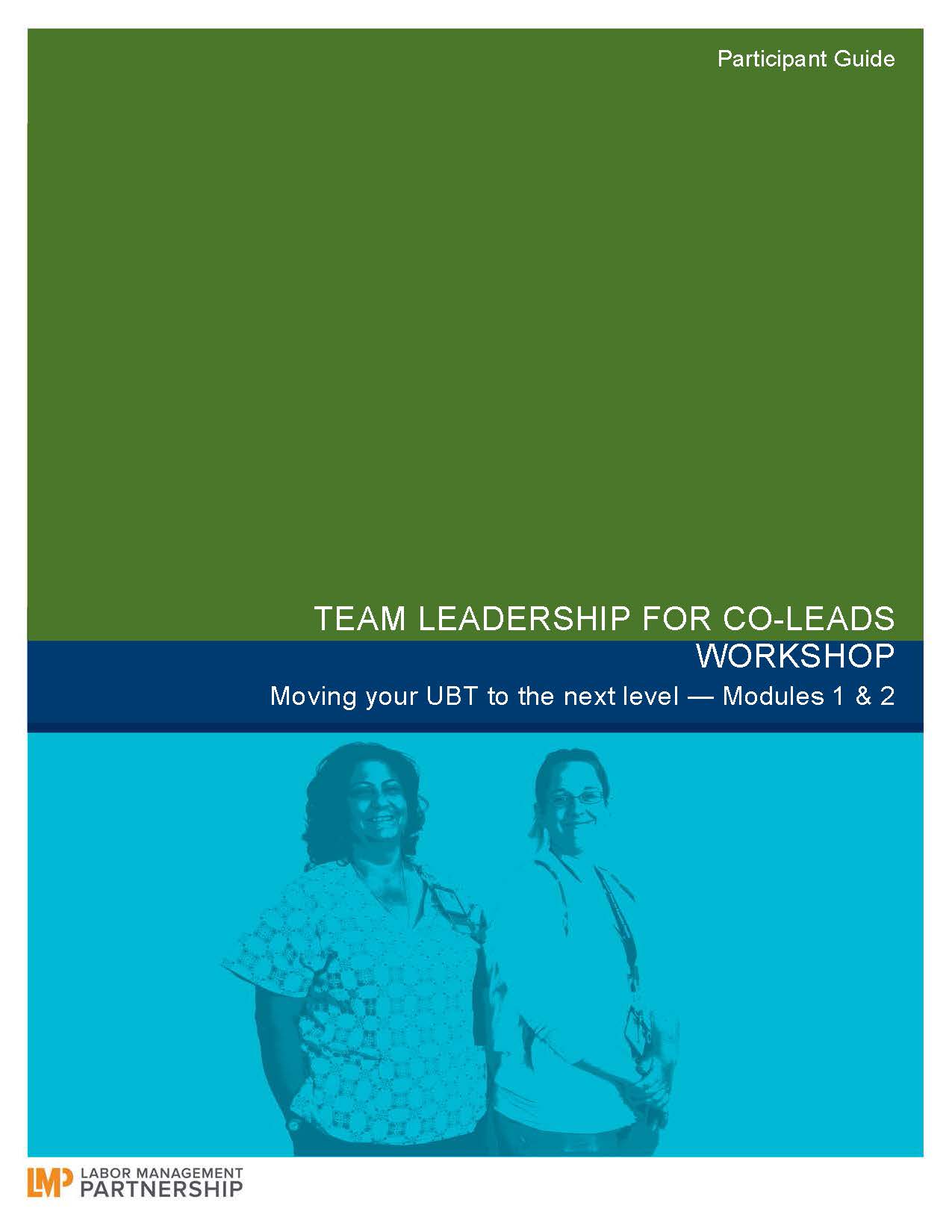
The Co-lead workshop exposes co-leads to the skills and knowledge needed to make unit-based teams work together effectively. The skills the co-lead learns are discussed and agreements are made regarding implementation as he/she returns to the unit-based team.

Path to Performance

Levels 2, 3

Duration

Two 4-hour modules (8 hours total)

Who should attend

This course is the first of two workshops intended specifically for all labor, management or physician unit-based team co-leads. The workshop builds on previous LMP orientation training co-leads may have attended. Following this course, co-leads are encouraged to attend the advanced course titled: Team Leadership for Co-leads: Leading Your Team to the Next Level. 

Course requirements

Requires basic knowledge of:

Corrective Action (classroom)

Story body part 1: 

Course description

Issue resolution/corrective action is one of the foundation blocks for success of the partnership. The course explores how issues are discovered and together labor and management determine root cause, working with the employee. Also covered is how creative problem solving is used in the workplace to resolve team issues to individual performance in a non-punitive manner.

Path to Performance

Level 1

Duration

8 hours

Who should attend

Job categories include stewards, union representatives, managers and human resources consultants

Course requirements

Belong to a union in the Alliance of Health Care Unions or the Coalition of Kaiser Permanente Unions, or work with an Alliance- or Coalition-represented employee

Interest-Based Problem Solving (web-based)

Story body part 1: 

Course description

Interest-Based Problem Solving offers labor and management partners a method to solve problems using a non-adversarial process. This module guides the four-step interest-based problem-solving process and a simulation exercise that allows participants to practice the process.

Path to Performance

Levels 1, 2 

Duration

  • 30 minutes (online)

Who should attend

People engaged in problem solving at the unit-based team level up to regional Labor Management Partnership committees should attend this training, along with any union and management staff members working on issue resolution and corrective action. Job categories who can take this class are labor, management and physician members of a unit-based team, Labor Management Partnership and unit-based team consultants, improvement advisers and Union Partnership Representatives.


Preparing Managers for Partnership (classroom, virtual)

Story body part 1: 

Course description

The curriculum is designed to prepare new frontline managers for the rewards and challenges of partnership. It provides them tools and skills to be successful as they work with unit-based teams toward the benefit of patients and members. 

Path to Performance

Level 1

Duration

6 hours

Learning outcomes

  • Learn the history of the Labor Management Partnership
  • Understand how unions and National Agreements play an essential role in partnership
  • Explain why the partnership between management and labor is crucial for Kaiser Permanente's business strategy
  • Learn LMP elements, methodologies and partnership culture
  • Develop learning plan for KP managers

Who should attend

Frontline managers who are new to working in a partnership environment.

Course requirements

Labor Management Partnership Orientation (classroom, virtual)

Story body part 1: 

Course description

For over 25 years, the Labor Management Partnership has been a structure where Partnership unions, management and providers can work together at Kaiser Permanente. This training explains the history and design of the LMP and will help new employees, managers and care providers work together for the benefit of patients, members and teams.

Path to Performance

Level 1

Duration

4 hours (classroom, virtual)

Learning outcomes

  • Understand Partnership history and National Agreements
  • Understand and identify key Partnership elements: principles, Value Compass, unit-based teams, roles and responsibilities
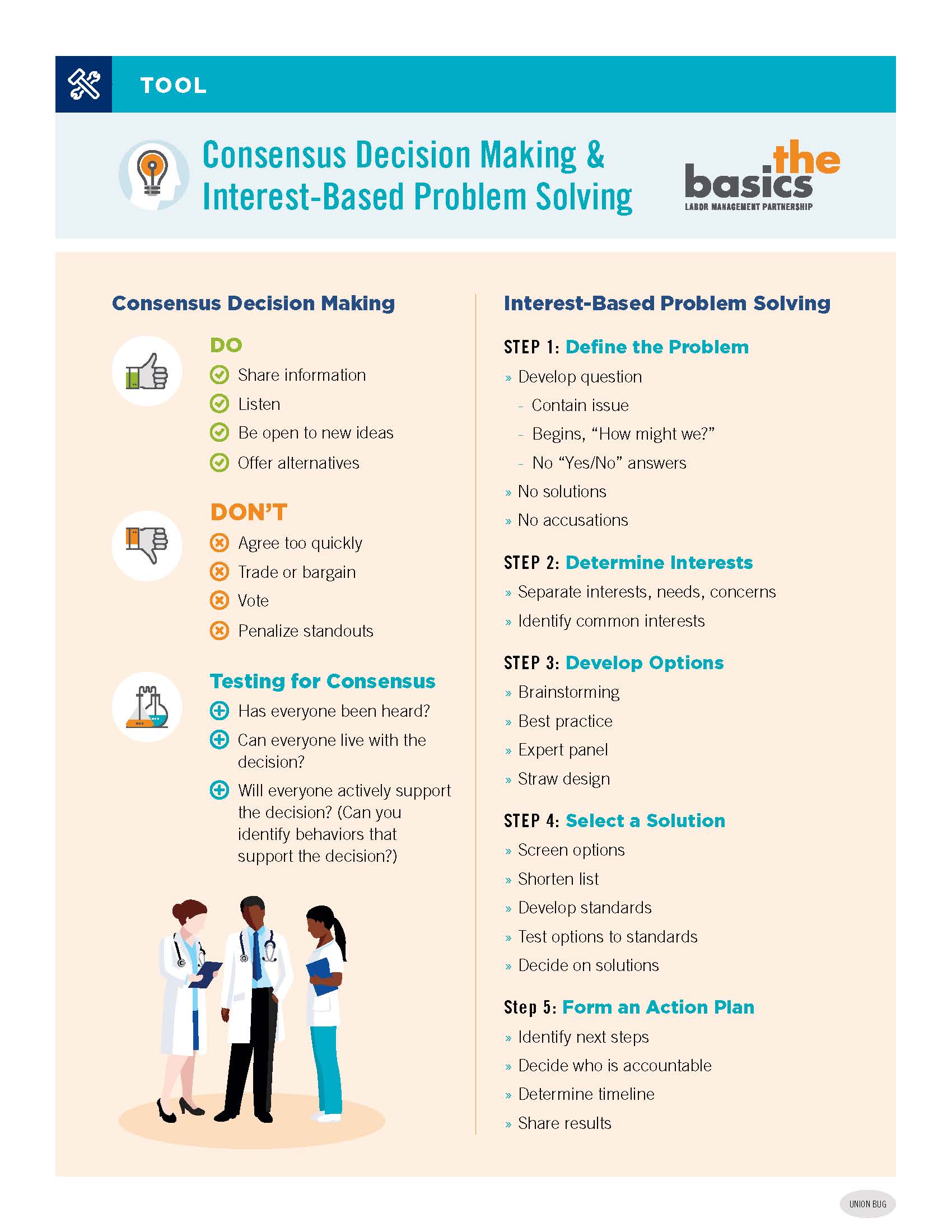
  • Learn Partnership methods, including Interest-based conversations, problem solving and consensus decision making
  • Learn Partnership structures like unit-based teams, co-leads and sponsors

Who should attend

  • Alliance-represented employees within their first 90 days of employment
  • Coalition-represented employees within their first 120 days of employment

Course requirements

  • This is an introductory course. There are no prerequisites.

Communication, Commitment, Consensus

Deck: 
Partnership basics cement co-leads’ bond

Story body part 1: 

Su-Xian Hu and Runeet Bhasin make partnership look easy. The telemetry team co-leads at Downey Medical Center in Southern California share a relaxed rapport that belies the time, planning and occasional friction that are part of running a busy inpatient unit. 

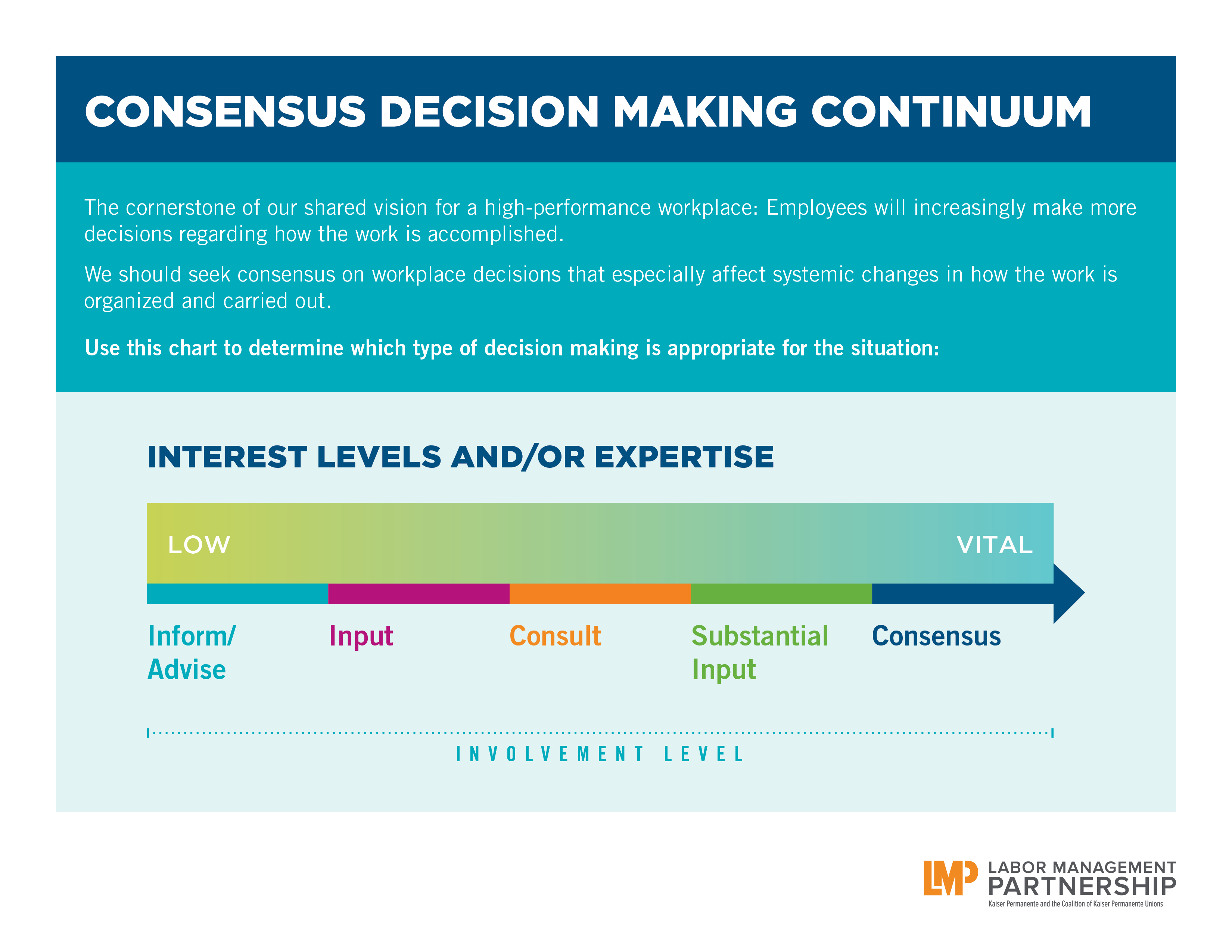
Together for more than a year, the pair attribute the success of their budding relationship to communication and a commitment to partnership principles—especially consensus decision making. Those core values came in handy recently when a disagreement arose about the best way to educate patients about medications. 

Nurses preferred a less overwhelming one-page sheet, but managers wanted to switch to a detailed three-page form that had been adopted by other units in the hospital. 

“It was a major issue,” says Bhasin, RN, a staff nurse and member of UNAC/UHCP who is the team’s labor co-lead. “We had to come up with a solution to fulfill management’s needs and labor’s needs.”

At the time of the disagreement, UBT members turned to consensus decision making to determine next steps they all could support. A subsequent test of change resulted in a short-term fix: Nurses used the short form with patients, while the longer handout was provided as a resource guide in patient rooms.

New to partnership

Managing in partnership was a new experience for Hu when she joined the team in April 2016 as assistant clinical director and became a co-lead. She previously had overseen a Kaiser Permanente inpatient nursing unit that was not part of the Labor Management Partnership. Bhasin, a co-lead with two years of experience, served as mentor and coach.

“Runeet was wonderful with helping to bring me onboard,” says Hu, who is also an RN. 

Both say LMP training has given them a shared understanding of their roles as co-leads, the purpose of UBTs and how to use consensus decision making. A business literacy class both took proved especially fruitful: With the information they brought back, the team tackled an affordability project that reduced overtime costs by more than $95,000 last year. 

“The UBT classes,” says Bhasin, “made me realize the real meaning of partnership, the collaboration of labor and management to work toward the same goal to provide high-quality care and to have a great work environment.”

The pair’s approach seems to be working. Their 75-member UBT is at Level 4 on the five-part Path to Performance, and it has earned accolades for outstanding patient care and gains in workplace safety and affordability. 

“We want what is best for patients and for staff,” says Hu. “We might have differences, but we always come together with open and professional communication, sitting down together to solve those issues.”

How-To Guide: Have Great Meetings

Well-run meetings keep members of unit-based teams connected. Employees, managers and physicians can share information and solve problems face to face.


Poorly planned or badly run meetings, on the other hand, waste participants' time and lead to frustration and cynicism.


This guide will help you plan and conduct meetings that build teamwork and help your UBT make improvements that benefit our members and patients. 


2012 National Agreement

Story body part 1: 

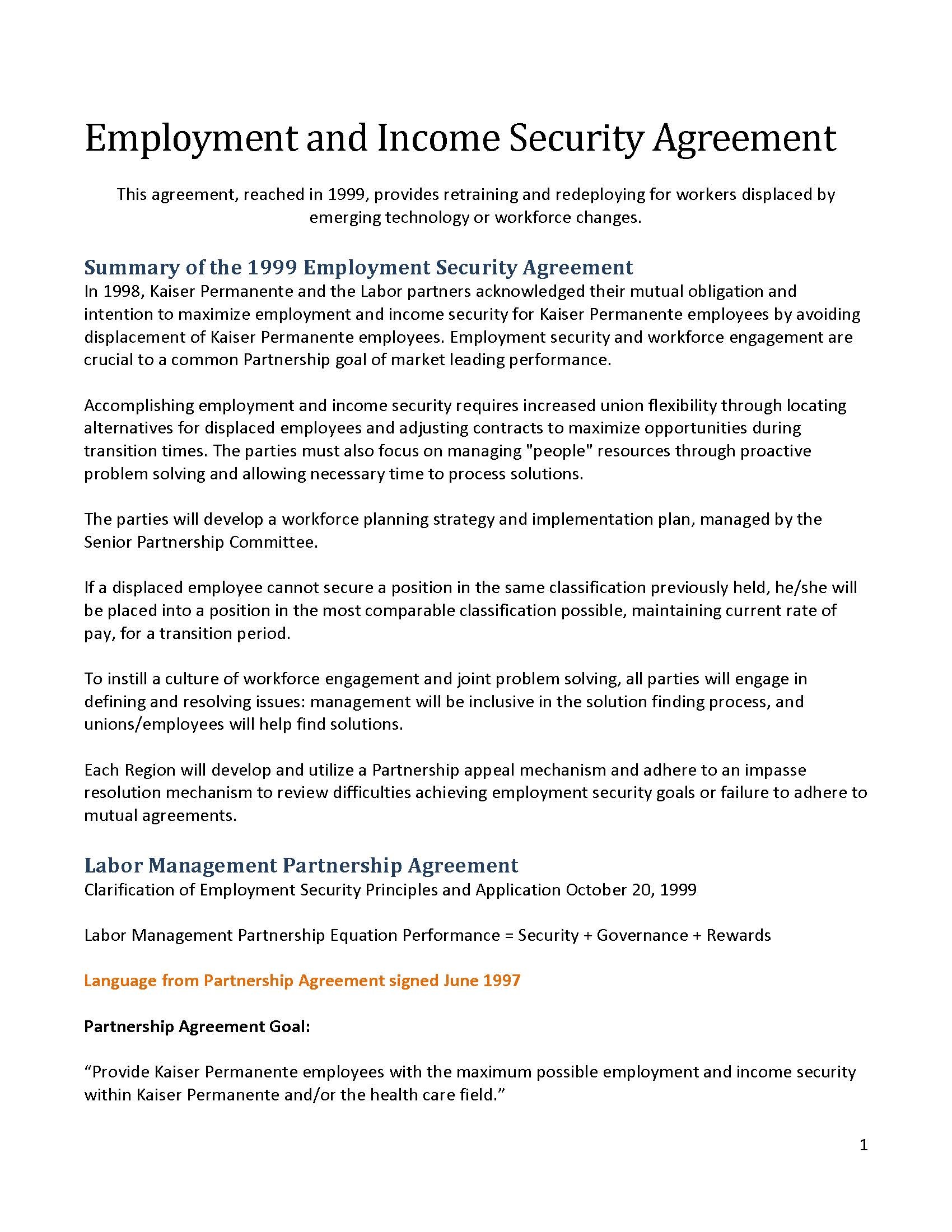
Our 2012 National Agreement established the conditions for creating the healthiest workforce in the industry.

One of the key innovations in the 2012 National Agreement is the Total Health Incentive Plan, a voluntary program that rewards employees for collective participation in confidential health screenings and improvements. 

Pages

Subscribe to RSS - LMP Processes