Program-wide

Help Video

How to Find UBT Basics on the LMP Website

Learn how to use the LMP website:

LMP Website Overview

Learn how to use the LMP website:

How to Find How-To Guides

This short animated video explains how to find and use our powerful how-to guides

Learn how to use the LMP website:

How to Find and Use Team-Tested Practices

Does your team want to improve service? Or clinical quality? If you don't know where to start, check out the team-tested practices on the LMP website. This short video shows you how. 

Learn how to use the LMP website:

How to Use the Search Function on the LMP Website

Having trouble using the search function? Check out this short video to help you search like a pro!

Learn how to use the LMP website:

How to Find the Tools on the LMP Website

Need to find a checklist, template or puzzle? Don't know where to start? Check out this short video to find the tools you need on the LMP website with just a few clicks. 

Learn how to use the LMP website:

TOOLS

LMP Vision: Reaffirmation and Understandings

Format:
PDF

Size:
8.5” x 11” (29 pages)

Intended audience:
Anyone interested in LMP principles and their history

Best used:
This pamphlet sheds light on the issues the Labor Management Partnership faced during its first 5 years. It outlines the findings that came an important round of discussions in 2002, when union and Kaiser Permanente leaders reaffirmed that putting the LMP vision into practice was essential to the future of the organization.


Related tools:

2018 Alliance Labor Management Partnership Agreement

2018 Alliance National Agreement

Story body part 1: 

The 2018 KP-Alliance National Agreement renews and strengthens the Labor Management Partnership to better serve the needs of our members and patients, the organization and the 49,000 workers represented by the Alliance of Health Care Unions. Alliance union members, their managers, and physicians who work with them should know key provisions of the agreement and what it does to help achieve high-quality, affordable health care while creating a great place to work. 


How Unit-Based Teams Make Kaiser Permanente a Better Place to Work

Deck: 
Positive results for KP members, patients and workers

Story body part 1: 

Do teams get better results when frontline workers are engaged, free to speak and can influence decisions? Yes, say the people who know best — Kaiser Permanente workers and managers themselves.

Recent People Pulse surveys confirm that unit-based teams get positive results for health plan members and patients, the organization and workers themselves.

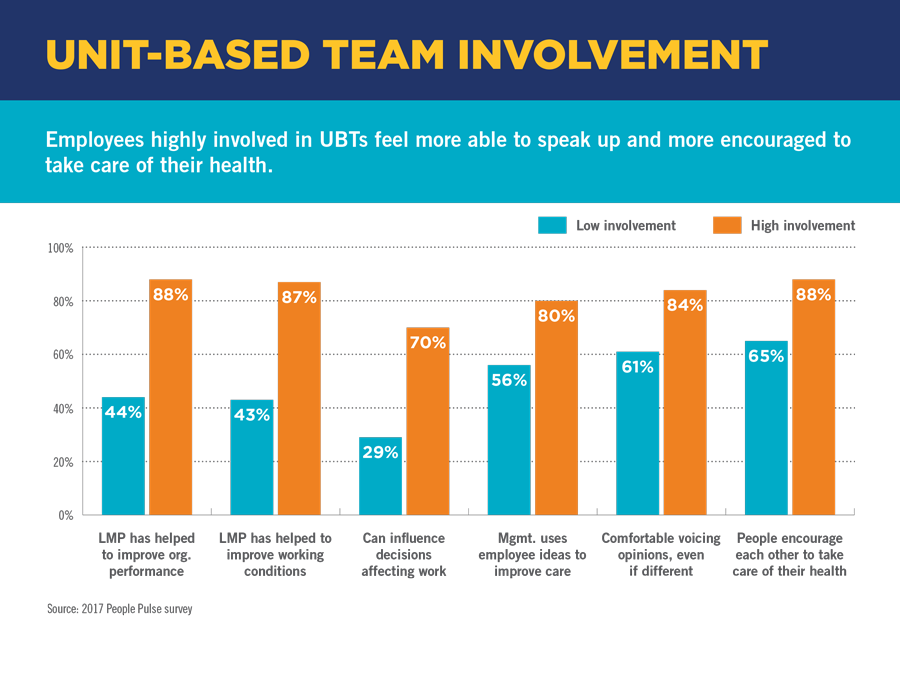
For instance, the 2017 People Pulse survey of more than 155,000 KP employees showed that when union-represented employees are highly involved in UBT activities, they get 29 percent higher scores on measures of their willingness to speak up — a key driver of patient and workplace safety and satisfaction. They also get 33 percent higher scores on questions regarding workplace health and wellness.

Improved safety and satisfaction

Further analysis, included in the 2016 People Pulse survey, showed that teams with high employee involvement have:

  • 18 percent fewer workplace injuries
  • 13 percent fewer lost work days
  • 4 percent higher patient satisfaction

“Our findings show that employees who are highly involved in their unit-based teams feel more able to speak up and more encouraged to take care of their health,” says Nicole VanderHorst, principal research consultant with KP Engagement & Inclusion Analytics. “That makes them more likely to have better performance outcomes.” 

A better way to work

Workers’ greater propensity to speak up and look after their health when they’re involved in team activities covers several questions (see chart below). For example, workers who are highly involved in their UBTs are far more likely to say:

  • The Labor Management Partnership has helped improve organizational performance and working conditions.
  • They can influence decisions affecting their work.
  • They’re comfortable voicing differing opinions.
  • Management uses their ideas to improve care.
  • They’re encouraged, and encourage others, to take care of their health.
Unit-Based Team Involvement

Click to enlarge.

Roots of workforce engagement

All these factors contribute to a better employee experience as well as performance. And UBTs reflect KP’s unique history with the labor movement.

“Henry Kaiser was perhaps the 20th century’s most worker-friendly industrialist. He supported organized labor and knew that people step up when allowed to exert their job experience, as they do with UBTs,” says KP archivist and historian Lincoln Cushing.  “He trusted employees to make decisions that benefitted themselves and their organizations.”

If you belong to a unit-based team — and most union-represented employees do — talk with a team co-lead about ways to get more involved.

Take the Easy Way Out

Deck: 
Speed your team on its way with ideas from other teams

Story body part 1: 

Do you or your teammates want to shrink wait times? Save money on supplies? Reduce time wasters or roadblocks? Once you’ve identified a problem to solve, you may wonder where to start. No need to invent an improvement project from scratch. Visit the Team-Tested Practices section and see what’s worked for others. We’ve got short summaries of successes from every region and every type of work environment to give your team a kickstart.

1. What’s here? 

When you visit LMPartnership.org/team-tested-practices, you’ll find the first several “tiles” of the dozens you can choose from as you scroll through this section. Each tile will have a photo and short preview about a specific, measurable improvement a team has made.

2. Sharpen your search 

Want to narrow down what you see? Use the filters on the left side of the page. There are several to try, including:

  • Topic. Choices include affordability, patient safety, service and more.
  • Department. See what departments like yours have done.
  • Region. Check out the projects done in your region.

Selecting more than one filter at a time works, too. And remember that you can get great ideas from departments very different from yours and regions other than your own. You’ll notice these filters throughout the website to help you focus your searches. 

3. Intrigued? 

See something your team might want to try? Click on the tile to get a more complete description of the challenge the team was facing — and the main tests of change that helped the team achieve its goal. And the measurable result: “Saved $40,000,” “decreased wait times by 11 minutes,” “69 percent drop in costs.”

4. No dead ends! 

So, maybe the practice you clicked on isn’t right for your team. Before you move on, check out the related tools and stories in the colorful columns farther down this page. Throughout the site, the color orange means, “Here are tools to get your team started on work like this.” Blue is, “Get inspired by stories and videos about teams working on similar efforts!” And, “Just for fun” — green will take you to puzzles, games and other light-hearted resources to kick off your improvement campaign on an upbeat note.

From the Desk of Henrietta: What’s in It for You?

Deck: 
Treat our website like a one-stop shop for all your partnership needs

Story body part 1: 

What’s your favorite thing to do online? Watch cat videos? Scroll through Facebook? Maybe some occasional retail therapy?

Going online can also help make your work life better and save you time. It can help your unit-based team solve problems so you can deliver the best care and service to our members and make Kaiser Permanente a great place to work. All that, after all, is what the Labor Management Partnership is all about.

This issue of Hank magazine is a whirlwind tour of the Labor Management Partnership website, a one-stop shop for everything you need to turbocharge your team’s performance. Tip sheets, videos and inspiration are always just a few clicks away. If you can’t find what you want easily, just use our vastly improved search function. As one of our biggest fans put it, “Boom — there it is!”

On LMPartnership.org, you will:

  • learn from other teams — what worked, what didn’t, what sorts of roadblocks to expect and how to overcome them
  • download icebreakers to build trust and help quieter team members gain the confidence to speak up
  • meet the Humans of Partnership, a gallery of short, personal profiles that will make you proud to #BeKP

If you don’t sit at a computer as part of your day-to-day work, it’s easy to access LMPartnership.org on the go. Follow these instructions so we’re always at your fingertips on your smartphone. You’ll find yourself in a UBT meeting and calling up just the tool you need to help a team through a sticky situation.

You can even share resources from your phone with others who may not be as smartphone savvy. Pretty much every page has buttons that make it easy to email it to a colleague or share it on Facebook or Twitter.

Here’s another handy tip: even if you don’t visit LMPartnership.org (though I hope you do), reading this issue of Hank will help you learn how and why we do the vital work we do. So read on, log on and enjoy.


Keep Your Eye on the Prize

Deck: 
How to stop being distracted by shiny objects

Story body part 1: 

Let's be real: If everything is important, nothing is important. The prize for us is providing high-quality care and service at an affordable price to our members, patients and communities we serve — and the Focus Areas section of LMPartnership.org is a tool for helping unit-based teams prioritize their work and stay grounded.

What will you find here? Let’s start with the Value Compass. The Focus Areas section has pages that go in depth on each of the four points — Quality, Service, Affordability and Best Place to Work. You also can learn more about topics that are part of the National Agreement, including Total Health and Workplace Safety, Workforce Planning and Development (Workforce of the Future), and Union and KP Growth.

And then two pages are specifically for improving your team’s culture — which will in turn improve performance (we have the stats to prove it). The Join the Team, Be the Change page has tips and tools for improving team communication and engagement, while the Free to Speak page will help you build a Speak Up culture on your team.

Join the team, be the change!

How do you get your unit-based team to be excited about the work? Why would staff members want to be involved? How do you get those quiet people — who you just know have great ideas — to speak up?

Ideas to answer these questions and many more are found on the Join the Team, Be the Change page of the website. You’ll find tips and tools for improving team communication, the first step in getting employees interested and involved.

But it doesn’t stop there. As communication improves, it’s easier for the team to pull together and solve problems — which in turn raises morale and can foster a sense of joy at work. Teams with good communication have more fun, report higher engagement, have better People Pulse scores and are rated higher on the Path to Performance.

And when employees are happy and satisfied with their jobs, our members and patients feel the difference in the care we give. Have fun with your team and make things happen!

TOOLS

Six-Word Call-to-Action Planning Sheet

Format:
PDF 

Size:
8.5" x 11"

Intended audience:
Farmers market champions

Best used:
Use this planning sheet to create a compelling six-word call to action for your farmers market.

Related Material:
Call-to-Action Poster 


Related tools:

Meet Your National Agreement: Sick Leave HRA Rewards Good Attendance

Story body part 1: 

If you're covered by one of the national agreements between Kaiser Permanente and the Partnership unions, you may be eligible to convert your unused banked sick leave to a Health Reimbursement Account (HRA) when you retire from Kaiser Permanente. You can use the Sick Leave HRA to help pay for eligible out-of-pocket medical, dental, vision and hearing care expenses on a tax-free basis.    

The Sick Leave HRA gives you a strong incentive to bank your unused sick time and helps ensure that you will have sick time when you need it. This benefit is separate from and in addition to the Retiree Medical HRA established as part of the retiree medical benefits package in the 2021 Alliance National Agreement and the 2019 Coalition National Agreement.  

See the Retirement Programs section of your Summary Plan Description on MyHR for details:

  • Select your region.
  • When the Benefits by Employee Group page opens, click on View under Summary Plan Description.
  • Once the file opens, click on Retirement Programs from the menu on the left.
  • Look for details for the Sick Leave Health Reimbursement Account.

If that benefit is not included in your Summary Plan Description, you are not covered by the benefit.

Pages

Subscribe to RSS - Program-wide