Program-wide

Help Video

How to Find UBT Basics on the LMP Website

Learn how to use the LMP website:

LMP Website Overview

Learn how to use the LMP website:

How to Find How-To Guides

This short animated video explains how to find and use our powerful how-to guides

Learn how to use the LMP website:

How to Find and Use Team-Tested Practices

Does your team want to improve service? Or clinical quality? If you don't know where to start, check out the team-tested practices on the LMP website. This short video shows you how. 

Learn how to use the LMP website:

How to Use the Search Function on the LMP Website

Having trouble using the search function? Check out this short video to help you search like a pro!

Learn how to use the LMP website:

How to Find the Tools on the LMP Website

Need to find a checklist, template or puzzle? Don't know where to start? Check out this short video to find the tools you need on the LMP website with just a few clicks. 

Learn how to use the LMP website:

Empowering the Workforce

Deck: 
Education and training programs expand opportunities for career growth

Story body part 1: 

The training and education resources negotiated by Kaiser Permanente and the Partnership unions are helping employees advance their careers. These opportunities are making KP’s promise of a diverse and inclusive workplace come to life. Learn more from employees, managers and leaders who shared their stories during the first virtual Workforce Development Week.

Addie Darby, UFCW Local 1996, quality control, Health Information Management, Georgia

With the help of the Ben Hudnall Memorial Trust and encouragement of manager Sophia Wilson, Darby has earned an associate degree in business management, a bachelor's in health administration, and a master's in health technology and education. She’s not stopping there. Darby is enrolled in a doctorate program and plans to graduate this year (2021).

Sadao Nakachi, UNAC/UHCP, emergency room nurse, Southern California

After leveraging workforce development opportunities to become an RN and earn a bachelor’s degree in nursing, Nakachi went on to get a master’s in business for veterans. He holds numerous professional certifications and connects fellow nurses to educational opportunities. “I always try to find courses that’ll overall maximize my potential at KP,” he says. Follow him on Instagram @NurseScholar.

Crystal Muir, OPEIU Local 2, clinical assistant, Mid-Atlantic States

Muir is using tuition reimbursement to pursue her bachelor’s degree in nursing. She’s also used the Ben Hudnall Memorial Trust’s Individual Stipend Program to attend school once a week, which she says, “I've been fortunate to do with trying to balance school, work and life being a mom.” She aims to graduate in 2022.

Sophia Wilson, supervisor, Health Information Management, Georgia

“I encourage all my staff to pursue education to stay marketable and relevant,” Wilson says. “I tell managers, ‘Please do not be so rigid as to make it harder for your employees to soar.’ If you put the resources into your staff, it can be nothing but a win-win.”

Philidah Seda, director, Specialty Care, Georgia

Not only does Seda encourage her staff to use workforce development resources, but she herself is studying for her doctoral degree. “The health care environment is getting more and more complex,” she says. “For us to prepare the workforce of the future, we have to invest in their learning.”

Eula Smith, SEIU-UHW, medical assistant, Northern California

Ask Smith why she wanted to work in health care, and she will bluntly tell you she didn’t. She started at KP as a shuttle bus driver. When that department was outsourced, Smith was offered the opportunity to train as a medical assistant with the help of the SEIU UHW-West & Joint Employer Education Fund. She has overcome her initial reluctance to deal with patients, saying “I love it now.”

Ingris Solares, SEIU Local 105, medical lab technician, Colorado

Solares began her career at KP as a phlebotomist before getting trained in her current field in an apprenticeship program with the help of SEIU Local 105 and the SEIU UHW-West & Joint Employer Education Fund. She intends to get more education to become a clinical lab scientist. “I knew I wanted more because I'm the first generation here in the United States,” she says. “My parents came from Guatemala, so I always felt like I needed to make the trip here worth it.”

Michael Brown, senior vice president, HR Consulting, National Functions

Before embarking on a career path that would bring him to KP as an HR leader, Brown went to law school. His father was frank with him: As a Black man, he needed an advanced degree to position himself for the same opportunities that others had.

“Before I even started working, I knew that education was going to be the equalizer.” That’s why he encourages KP employees to use workforce development programs and cultivate learning agility by trying different shifts, joining different departments and seeking informal leadership roles.

Kerrin Watkins, manager, Dental Office, Northwest

It's hard to lose top performers, but amazing to see them grow. “Invest in your employees and let them know you want to see them succeed,” Watkins says. “This will benefit you in the long run, because you will have employees that will feel more valued. If you take care of your employees, your employees will take care of your business.”
 

TOOLS

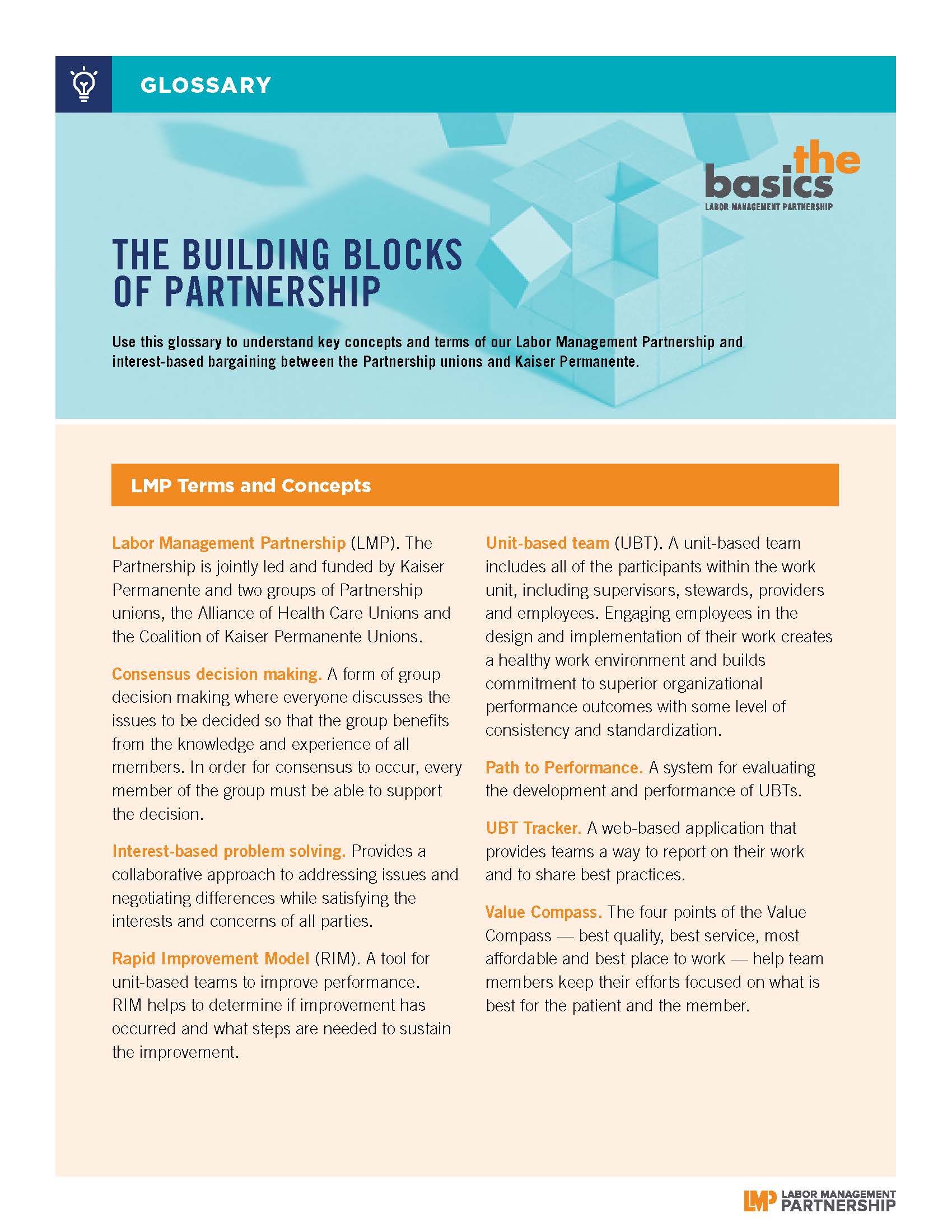
Glossary: The Building Blocks of Partnership

Format:
PDF

Size:
2 pages, 8.5” x 11”

Intended audience:
Members and leaders of unit-based teams

Best Used:
Use this glossary to understand key concepts and terms related to the Labor Management Partnership and interest-based bargaining.

Related tools:

TOOLS

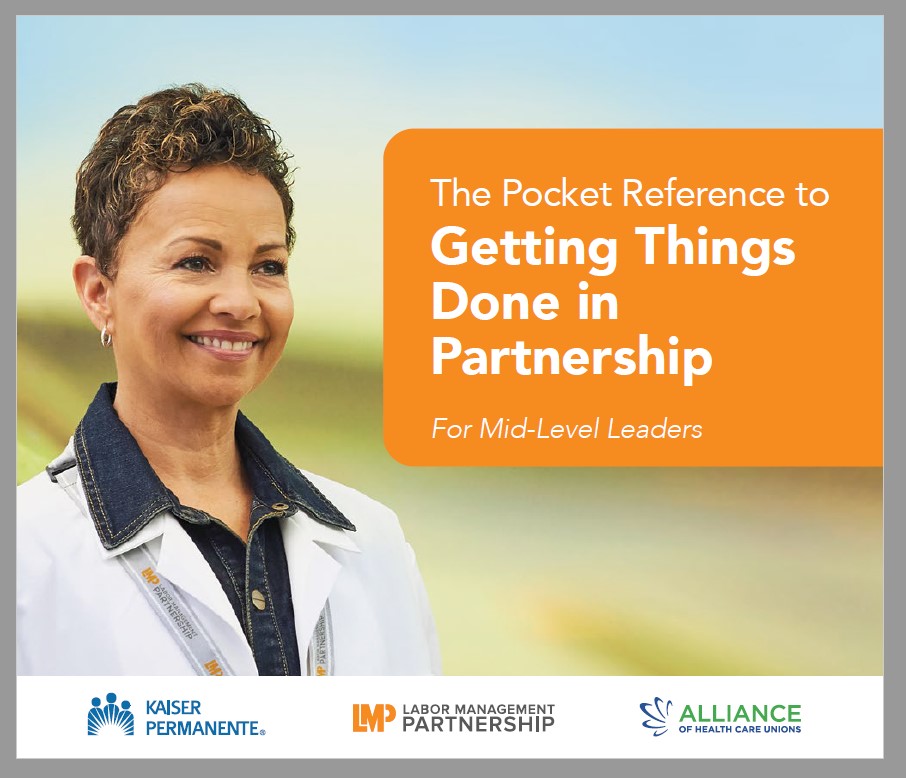
Pocket Reference to Getting Things Done in Partnership

Format:
PDF

Size:
Best printed on 8.5" x 14" paper; 33 pages 

Intended audience:
Mid-level leaders

Best used:
Carry this guide in your pocket to quickly refer to the concepts and processes teams can use to work in partnership effectively. This is a 2018 KP-Alliance National Agreement deliverable.

Related tools:

TOOLS

Virtual Meeting Backgrounds

Format:
PNG

Size:
1920 x 1080 pixels

Intended audience:
Anyone attending or hosting online meetings.

Best used:
Upload to Microsoft Teams, Zoom and any other online virtual meeting platform.

Related tools:

Welcome to the New e-Hank

Joy in Work

Deck: 
The antidote to job burnout

Story body part 1: 

Joy in work might seem like an idea that’s superficial or unattainable — especially in a pandemic. But in times like these, it’s more important than ever.

Joy in work is about being connected with what you do and why you do it. It’s the feeling of success and fulfillment that comes from doing work that matters. It connects us with colleagues and patients through a sense of shared purpose.

Joy in work is practical and science-based, according to the Institute for Healthcare Improvement, which has taken the lead in researching the subject. Joy in work produces tangible results: Studies link it to reduced turnover, higher productivity, and improved patient experience, outcomes and safety.

It doesn’t turn every workday into a breeze. There still will be fatigue, long hours and tough days.

But cultivating joy in work creates the deep engagement that helps keep stress from turning into burnout — which was a serious issue in U.S. health care even before COVID-19 arrived on the scene.

For everyone’s benefit, let’s nurture it at Kaiser Permanente.

What brings you joy in work? Use the stories, tips and tools on these pages to explore that question — on your own and with your team. Work together to create joy in work.

The Basics

Deck: 
The building blocks of partnership

Story body part 1: 

What does it mean to work in partnership?

It’s a joint commitment to collaborate, enshrined in the Labor Management Partnership’s national agreements.

It’s employees, managers, physicians and dentists building on common interests to make decisions and solve problems.

It’s Kaiser Permanente and the Partnership unions finding creative, mutually beneficial solutions that result in improved care, service and affordability.

There's never been a better time than right now to shine a fresh spotlight on the basics — the team-tested tools and practices fundamental to a strong partnership, such as the Rapid Improvement Model, consensus decision making and interest-based problem solving.

Whether you’re new to partnership or well-versed in its ways, use these performance improvement tools to identify issues, test changes, solve problems, make decisions, deliver better care and service, and enhance your work life.

LMP tools are designed to help you work together when things are going well — and bridge differences when the going gets tough. This approach addresses the needs of union members and helps the organization improve performance — which ultimately benefits Kaiser Permanente’s patients, members and communities.

Editor's Letter

Deck: 
A new day dawns

Story body part 1: 

Welcome to e-Hank! The national Labor Management Partnership communications team is pleased to serve you in this new format, and we’re grateful to those of you who’ve reached out and said you miss the print editions of Hank. But until the crisis of the COVID-19 pandemic subsides, an electronic communication seems best.

This issue looks at how our Partnership — which now includes 2 union federations, with separate National Agreements — helped Kaiser Permanente meet the extraordinary challenges that a worldwide pandemic brought to our doors. We’ve never been tested like this before. And how we’ve responded in the last several months provides a look at how we will respond and grow and adapt to future challenges. The dialogue and collaboration that have been taking place during the pandemic are a model for the future.

In this e-edition of Hank, we’re also introducing 2 concepts we think will help strengthen the culture of partnership throughout the enterprise.

The first is a renewed focus on The Basics — tips, tools and stories that will help you understand the core philosophy of the Labor Management Partnership and what it means to work in partnership. New to the Partnership? These materials will help show why Kaiser Permanente and the Partnership unions that belong to the Alliance of Health Care Unions or the Coalition of Kaiser Permanente Unions are committed to it as an operating strategy. Been around for a while? Dive in and refresh your knowledge of the principles and processes that make our Partnership a success.

The second is a new focus on Joy in Work, a concept pioneered by the Institute of Healthcare Improvement. By Joy in Work, we don’t mean smiley faces or i’s that are dotted with hearts. We hope our Joy in Work stories and tools will help you connect with your deeper, personal motivations for working in the  demanding health care field. The stats show that people who feel this sort of connection — this fundamental Joy in Work — are less likely to suffer from depression and burnout.

Lastly, don’t miss the back cover, which provides a quick refresh on a core principle that helps our Labor Management Partnership thrive: Free to Speak. It’s a reminder that your voice matters. Thank you for reading this and for all your hard work. Together, there is strength in partnership.

Strength in Partnership

Deck: 
Labor and management collaborate to address pandemic

Story body part 1: 

In 1997, the Labor Management Partnership turned strife between Kaiser Permanente and its unions into strength.

That strength is coming to the forefront again today. Decades of working in partnership are helping the organization respond to the COVID-19 pandemic, move forward together and provide a model for the health care industry.

With interest-based problem solving, a Free to Speak culture and performance improvement through unit-based teams, the Partnership has built a foundation that’s given leaders, managers and union members tools and relationships to collaboratively address this crisis.

Acting fast

Some of the response took place at the highest levels. Over a weekend, Kaiser Permanente and union leaders reached an agreement to temporarily enhance benefits for physicians and frontline employees.

“I’ve never negotiated anything as fast,” says Dennis Dabney, senior vice president of National Labor Relations and the Office of Labor Management Partnership.

Throughout the crisis, union leaders joined twice-weekly calls with top Kaiser Permanente leaders and played a central role with command centers and surge planning.

The key to making faster decisions was directly involving labor in operations meetings, says Hal Ruddick, executive director for the Alliance of Health Care Unions.

Having a voice

Partnership laid the groundwork for a nimble response in other ways, too. When COVID-19 hit, most vision appointments were canceled.

In Northern California, IFPTE/ESC Local 20 negotiated with management to have optometrists work in different roles. More than 120 optometrists volunteered to staff the COVID-19 test results call-in line.

“We showed our willingness to do alternative work — work that would be meaningful and keep our union members safe,” says optometrist John Corpus, a member of the local union’s optometry unit board.

Having a voice on the job equipped members to negotiate that deal, which included training, laptops and greater flexibility to work remotely.

“If our teams remain safe, are listened to and feel respected in the changes, they can live with the changes during this time,” Corpus says.

Improving workflows

At Beaverton Medical Office in Oregon, after COVID-19 testing began, managers saw that patients often needed multiple services. A new workflow was required — and the Nurse Treatment Room team’s registered nurses and medical assistants rose to the challenge.

“Everyone began sharing ideas and brainstorming possible solutions,” says nurse manager Cyndy Gillis. “The team formulated a plan that respected scope of practice, safety for the staff and patients, and a streamlined workflow that continues to adjust to new challenges.”

“It was the epitome of collaboration,” says team member Kellie Butchino, a certified medical assistant and SEIU Local 49 member.

Fighting together

One of the most vexing problems during the pandemic has been getting caregivers the personal protective equipment they need to safely care for patients. Working in partnership has helped.

“It’s not perfect,” says UNAC/UHCP member Andrew Calderon, a physician assistant at South Bay Medical Center in Southern California.

“But labor and management were there updating staff regularly and fighting to get us the materials we needed.

“We are able to provide the best care for our members because of partnership.”

Looking forward

Such collaboration across the enterprise will help Kaiser Permanente navigate the future — and inspire others, too.

In May, LMP leaders shared their pandemic experiences during a Labor and Employment Relations Association webinar, drawing praise from members of a 4-year-old labor- management partnership in Massachusetts.

“We are trying to proceed on the premise that there is no business case for adversarial labor relations,” says Bart Metzger, chief human resources officer for UMass Memorial Health Care. Partnership is “the only way we can push organizations such as ours forward.”

Partnership is an effective strategy for labor and management, Ruddick says.

“It’s harder, but it’s worth it because the results that you get are better.”


Pages

Subscribe to RSS - Program-wide