Northern California

Help Video

How to Find UBT Basics on the LMP Website

Learn how to use the LMP website:

LMP Website Overview

Learn how to use the LMP website:

How to Find How-To Guides

This short animated video explains how to find and use our powerful how-to guides

Learn how to use the LMP website:

How to Find and Use Team-Tested Practices

Does your team want to improve service? Or clinical quality? If you don't know where to start, check out the team-tested practices on the LMP website. This short video shows you how. 

Learn how to use the LMP website:

How to Use the Search Function on the LMP Website

Having trouble using the search function? Check out this short video to help you search like a pro!

Learn how to use the LMP website:

How to Find the Tools on the LMP Website

Need to find a checklist, template or puzzle? Don't know where to start? Check out this short video to find the tools you need on the LMP website with just a few clicks. 

Learn how to use the LMP website:

TOOLS

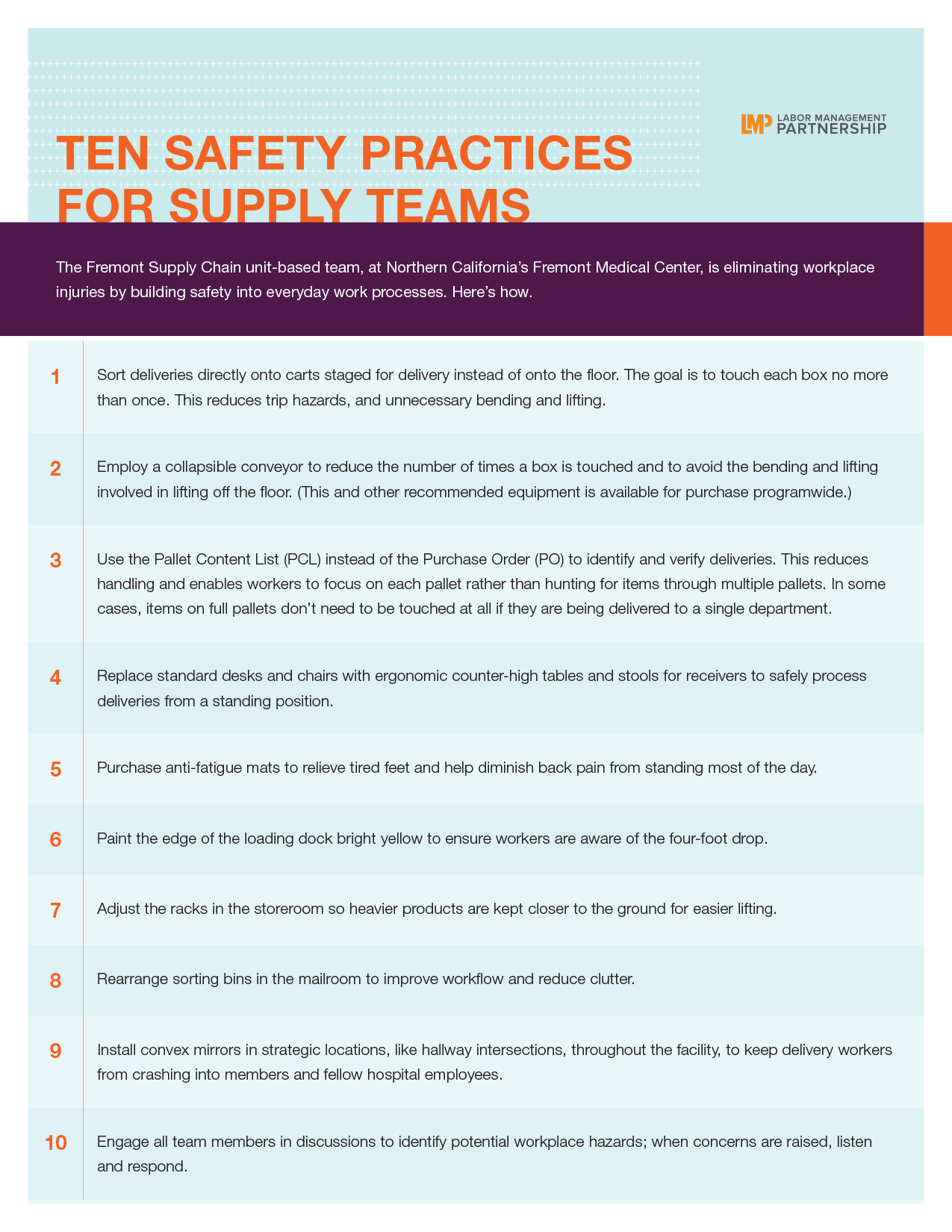
Ten Safety Practices for Supply Teams

Format:
PDF

Size:
8.5" x 11"

Intended audience:
Materials management and supply teams

Best used:
One-page tipsheet with 10 safety principles for materials management and supply teams. Use to share successful workplace safety practices with similar teams.

Related tools:

TOOLS

Team Presentations on Patient Safety

Format:
Powerpoint

Size:
41 pages

Intended audience:
Frontline employees and managers

Best used:
These slides were presented by three teams that shared their outstanding work on patient safety in a virtual UBT Fair in March, 2013. Use to spread best practices on patient safety.

The teams featured are:

  • Cumberland (GA) infectious diseases/oncology team on medication reconciliation
  • Rock Creek (Colorado) gastroenterology team on equipment cleanliness
  • South San Francisco (NCAL) radiology team on a stop-the-line process to prevent wrong-site X-rays


Related tools:

TOOLS

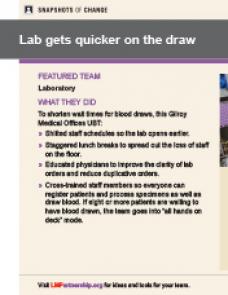
PPT: Lab Gets Quicker on the Draw

Format:
PPT

Size:
1 Slide

Intended audience:
LMP employees, UBT consultants, improvement advisers

Best used:
This PowerPoint slide features a Gilroy team that shortened wait times at the lab. In presentations to show some of the methods used and the measurable results being achieved by unit-based teams across Kaiser Permanente.

Related tools:

Videos

Preventing Pressure Ulcers

Loading the player...

(2:59)

This approximately three-minute video highlights a Walnut Creek Respiratory Care Services team that has gone two years without a single instance of a serious pressure ulcer resulting from a respiratory aid.


The Sponsorship Dilemma

Deck: 
Active sponsors drive high-performing teams. Can partnership overcome the short supply?

Story body part 1: 

If you ask Los Angeles Medical Center sponsors Ilda Luna and Sanjit Sodhi for the secret to successful sponsorship, they’ll agree it boils down to investment—of time, trust and respect—in each other, in their teams and in the collaborative work process.

Luna, a family medicine receptionist, and Sodhi, the chief financial officer for LAMC, didn’t know each other when they were asked to co-sponsor the Health Information Management, Admitting and Patient Revenue, and the local business office teams—teams that were failing to meet performance goals and were entrenched in mistrust between labor and management.

“Sanjit said, ‘Tell me what I need to do to get us up and running,’ ” recalls Luna, a member of SEIU-UHW. “I said, ‘You need to meet with your teams. If you invest time in labor, you’ll get huge dividends.”

Like most investments, success didn’t happen overnight — and it wasn’t guaranteed. But after a year and a half of perseverance, dedicating time and hard work to supporting the work of those teams, the pair has watched the departments go from being in the red in most metrics to seeing huge improvements in areas like attendance and co-pay collection.

“We’re taking on types of projects that we could never have dreamed of a year ago,” Sodhi says. “And when you work though relationship issues and put the focus back on partnership and performance improvement, it’s highly satisfying.”

What’s so special about sponsors?

study by Johns Hopkins University, Rutgers University and Kaiser Permanente identified five key characteristics of high-performing teams, including “consistent, aligned and visible sponsorship.” It confirmed what has been seen throughout the organization—strong sponsorship and support from higher levels of leadership are key factors in a team’s success.

The reasons are straightforward. Many frontline workers say simply having leaders’ involvement and support gives their work validation, letting them know that what they’re working on is important, that their contributions matter. In addition:

  • Sponsors mentor unit-based teams and connect them with effective practices and other resources to help them do their work.
  • They help break down barriers and provide guidance on setting goals that line up with local and national performance goals.
  • They act as role models and advocates for working in partnership.

“There are teams that need both management and labor sponsors to model partnership behaviors, who can agree to disagree and who can have some healthy courageous conversations till they get to an outcome,” says Vicki Barkan, the UBT consultant at the Los Angeles Medical Center. “Sometimes teams and co-leads haven’t experienced that, so they need to see it. It really helps to further the team dynamics.”

Sodhi agrees.

“As sponsors,” she says, “we have the same common goals and mutual respect for each other” that team members should have. “It trickles down to the rest of the UBT.”

“Sponsorship is a way to help move UBTs forward,” says Diane Ochoa, the regional director for Medical Group Support Services in Northern California and a former San Jose Medical Center medical group administrator. “It’s just like having a mentor, somebody you can talk to, to help you with issues and celebrate with you, and be there to really acknowledge the work you’re doing.”

So, what’s the problem?

Yet sponsorship is still a developing area in the partnership structure, even though many regions find that without active union and management sponsors, UBTs’ performance improvement work stalls.

Several challenges get in the way, and chief among those is time. Sponsors repeatedly cite the difficulty of finding time in their regular work to mentor teams. Labor sponsors face the added challenge of needing to cover their duties when they’re away from their usual post, lest those duties fall to colleagues.

Even with a commitment from facility and department leadership to backfill her position when her sponsorship work takes her away from her regular job, Luna, who is the union co-lead for the medical center’s LMP Council, says there isn’t enough time for everything she needs to do.

“But you have to make time,” she says. “I put in my own time, during lunch and after I clock out.”

Luna’s partner Sodhi agrees. The time challenge has to be reckoned with—but it’s a challenge worth solving.

“I’ve definitely made it a priority,” she says. “It was tiring devoting all that time, but I knew that I needed to do that to develop my relationships. In order to achieve any results, I knew I had to invest in time.”

“Capacity” is another word that surfaces when sponsors talk about challenges. Identifying people who can be strong sponsors and ensuring they have the tools and skills for the role is not easy. Labor bears the brunt of this barrier, in part because the unionized workforce typically has a smaller pool of leaders to draw from than management has. Many potential labor sponsors lack the consulting and facilitative skills required to mentor a team. As a result, union sponsors are in short supply, and those few become overwhelmed, with too many teams to support.

“I think that with labor, with so much work to do for our regular jobs, this is too much,” Luna explains. “So a lot of my peers didn’t want to do it. (Or) the ones who want to do it couldn’t get released because of operational needs. Patient care comes first, so operational need is a huge barrier.”

Some say successful sponsorship won’t happen until sponsors are held accountable, with their success tied to performance goals and financial compensation.

But in the meantime, many medical centers and regions are wrestling with finding other solutions to these issues. As a first step, some are revamping their training to clarify roles and responsibilities, which many sponsors — both labor and management alike — say have not been clear.

“It will be helpful for people to understand what they are supposed to do and see examples of how that’s done,” Ochoa says. “This is relatively new for some labor folks especially, and the more we can give them the tools to be a good sponsor, we need to do that.”

At the Los Angeles Medical Center, the facility’s LMP Council has made a series of changes in the last year it thinks will help shore up sponsorship. These include establishing criteria for becoming a sponsor, to make sure the right people are in the role and can model partnership and leadership behaviors; aggressively recruiting union co-leads of high-performing teams to become sponsors to increase the labor sponsor pool; and reassigning UBTs so a sponsor has no more than five teams.

Ultimately, time and commitment always will be challenges, but the potential rewards — the culture change and performance improvement work that come with high-performing teams — make the investment worthwhile. If sponsorship remains a barrier, there is a risk that teams will get discouraged.

As Luna says, “To be successful, we need successful sponsors and to build credibility with our teams. And we want to be successful.”

Labor Sponsor Profile: Andrea Badellebess

Story body part 1: 

Andrea Badellebess has been a labor co-sponsor in the Greater Southern Alameda Area (GSAA) in the Northern California region for seven years. She sponsors 37 teamsincluding EVS, Health Management and the pharmacy UBTs, all of which include OPEIU Local 29 membersby “spreading myself around as much as I possibly can.” In talking with LMP communications consultants Shawn Masten and Cassandra Braun about the challenges and rewards of being a labor sponsor, she introduced the idea of a “family team”—a team that is above even Level 5, when “teams just interact and do what’s needed…It’s a real partnership. And it’s unspoken; it just gets done. It’s not about whose job it is.”

Q. First: How do you sponsor 37 teams?

A. Mostly, I do it electronically. I look at team meeting minutes on the shared drive and look at UBT Tracker to see where they are on projects. For those teams that are unique and need additional pushes, I work with our UBT consultant and visit them more often. If they’re a Level 5 team, I try to get to meetings at least two to three times a year. Then I have teams that need a little more motivation. I have to visit those teams more often to let them know they’re not by themselves. So it’s kind of hard. But you have to let them know you’re there.

Q. What’s the state of sponsorship today?

A. The work of sponsors has evolved slower than the work of unit-based teams. At one point, teams thought their consultants were their sponsors. But that’s the beauty of this whole performance improvement thing—it is its own ongoing small test of change. Everyone is learning as they go. There’s been a whole new culture change.

Q. What about sponsorship needs improving?

A. Here in the GSAA, we have been taking steps to improve union sponsorship especially. There are not enough people who can wear that sponsor hat. So now we are looking for stewards who want to—and have the capacity to—be sponsors. They have to be capable of seeing the common barriers teams face. And they have to either know who can remove those barriers or to point their teams in a different direction. What we’re doing is providing the training and development needed for stewards to succeed as sponsors. This is a significant shift, and one that we hope will make a difference.

Q. What do you like most about being a sponsor?

A. One of my greatest thrills—and sometimes one of my hardest jobs—is helping UBT members recognize that if they speak up they will be listened to. This is still hard for some, especially those skeptical that this whole unit-based team thing isn’t just another experiment that will pass. But this is what I tell them: “You are the experts. Who knows how to do your job better than you?” Once they realize they are the experts and have a say, and they are heard, they become a partner. UBTs make the frontline staff become partners. You’re not just a worker, you’re a partner, and you have a say in what’s going on.

Q. Can you give an example where the workers solved the problem?

A. Our call center operators were having a problem with elderly members getting hung up on or calls being dropped after they were transferred. They came together as a unit-based team and found a solution: Instead of simply putting such calls through, they stayed on the line and would talk with the person at the other end, explain who the member was and why they were calling. They had a problem, they solved it and there was no finger-pointing, no blame.

Words from the front line

“She’s very involved. It’s not like you just see her once a month or every other month. And you can tell that she’s interested in what we’re trying to say and do. If we go out of bounds, she’ll ask, ‘Is this what you meant?’”—Leilani Mejia, Health Information Management specialist, OPEIU Local 29 member and union co-lead, Fremont Medical Center

TOOLS

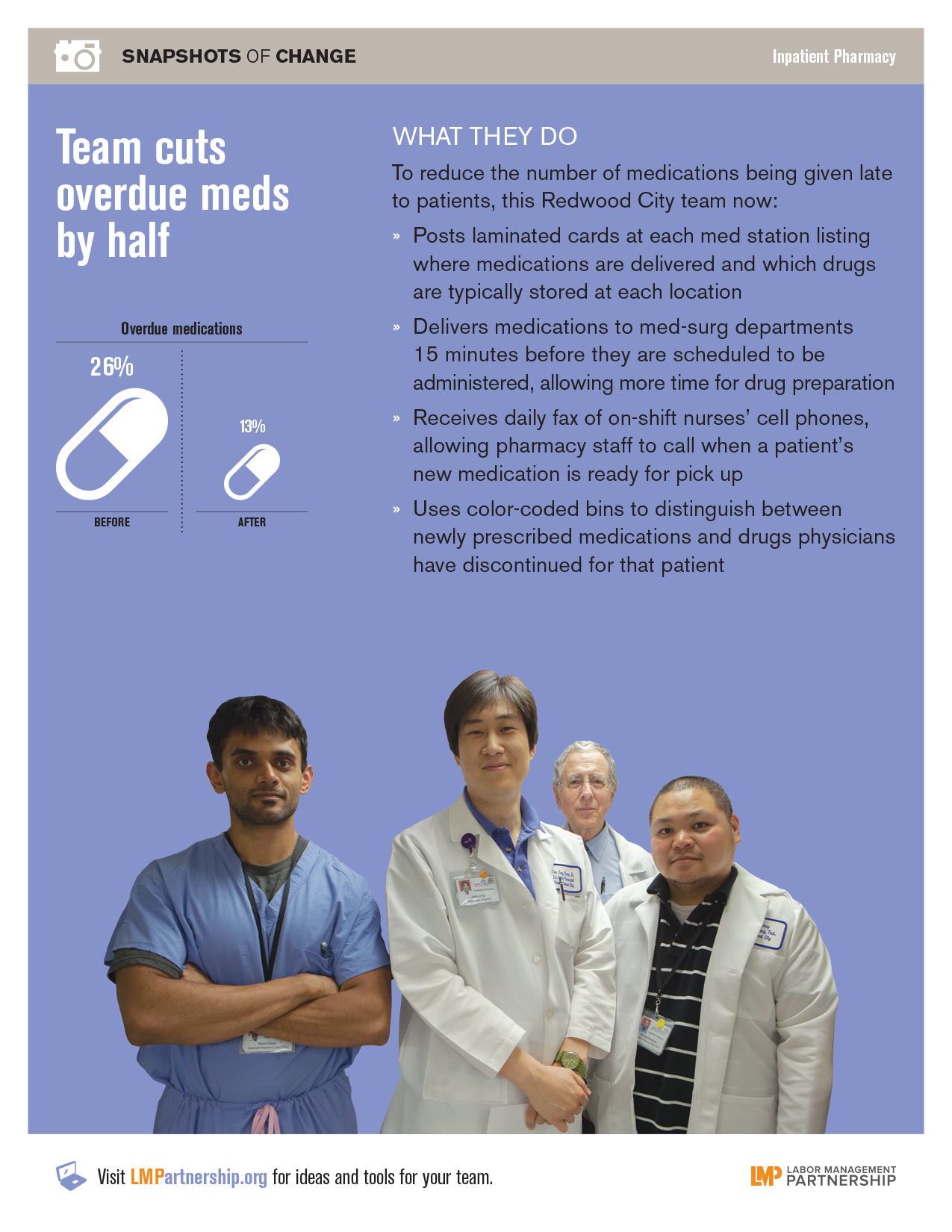
Poster: Team Cuts Overdue Meds by Half

Format:
PDF

Size:
8.5" x 11"

Intended audience:
Frontline employees, managers and physicians

Best used:
This poster features a Northern California team that found a way to get medications to patients in the hospital more quickly. Post on bulletin boards, in break rooms and other staff areas.

Related tools:

TOOLS

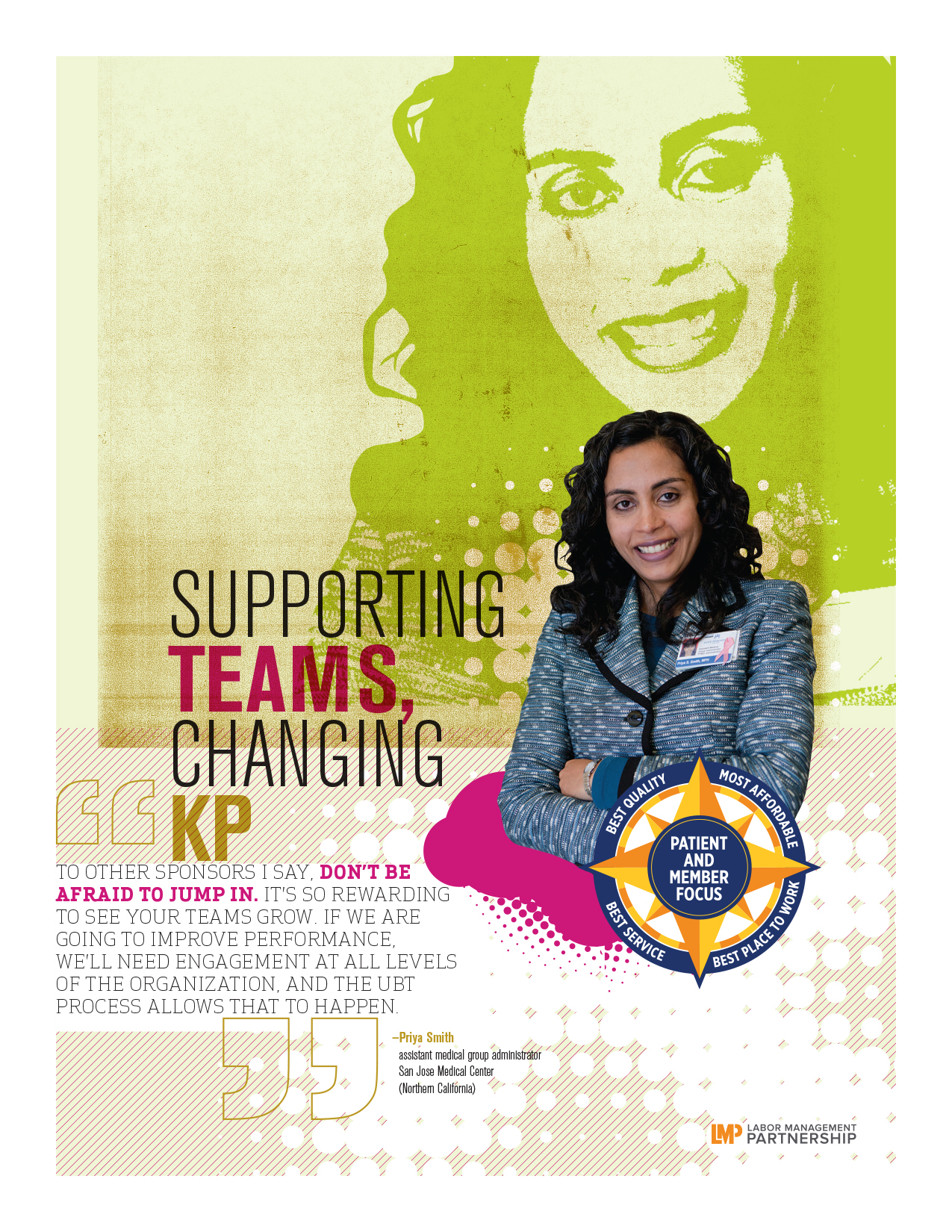
Poster: Supporting Teams, Changing KP

Format:
PDF (color and black and white)

Size:
8.5” x 11”

Intended audience:
Unit-based teams and UBT sponsors

Best used:
This poster features UBT sponsorship advice from Priya Smith, a sponsor in Kaiser Permanente's Northern California region. Post on bulletin boards, in break rooms and other staff areas.

Related tools:

TOOLS

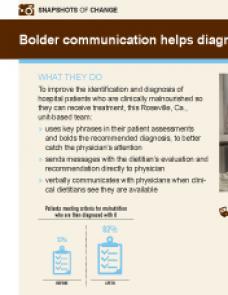
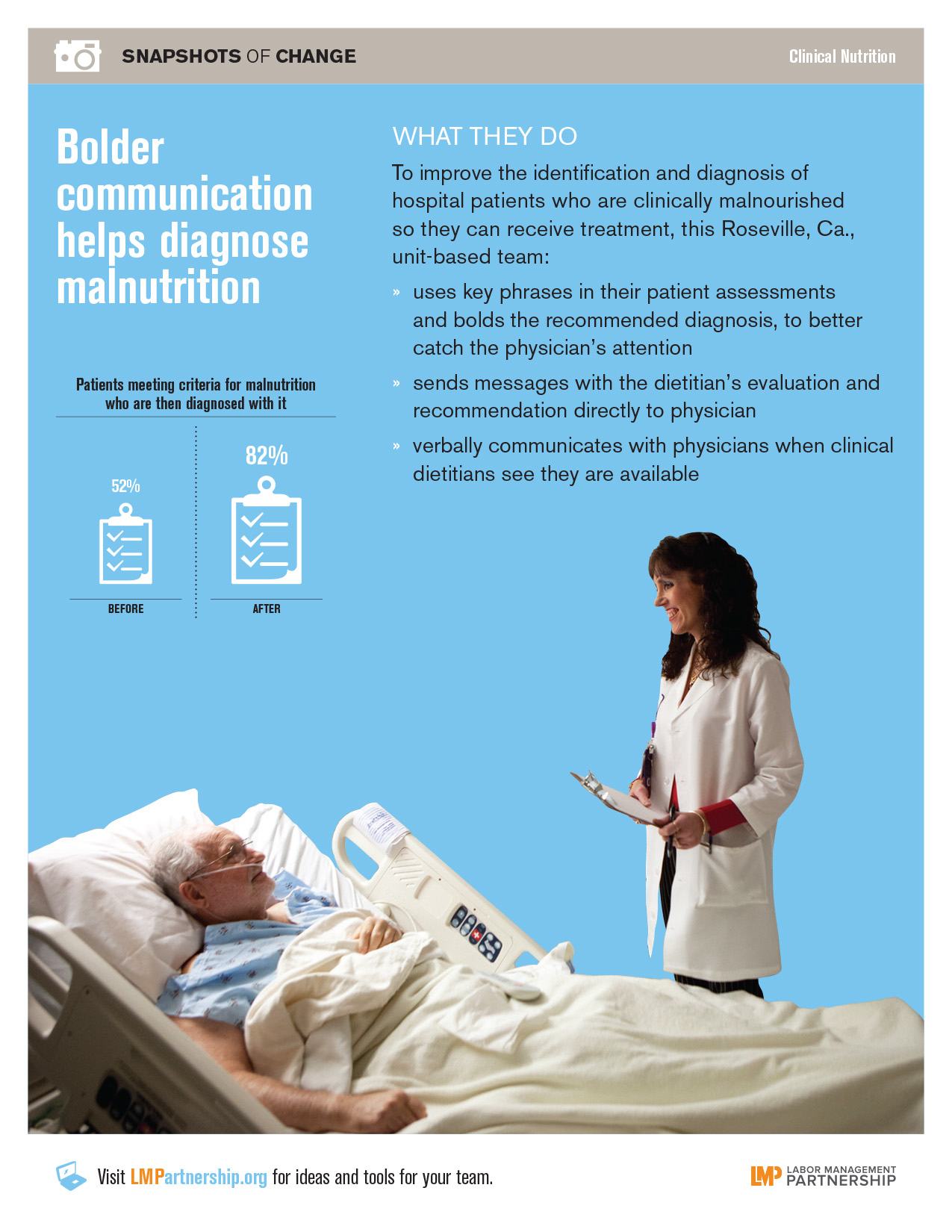
PPT: Bolder Communication Helps Diagnose Malnutrition

Format:
PPT

Size:
1 Slide

Intended audience:
Frontline employees, managers and physicians; LMP staff, UBT consultants, and improvement advisers

Best used:
This poster features a Northern California team that improved communication and its ability to diagnose malnutrition. Use in presentations to show some of the methods used and the measurable results being achieved by unit-based teams across Kaiser Permanente. 

Related tools:

TOOLS

Poster: Bolder Communication Helps Diagnose Malnutrition

Format:
PDF

Size:
8.5" x 11"

Intended audience:
Frontline employees, managers and physicians

Best used:
Gain inspiration from this Northern California team that improved communication and its ability to diagnose malnutrition.

Related tools:

Pages

Subscribe to RSS - Northern California