Northern California

Help Video

How to Find UBT Basics on the LMP Website

Learn how to use the LMP website:

LMP Website Overview

Learn how to use the LMP website:

How to Find How-To Guides

This short animated video explains how to find and use our powerful how-to guides

Learn how to use the LMP website:

How to Find and Use Team-Tested Practices

Does your team want to improve service? Or clinical quality? If you don't know where to start, check out the team-tested practices on the LMP website. This short video shows you how. 

Learn how to use the LMP website:

How to Use the Search Function on the LMP Website

Having trouble using the search function? Check out this short video to help you search like a pro!

Learn how to use the LMP website:

How to Find the Tools on the LMP Website

Need to find a checklist, template or puzzle? Don't know where to start? Check out this short video to find the tools you need on the LMP website with just a few clicks. 

Learn how to use the LMP website:

How to Prioritize Team Goals

Deck: 
Tool helps teams rank projects for most impact

Story body part 1: 

Successful unit-based teams take on multiple goals on the Value Compass, get results and move on. But focusing on the right goals—and not getting lost in the process—can be a challenge. Fresno Medical Center, which reports the highest percentage of high-performing UBTs in all of Kaiser Permanente, has developed tools to help teams set priorities. The prioritization matrix, a tool used in performance improvement, is part of a four-step process.

•   Step 1: Identify improvement opportunities with the team. Develop ideas with the help of the team sponsors or UBT consultants, and pay special attention to your Performance Sharing Program (PSP) goals.

•   Step 2: Use the Project Prioritization Matrix to determine project priority.

•   Step 3: Enter project data into UBT Tracker.

•   Step 4: Share project information with the UBT consultant or union partnership representative, who can connect the team with other resources, including “affinity groups” working on similar goals.

“It’s a very simple process that helps teams focus and know why they’re doing what they’re doing,” says Fresno’s Navneet Maan, a UBT consultant.  

“Teams can work through this process during their regular meetings,” she adds. “The project selection becomes a more transparent process, and the tool helps align their work with regional goals that will make a difference to members and patients.”

TOOLS

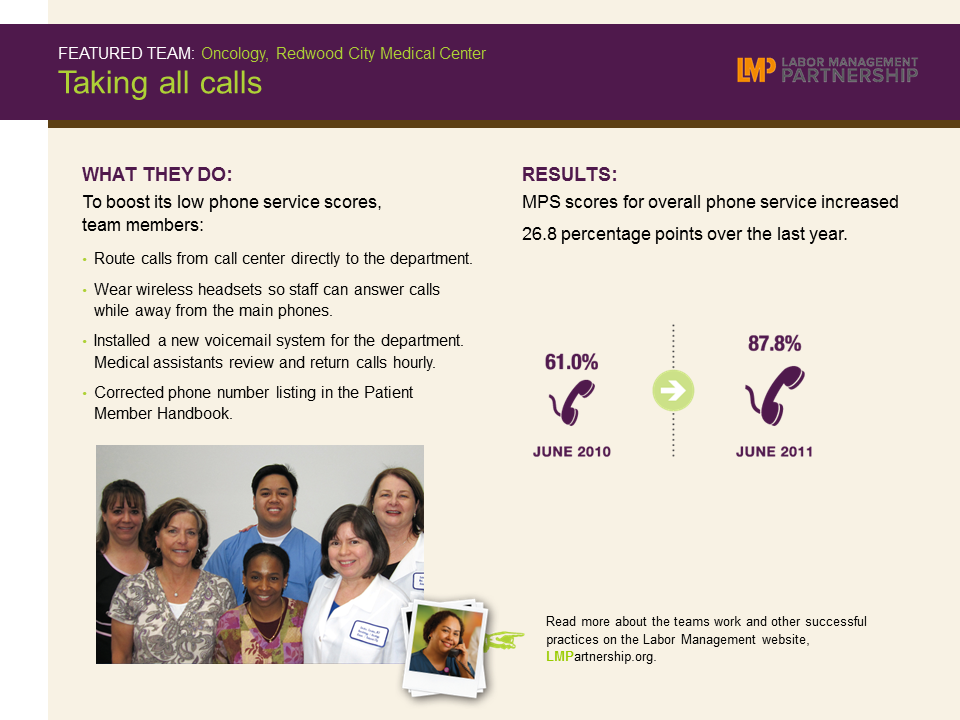
Redwood City UBT Improves Phone Service

Format:
PowerPoint slide

Size:
8.5" x 11"

Intended audience:
Frontline teams, managers, sponsors, physicians

Best used:

This one-page slide shows how the Oncology unit-based team in Redwood City boosted its low phone scores. Save on to your computer to include in meetings or presentations as an example of UBT performance around telephone service.

Related tools:

The Best Approach Is a Team Approach

Deck: 
What UBTs offer docs

Story body part 1: 

I am a big proponent of the team approach to medicine. That’s why I am an active participant of my department’s unit-based team.

As the physician co-lead for the Pediatrics unit-based team, I participate in the UBT meetings both to give and to receive ideas. Ideally, a physician brings to a UBT the vision on how to work together to provide the best possible patient care, support for the management co-lead, and the willingness and openness to listen to what other people have to say. 

According to Dr. Atul Gawande, noted author and surgeon, it used to be that doctors were trained to be cowboys. They worked alone and saved the day. In today’s world, what people really need are pit crews, teams of people where everyone’s function is vital to the overall success of the enterprise. Medicine is no longer an individual endeavor—it has grown so complex and multifaceted that no physician can know everything. So we need to foster the team approach to give our patients the best possible care. 

When I first came to Kaiser nearly 10 years ago, the thing I heard that really stuck with me was the KP Service Quality credo: “Our cause is health. Our passion is service. We’re here to make lives better.” I immediately connected with it and have used it to filter everything I do. 

In other words, I always ask myself: Does what we are doing support our cause, passion and goal? If it does, then it’s usually worth doing. 

Advice to other physicians  

  • Say "thank you" and say "please." Really go out of your way to appreciate someone who comes up with an idea that has made your life easier. And do it publicly.
  • Make time for daily huddles with your staff.
  • Create an environment in which people feel free to share their ideas. One of the worst forms of waste is unused creativity.
  • Give people the benefit of the doubt; pause and reflect when you feel yourself getting upset.
  • Think outside the box. Go to staff members who aren’t at the nursing station to help out when needed. This gives the whole team a sense of ownership over patient care. 

Bottom line? Being a leader isn’t just about being in charge. Just because you’re a physician doesn’t mean you have to spearhead all of the work. If you really want to make a difference or a change, you have to include the entire staff. The work will get done better, faster and easier if we work together. And if you believe in the work that you are doing, then teamwork is a natural expression of patient care.

Tips on huddles

Huddles are a key part of my day. At the start of each day I review the day’s schedule with the medical assistant. I look for patient names that are familiar so that we are prepared for the day’s visits. For example, if I know that a patient has concerns that are likely to take up more than the usual 15-minute office visit, I will tell that to the medical assistants so they are prepared, and together, we give our patients the best care possible. 

These huddles are very informal, but they go a long way toward being prepared and letting the patients know they are well cared for.

Sick Days Are Not Days Off

Deck: 
Team explains attendance policy, boosts morale

Employees calling in sick was having a negative impact at the radiology lab.

Those serving the South San Francisco Medical Center and Daly City Medical Office Building had to work harder to fill in gaps.

Morale was sinking. And tired employees were vulnerable to getting sick, creating a downward attendance spiral.

Recognizing a crisis, the UBT issued an anonymous attendance survey and found there was widespread confusion about sick leave.

Wanting to encourage teamwork in improving attendance and to boost department morale, team members agreed to create department-wide goals, a department-wide educational effort, and a group celebration.

But the true aim was clear—help all staff members make their goals and encourage them to attend the party. They also wanted employees to have a clear understanding of expectations.

In setting the new targets in the attendance guidelines, the team defined clear goals. By announcing the guidelines at a staff party, it also set an upbeat tone, says labor co-lead Donna Haynes.

The new targets included:

  • no more than one tardy per two-week pay period (a tardy is three minutes past start time)
  • no more than two sick leave absences per quarter; and
  • no more than two 'danglers' (forgetting to clock in or out) per pay periods.

Supervisors met with each employee to review his or her attendance trends and to discuss concerns or needs. The staff found the meetings supportive.

"They asked, 'What can we do to help?’ They were trying to encourage you," says labor co-lead and lead mammography technologist, SEIU UHW, Adie Hoppis.

Employees who met the guidelines were invited to a quarterly lunch—complete with white tablecloths, silverware, wine glasses (for nonalcoholic beverages), music and catered food. Managers served the staff members.

"We're there to celebrate the staff," says Tracey Fung, service unit manager. "They were really floored. There had never been anything like this before in the department."

Hoppis says the lunches are a powerful positive reinforcement.

"They’re really nice. You’re treated special.”

With more employees at work, patient waiting time has decreased.

"Employees are happier, and patients are, too," Hoppis says.

TOOLS

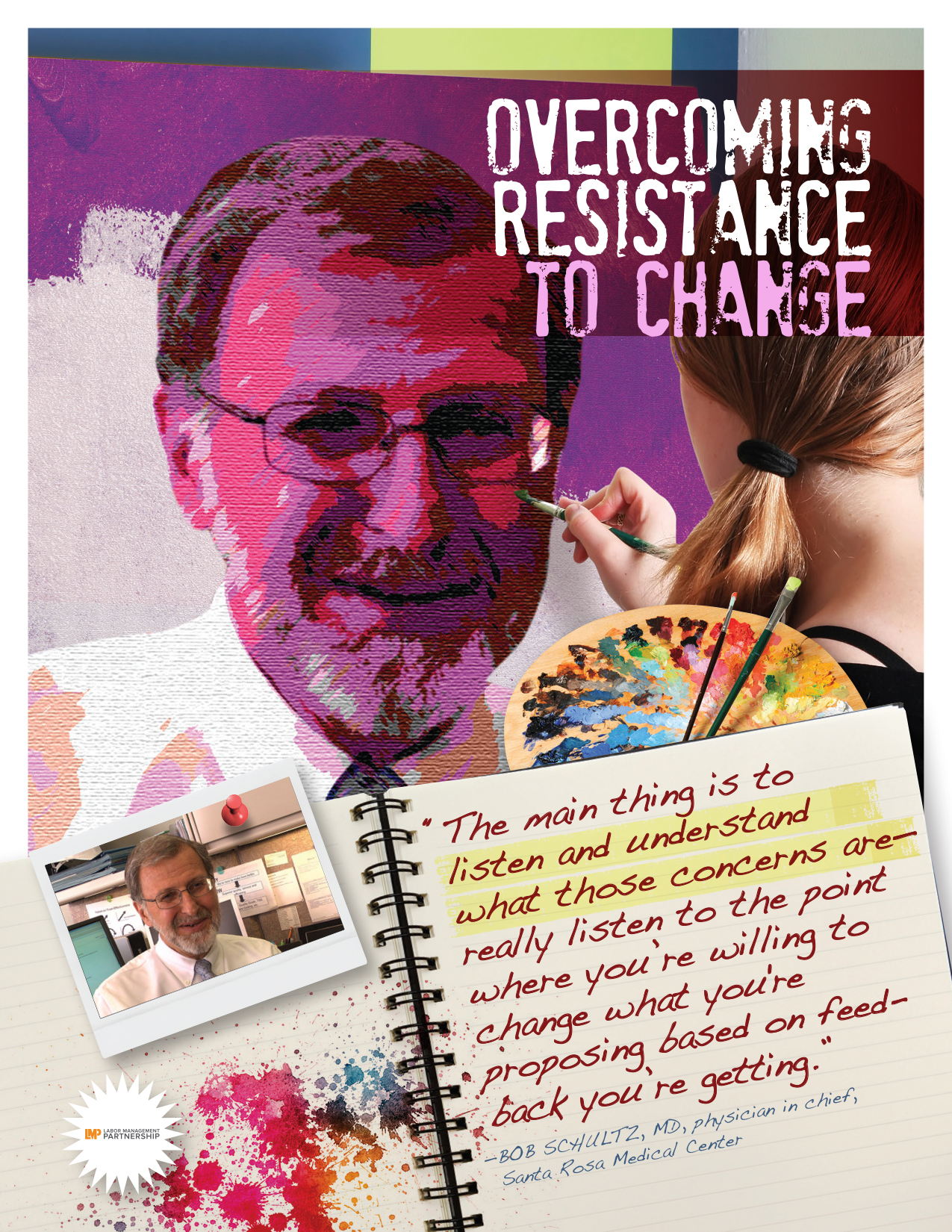
Overcoming Resistance to Change

Format:
PDF (color and black and white)

Size:
8.5 x 11

Intended Audience:
Frontline employees, managers and physicians

Best used:
This poster features advice from a physician leader about overcoming resistance to change. Place on bulletin boards in break rooms and other staff areas.

Related tools:

TOOLS

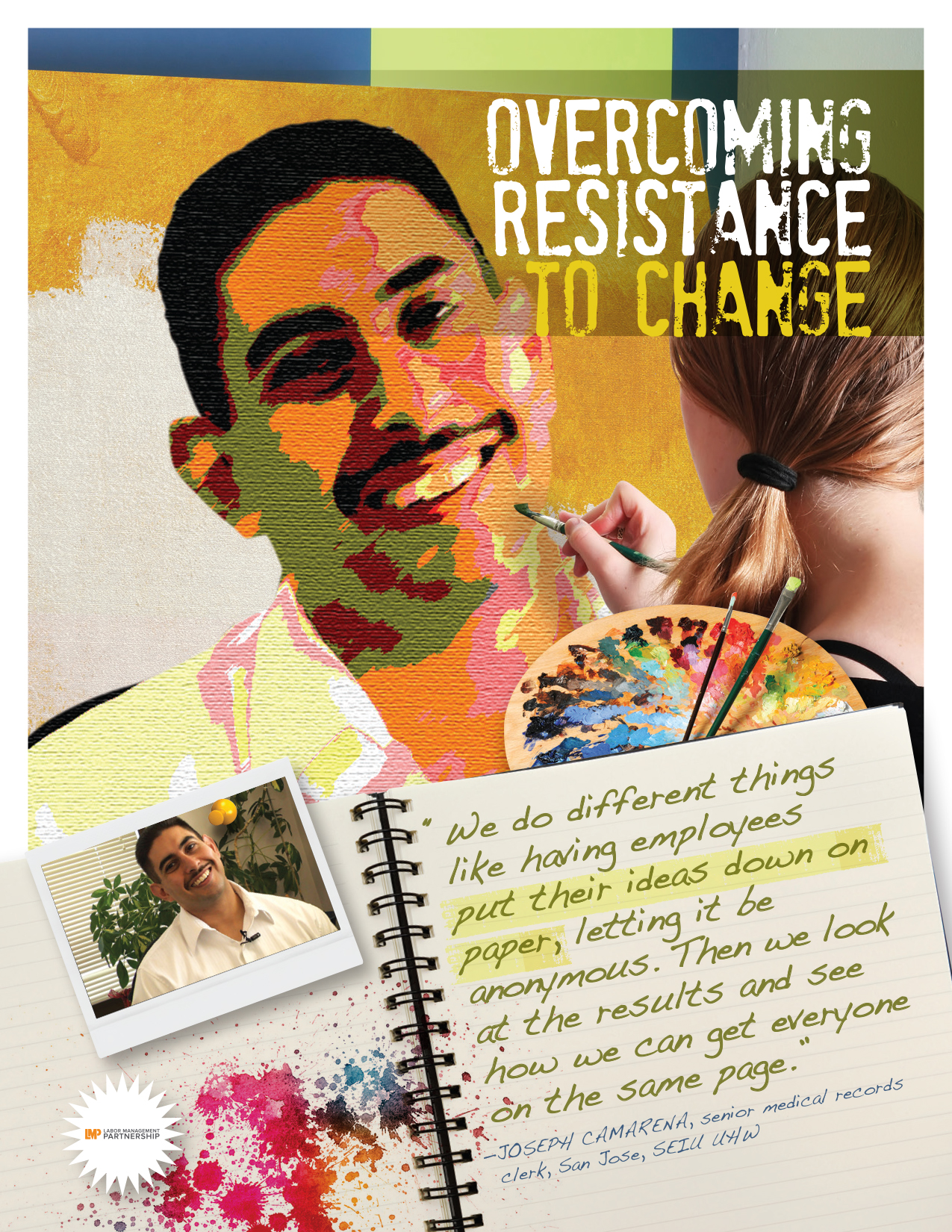
Poster: Overcoming Resistance to Change

Format:
PDF (color and black and white)

Size:
8.5" x 11"

Intended audience:
Frontline employees, managers and physicians

Best used:
Post this advice from a UBT labor co-lead, about overcoming resistance to change, on bulletin boards, in break rooms and other staff areas.


Related tools:

TOOLS

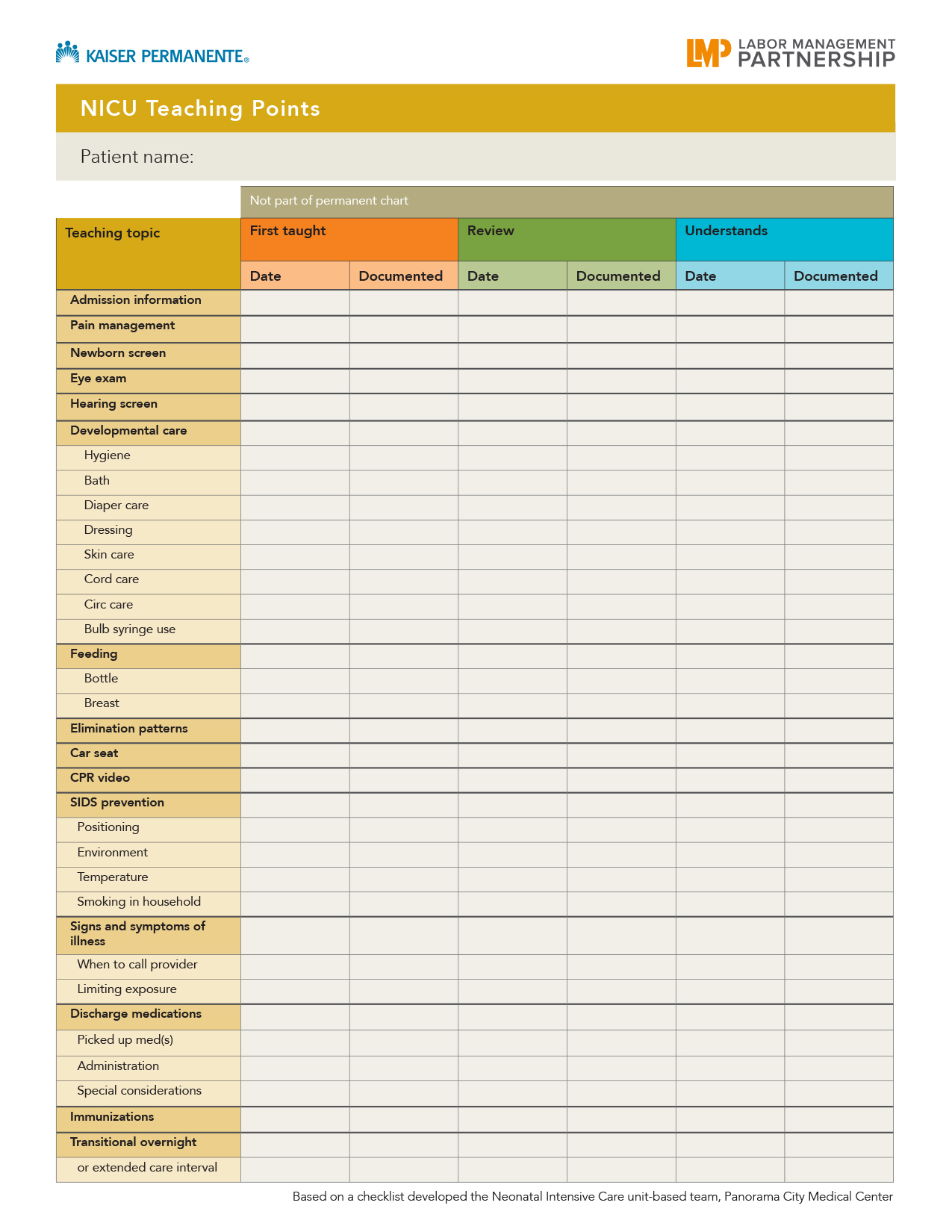
NICU Teaching Points

Format:
PDF and Word DOC

Size:
8.5" x 11"

Intended Audience:
NICUs and maternity wards

Best used:
Use this checklist to ensure that information about how to take care of a new infant is gone over consistently with parents of newborns. 

Related tools:

A Child-Friendly Environment Helps With Healing

Deck: 
Team lifts spirits with toys, trains, clubhouse and books

The Pediatric Neurosurgery team in Oakland couldn’t figure out why their staff courtesy scores were low.

They had a new office building and felt providing exceptional care was part of the routine.

Then union co-lead Tanya Johnson noticed there was very little for the department’s young patients and their families to do in the waiting room.

“Kids would be running up and down the hallway,” says Johnson, who is a medical assistant and SEIU UHW member. “Parents would be chasing after them and not being able to focus. It was crazy.”

The department of Pediatric Neurosurgery cares for children with a full spectrum of disorders, including tumors of the brain, spinal cord and peripheral nervous system.

“These kids are the sickest of the sick,” says service manager Jim Mitchell, RN PNP. “They have serious, serious conditions. Anything we can do to make their visit a little brighter, we do.”

So the team decided to create a child-friendly environment, and went to senior leadership for funding.

The improvements included a large, colorful playhouse, a treasure chest, books and toys in each of the patient rooms—as well as a custom-built train set.

“Everyone on the team had input as to how the clinic would be set up and where the items would be placed,” union co-lead and receptionist Leap Bun says of the improvements that cost about $18,000.

To ensure infection control, the toys are wiped down on a regular basis by Environmental Services employees.

And the atmosphere does a lot to ease tension for their medically fragile patients and their families. 

“The children are less threatened and want to come here to play,” Mitchell says. “It seems like every day we have parents on a regular basis having to coax their children to leave the clinic.”

In three quarters, department scores for staff courtesy increased from 69.6 percent to 90.3 percent.

“In addition to our MPS scores we can measure the change in the faces of the children we interact with,” Mitchell says.

For other teams interested in this type of project, they suggest field trip to other facilities doing the same work. The Oakland team visited Sacramento and Roseville to refine their workflow processes.

And the team also found that families with children choose to wait in the clinic, even if their appointment is elsewhere or they’re picking up a prescription from the nearby pharmacy.

"They tell us it’s a nice place to relax and to calm their kids down while waiting,” Bun says.

Improving Patient Care by Speaking Spanish

Deck: 
Team helps provide culturally competent care by speaking Spanish from reception to examination

Story body part 1: 

Imagine developing a severe cough and teeth-chattering chills. You want to be seen by a doctor but no one really understands you: Not the call center operator with whom you try to make an appointment; not the receptionist who checks you in; not the medical assistant who takes your temperature and blood pressure. Not even the doctor who speaks quickly and uses complicated medical terms.

“When you come in for medical care, it’s already like a foreign land,” says Kathleen Kearney, the manager and the UBT co-lead for the Obstetrics and Gynecology department at San Jose Medical Center.  “If you don’t speak English, it can be downright frightening.”

Giving patients better access

Kaiser Permanente has long been committed to providing language access in the form of interpretive services for its non-English speaking members. The Ob/Gyn unit-based team in San Jose has taken the additional step of creating a Spanish-speaking module, a sort of one-stop shop for Spanish-speaking patients.

The idea for the module came from Joseph Derrough, MD, who recognized that good patient care involves more than just the patient and the physician in the exam room. It includes each interaction, from making an appointment to checking in and being assigned a room.

“I realized that we had a significant percentage of patients who only spoke Spanish, and we could do better service to them by providing linguistic and culturally competent care,” Dr. Derrough says. “We had staff that spoke Spanish, but they weren’t all in the same place. My vision was that we could create a clinic module where, from registration to examination, the patient was spoken to in her own language.”

Making it happen

The unit-based team made it happen.

“From the time they walk in the door, every patient should receive the same level of care regardless of the language they speak,” says Glenda Morrison, a medical assistant, SEIU UHW chief shop steward and the UBT co-lead.

But in the beginning, the frontline staff members, including Morrison, were skeptical.

“Since we were already serving Spanish-speaking patients in our clinic, the question we were asking was, ‘Why is this needed?’ ” Morrison says.

But a visit to the Spanish-speaking Medicine module at the Santa Clara campus made them believers. That module has been in place for five years.

“When I saw it in action, a light went off—and I realized that by not speaking to our Spanish-speaking members in their own language, we weren’t providing them with the same care as we were our English-speaking members,” Morrison says.

Overcoming obstacles

Once the team decided to take on the project, it faced some challenges. Offices had to be moved and medical assistants had to be reassigned.

“We had a lot of meetings and a lot of nervous people,” Morrison says.

But again, the Santa Clara example eased fears: “Once they saw how it worked in Santa Clara, we got by-in from the staff and it was easier,” Kearney says.

The module, which opened Sept. 29, includes signage and literature in Spanish. The staff members, from the receptionists and medical assistants to the doctors, are fluent Spanish speakers.  Word about the new module went out through Spanish-speaking television news and newspaper reports. And there was a grand opening.

It’s going well so far, Kearny says, noting that “we have three Spanish-speaking providers each day, and they have appointment capacity for about 20 patients.”

Next steps

Now, the team is looking for ways to quantify the benefits of the new module. It’s hoping to be able to collect patient satisfaction data specifically from Spanish-speaking members to assess the impact, Kearney says.

“If it shows success, we’ll pass the idea on to other teams,” she says.

Meanwhile, the unit is looking at how it can provide culturally competent care for its other monolingual patients.

“We don’t what a certain group to feel singled out,” Morrison says. “We just want them to feel comfortable.”

A UBT Sponsor Explains How to Support Change

Deck: 
Removing barriers and providing perspective are key

Story body part 1: 

When you get to the leadership level it’s easy to become disconnected and to forget that where the rubber meets the road is at the front line. Sponsoring a unit-based team helps me stay connected—and that helps me be a better manager.

Staying connected

As a sponsor for the Medical Secretaries and Scanning Center, I help the teams see where they fit in the bigger picture—and they help me see the challenges that teams face every day.

I check in with the teams and their co-leaders regularly, make sure they’re accomplishing their goals and doing work that meets regional and national goals. They have their own ideas for improving department operations and doing their own small tests of change. I help them think strategically about how they can impact the region and Kaiser Permanente as a whole.  

There will always be the manager-employee relationship, but when you walk into a UBT meeting, you leave the hierarchy at the door. To build credibility, everyone on the UBT must have an equal voice at the table. I believe in the partnership and, yes, there are a few times when a manager shoulders the responsibility and has to make decisions about regulatory compliance issues, regional strategic direction and planning, scope of practice discussions about licensures and policies, and personnel management. But there are a lot of other decisions that staff can be a part of making in a group setting, and getting buy-in from the folks who do the work makes all the difference in the world.

Removing obstacles

Because I’m in a leadership role, it is important that I help the teams overcome barriers. If they need help understanding a goal, metric or budget, I can gather the information and package it in a way that is most helpful to the team.  When I started working with these teams in 2007, they were already doing good work despite some major obstacles. The chartroom transitioned to the scanning center, and the medical secretaries had a lot of manager and staff turnover, and had difficulty meeting performance metrics. Now both teams are high functioning. They have accomplished so much in the last two years.

So to other sponsors I say, don’t be afraid to jump in. It’s so rewarding to see your teams grow. If we are going to improve performance, we’ll need engagement at all levels of the organization, and the UBT process allows that to happen.

Pages

Subscribe to RSS - Northern California