Frontline Managers

Help Video

How to Find UBT Basics on the LMP Website

Learn how to use the LMP website:

LMP Website Overview

Learn how to use the LMP website:

How to Find How-To Guides

This short animated video explains how to find and use our powerful how-to guides

Learn how to use the LMP website:

How to Find and Use Team-Tested Practices

Does your team want to improve service? Or clinical quality? If you don't know where to start, check out the team-tested practices on the LMP website. This short video shows you how. 

Learn how to use the LMP website:

How to Use the Search Function on the LMP Website

Having trouble using the search function? Check out this short video to help you search like a pro!

Learn how to use the LMP website:

How to Find the Tools on the LMP Website

Need to find a checklist, template or puzzle? Don't know where to start? Check out this short video to find the tools you need on the LMP website with just a few clicks. 

Learn how to use the LMP website:

Why We Speak Up

Deck: 
Workplace injuries vanish almost entirely after these pharmacy workers find their voice

Story body part 1: 

Angela Chandler and Nee Tang, Pharm.D., didn’t like what they were seeing.

The team co-leads for the West Los Angeles Ambulatory Care Pharmacy crouched beside Camille Wong, scrutinizing her posture as the pharmacist and UNAC/UHCP member sat typing at her computer.

After a quick huddle, the pair worked together to adjust Wong’s chair until she was sitting in the ideal position to protect her from pain—and a potential injury.

“I didn’t know I could adjust my chair this way. It feels good,” Wong said appreciatively, her feet resting flat on the floor and her legs bent at the appropriate 90-degree angle.

Shift in culture

Such peer safety rounds are one of the hallmarks of a dramatic shift in culture for the team, a shift that has built engagement and created a workplace where frontline workers feel confident speaking up. The department went 3½ years without injuries and earned a national workplace safety award earlier this year.

“We’re all in it together, and we’re all here for each other,” says Chakana Mayo, a pharmacy technician and UFCW Local 770 member who is the team’s workplace safety champion.  

But the situation was not always so bright.

In 2011 and 2012, the department experienced a spate of workplace injuries. Employees, who spend most of their time on phones and computers, were sometimes reluctant to report pain—including one who suffered a repetitive motion injury so severe that it required two surgeries and time off from work.

“It was really a wake-up call,” says Tang, a pharmacy supervisor and the team’s management co-lead. “We needed to make sure that everyone feels comfortable enough to speak up when they have a problem.”

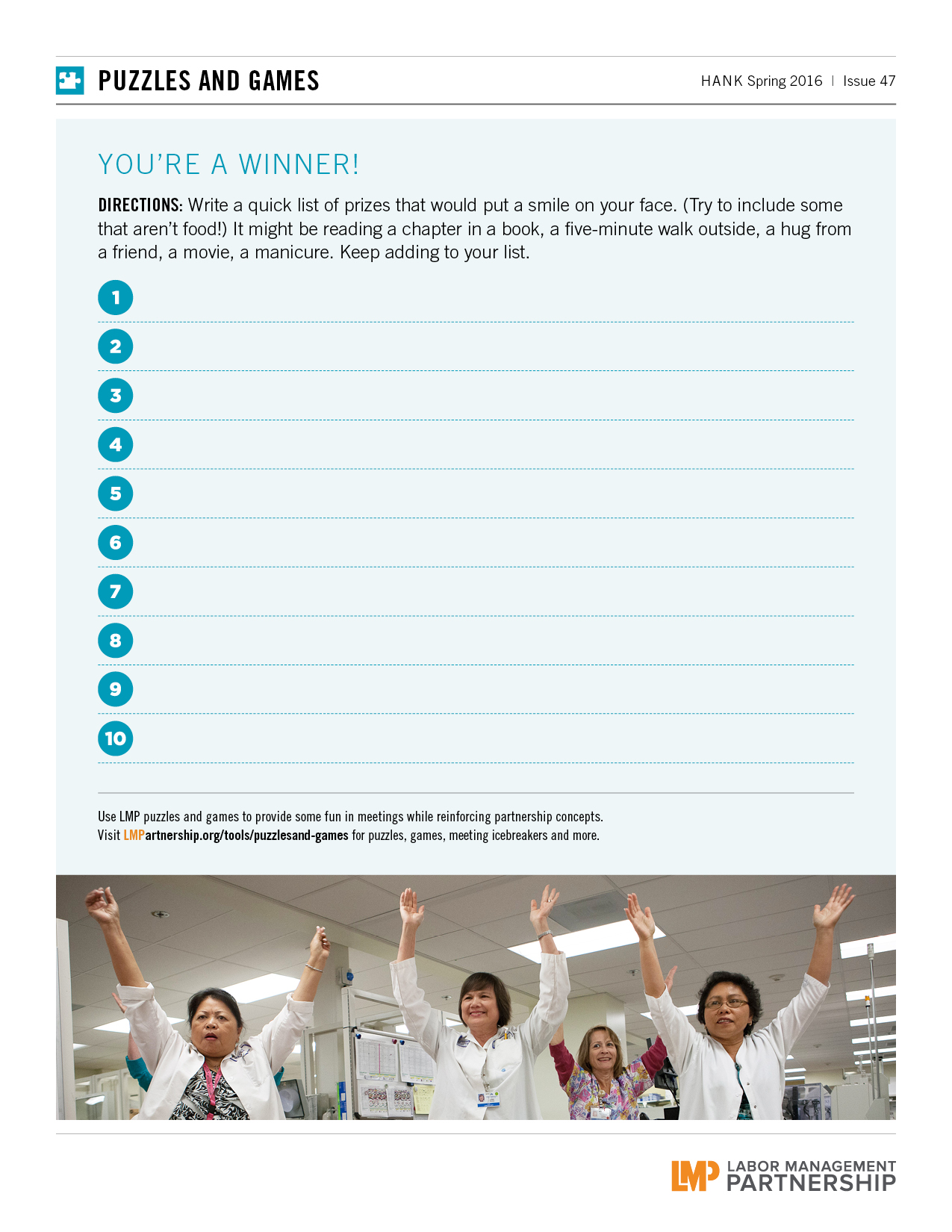
Hank Spring 2016

Format: PDF

Size: 16 pages; print on 8.5" x 11" paper (for full-size, print on 11" x 14" and trim to 9.5" x 11.5")

Intended audience: Frontline workers, managers and physicians

Best used: Download the PDF or visit the Hank page to read all the stories online.


How Managers Manage Stress

Deck: 
Advice for reducing job pressure and burnout—for yourself, and for others

Story body part 1: 

Part of a manager’s job is to look at the big picture—and job stress and burnout are usually part of the picture in health care. Operational leaders from two regions share their thoughts on keeping workplace energy and morale high.

Wendy Watson (Northwest)
Regional vice president, Professional, Clinical and Continuing Care Services 

There’s very little downtime in our work. We want to deliver great service, quality, affordability. The pace is fast, as our industry is changing rapidly. That can be a formula for stress. No one can do this work alone—we all need to support one another.

Build strong teams

High-performing unit-based teams are part of the solution. Solving even one problem at a time can help a team increase job satisfaction and get results, and that reduces stress. If you are leading teams you have to be very purposeful—making time with your team, creating space to talk and making our meeting time productive and solution-focused.

Some of our facilities have Living Room huddles, where people from all departments gather before the start of business, and one department presents a topic. It’s an opportunity to learn and build relationships across the facility. The more connected we are, the more we can support each other.

Make time for yourself

Running is my No. 1 antidote to stress. I try to run regularly—early in the morning before the workday, and longer on weekends. It’s my way to expend physical energy and feel mentally reenergized.

You have to make time for yourself, and that includes exercise. It’s not easy to do. But when you make exercise a priority, you create energy to be able to deal more effectively with stress.

Corwin Harper (Northern California)
Senior vice president, Area Manager, Napa-Solano

It’s hard to generalize about stress because everybody has a different stress meter. We all handle things differently. It’s an issue of work-life balance, and we’re in an industry where we all invest our personal energy, because health care is about caring for others.

People have to be aware of that and think about what they can do to manage their energy and stress levels. We should proactively manage things at work that sap energy and invest in things that raise our energy.

How do you help others?

As a leader, I have to be aware of what I can do to minimize energy-wasters and reduce job stress.

We talk about stress in our workplace safety conversations. I address it as part of leadership rounding. And rounding is not just checking the box. It’s focused on engaging with people about how they’re doing, letting them know you care, encouraging them to spend time with their families and calling out work-related issues that are barriers to performance.

We focus on creating a culture where we understand and respect one another.

Know yourself

I hate sitting all day long. I do core exercises at work in my spare moments. You have to know when to step away and recharge. I try to eat right, exercise, listen to music and pray. I’m still working on getting enough sleep.

Rounding for results

Rounding is a powerful tool for creating a culture where employees are free to speak. Having a short list of open-ended questions to ask each person on a regular basis makes it easier for staff members to raise concerns—and that, in turn, helps reduce stress levels.


Meet Your National Agreement: Champions for Health and Safety

Deck: 
By helping create a better workplace, new advocates also help improve patient care

Story body part 1: 

Rotonya Parker decided her journey to a healthier lifestyle could use some traveling companions.

She was already eating better and being more active when she learned that her unit-based team needed a Health and Safety Champion.

“I thought I should volunteer because doing it as a team would be an extra incentive,” says Parker, an external referral coordinator in Atlanta and a member of UFCW Local 1996. Since stepping up, she’s shared healthy recipes with her team and is planning a contest to see who walks the most.

Her activities help her UBT fulfill part of the 2015 National Agreement: The latest Path to Performance requires that Level 1 UBTs identify a Health and Safety Champion, who will help build the “culture of health and safety” required of Level 5 teams.

UBTs began identifying champions last fall. In January, they all received “Walk & Roll” buttons to help encourage their colleagues. They got going with an emphasis on walking and moving. In February, the theme was speaking up at work about safety concerns. Each month has a new focus.

With 32 years at Kaiser Permanente in Los Angeles under his belt, Darren “Tree” Wallace, a lead attendant in environmental services (EVS), offered to be his UBT’s champion. EVS departments frequently have a higher rate of workplace injuries, Wallace notes, so safety is key. Members of his UBT share daily tips about everything from how to avoid needle sticks to the proper way to push and pull.

“You don’t want to be old, retired and injured,” says Wallace, a member of SEIU-UHW. “You have to make sure your body is safe at work and at home.”

Take a break to thrive

For Johnyia King Turner, RN, a UFCW Local 400 member in the Mid-Atlantic States, volunteering to help her UBT as a champion was an obvious choice. Turner, who recently began working in Gastroenterology at Largo Medical Center in Maryland, frequently held two-minute thrive breaks when she worked at Capitol Hill Medical Center in Washington, D.C.

“We did squats, wall push-ups or ran in place,” Turner says. As lead nurse, she also presented safety messages in UBT meetings and paused during the workday to have quick safety conversations.

She says the messages were well received: “If you are not healthy and you are not safe, it decreases productivity and we can’t assist the members.” 

She’s excited to have a formal title to go with her passion. “I have my Walk & Roll button, and I encourage everyone to walk the stairs,” she says—and adds, laughing, “Now that I’m official, I can really go run my mouth and tell people what they need.”

TOOLS

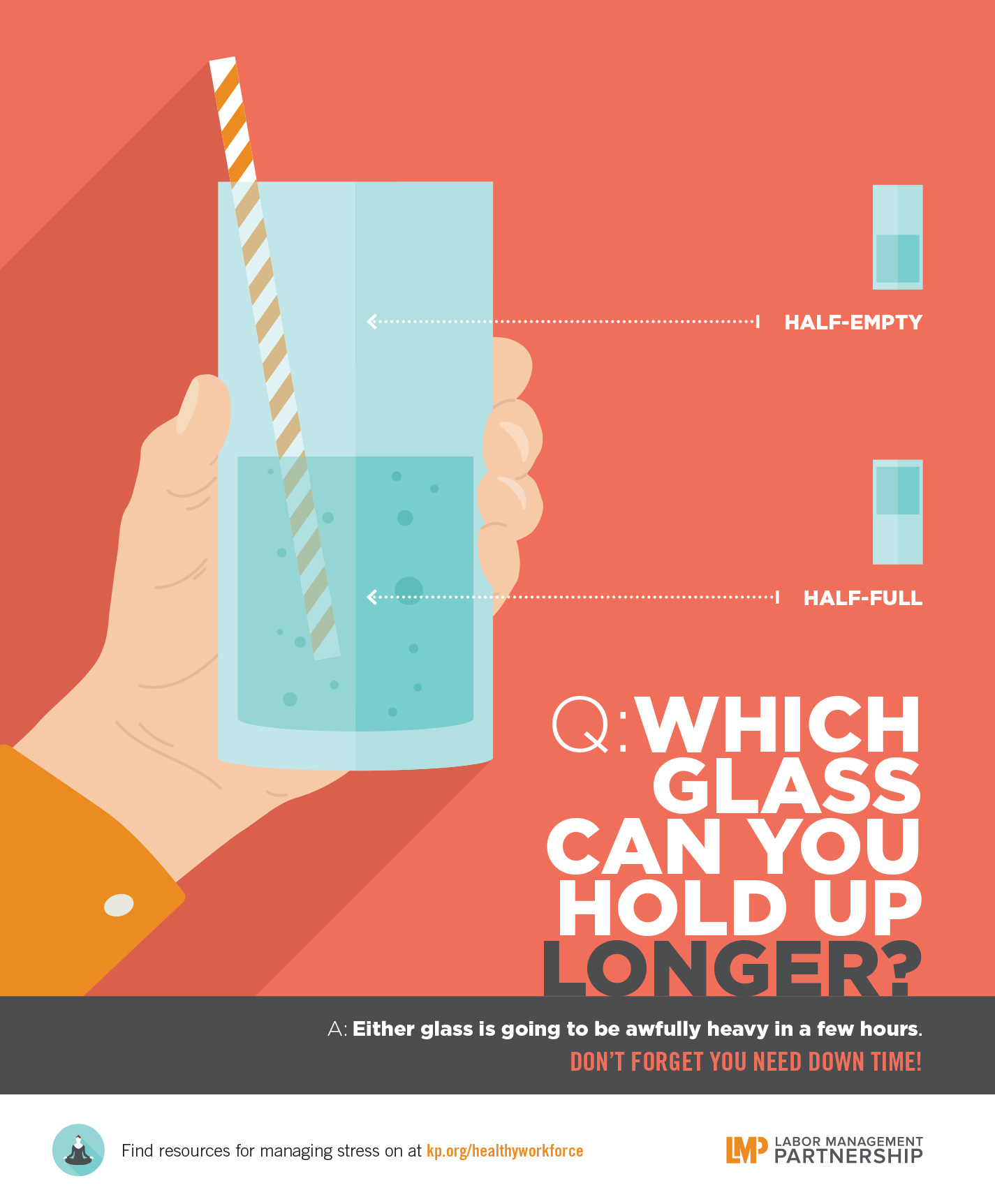
Poster: Half-Empty, Half-Full

Format:
PDF (color and black and white)

Size:
8.5” x 11”

Intended audience:
Frontline employees, managers and physicians

Best used:
Give yourself and your staff a break because attitude can be a matter of perspective. Take some down time, hit pause and reflect.

Related tools:

Pages

Subscribe to RSS - Frontline Managers