Frontline Managers

Help Video

How to Find UBT Basics on the LMP Website

Learn how to use the LMP website:

LMP Website Overview

Learn how to use the LMP website:

How to Find How-To Guides

This short animated video explains how to find and use our powerful how-to guides

Learn how to use the LMP website:

How to Find and Use Team-Tested Practices

Does your team want to improve service? Or clinical quality? If you don't know where to start, check out the team-tested practices on the LMP website. This short video shows you how. 

Learn how to use the LMP website:

How to Use the Search Function on the LMP Website

Having trouble using the search function? Check out this short video to help you search like a pro!

Learn how to use the LMP website:

How to Find the Tools on the LMP Website

Need to find a checklist, template or puzzle? Don't know where to start? Check out this short video to find the tools you need on the LMP website with just a few clicks. 

Learn how to use the LMP website:

I'm in a UBT?

Deck: 
Mid-Atlantic States UBT consultants aim to boost awareness and create a team culture

Story body part 1: 

The Mid-Atlantic States region has approximately 220 unit-based teams with more than 5,200 members. 

One problem, though: Some of those who belong to UBTs don’t know it.

The region’s seven UBT consultants, who made a commitment to work together as a UBT themselves, are trying to change that.

“Employees can’t contribute to the success of the team if they don’t know they are part of the team,” says Tracy Schrader, one of KP’s UBT consultants in the region, who is also an improvement advisor and OPEIU Local 2 member. “They don’t realize they can speak up.” 

From their travels around the Capital Beltway to team meetings and huddles, the consultants—each of whom supports about 35 teams—knew there was a disconnect for some UBT members. So when they established their own team’s 2015 goals, they planned two main tactics: to host several UBT Fairs to raise the profile of UBTs, and to improve communications so all UBT members know they are on a team.

The fairs, which the consultants originally were planning to hold at the region’s largest centers over the summer, would showcase the work of the teams at that facility and highlight such LMP initiatives and priorities as Total Health, Workplace Safety and the Ben Hudnall Memorial Trust, which provides a variety of resources for career-advancing education.

“We wanted to hold fairs that would have a strong impact,” says Jennifer Walker, RN, a lead UBT consultant and improvement advisor.

Surprising news

Then—just as happens with frontline teams—they received some data that surprised them. The 2014 People Pulse results showed that some locations the consultants thought would score poorly on UBT-related questions scored well and vice versa. Armed with that data, the consultants decided to hold the first five fairs at the centers that had the most teams with more than 10 percent of members answering “no” when asked “are you in a UBT?”

“It was a real eye-opener,” says Preena Gujral, another MAS UBT consultant and improvement advisor who’s a member of OPEIU Local 2. “Data is very important. It’s perception versus reality.”

The data also led the consultants to combine their two tactics:  The fairs would be the method for communicating the message that all work group members are indeed part of a UBT.

Walker, one of the region’s lead consultants, says it can be difficult to get the message across, especially with large departments. Unlike small departments where everyone participates in UBT meetings, larger departments typically have a core group of employees who attend UBT meetings as representatives of everyone on staff. Employees who aren’t representatives don’t always realize that they are part of the team, too.  

The energy and attendance of the first UBT Fair that the consultants sponsored, held at the end of June at the Fair Oaks Medical Center in Fairfax, Virginia, was higher than they expected, with more than 150 employees stopping by.

“The participation was fantastic,” says Wendy Williams, RN, a UBT consultant and member of UFCW Local 27.

Irene Taliaferro, a gastroenterology nurse practitioner, attended the fair at Fair Oaks in late August. She hadn’t realized she was a UBT member.

“I came to find out more about UBTs. Before I came to the fair, I knew nothing about them,” says Taliaferro. “We have a representative who goes to meetings. I don’t know much about it.”

Providing incentive—and a model

Steve Pereira, UBT consultant and improvement advisor, hopes the blitz of UBT Fairs gives workers like Taliaferro a better understanding of the partnership and an incentive to be more involved.

“People want to know more than their 9-to-5 jobs,” Pereira says. “This is the opportunity for that.”

Because of their commitment to use the same tools as frontline UBTs, the consultants have been using the Plan, Do, Study, Act cycle of the Rapid Improvement Model in planning and holding the fairs.

So, Walker says, “We structured it so the fairs happen before the annual People Pulse is taken again, in September”—that way, the fairs serve as a test of change. Will the communication provided by the fairs improve the score on the “I’m in a UBT” question?

“We’ll look for the next People Pulse results to validate whether this was the best way to go,” she says.

Watch for an update on the consultants’ efforts next year on LMPartnership.org, after the 2015 People Pulse results are in.

Take action to get the help you need

No need to struggle on your own. There are lots of resources out there to guide teams along the Path to Performance:

  • Find out who your UBT consultants and union partnership representatives are. Go to the “regions” tab on LMPartership.org to find regional or facility LMP co-leads, who will have the most up-to-date information.
  • Get the training you need to build and strengthen your UBT. Visit our training page for links and contact information.
  • Find out if there is a UBT Fair coming up at your facility or one nearby and go to it. Soak up great ideas and inspiration from other UBT members!
Videos

Portraits in Partnership: A manager's point of view

Loading the player...

(2:15)

Environmental Services Manager Leonard Hayes has built a workplace where each of his 150 employees has a voice. Watch this short video to hear his perspective on how the Labor Management Partnership at Kaiser Permanente helps him solve problems and improve safety with his team.


TOOLS

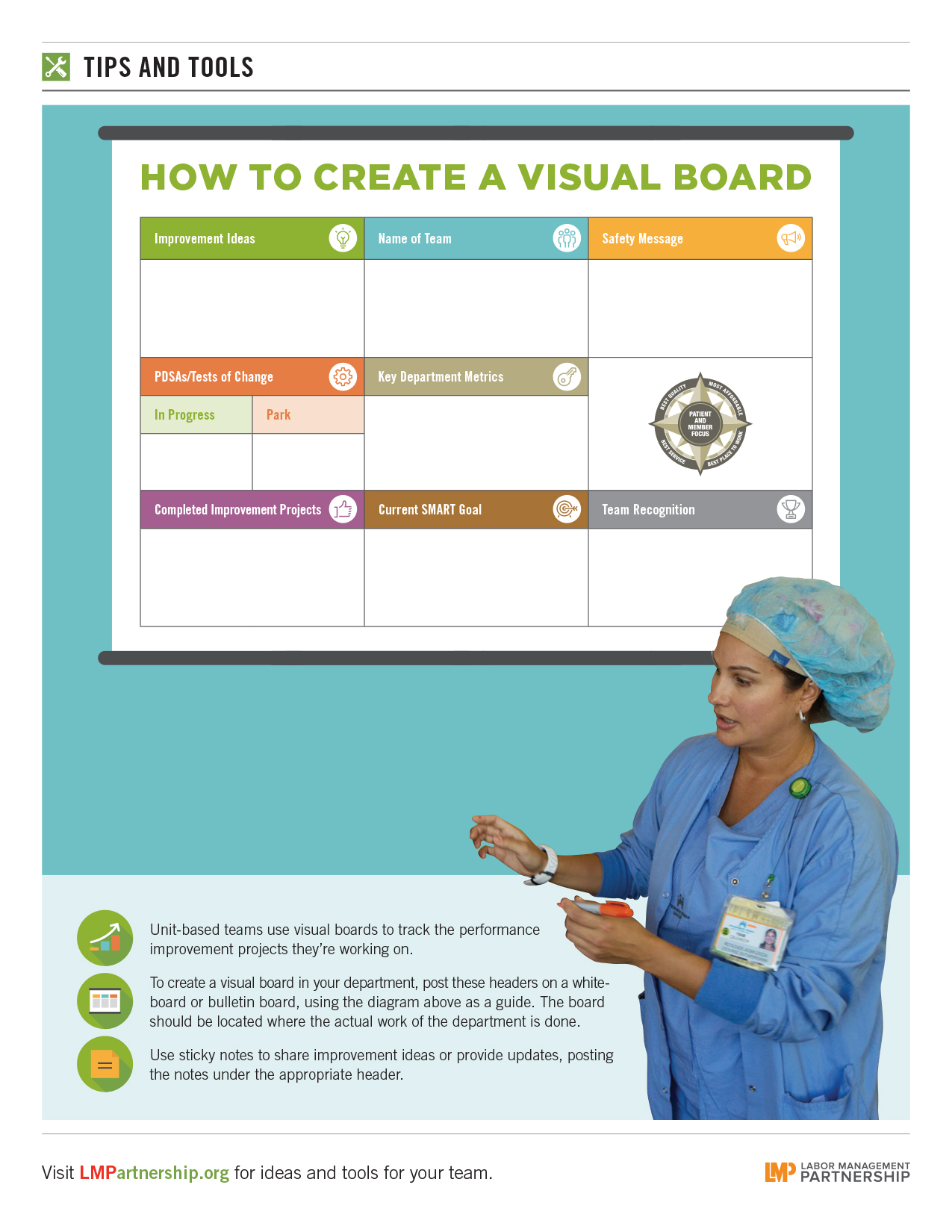
How to Create a Visual Board

Format:
8.5" x 11" PDF, plus headers (in color and black and white)

Intended audience: 
Unit-based team consultants and team co-leads

Best used:
This diagram is your guide to creating a visual board for your UBT's improvement projects, using a white board or bulletin board in a spot where your team can gather easily. Use these headers to organize your information.

You may also be interested in:
A Visual Board Is Worth 10,000 Words

Related tools:

KP, Coalition Reach Accord on Tentative 2015 National Agreement

Deck: 
If ratified by the unions and OK'd by the organization, contract to take effect Oct. 1

Story body part 1: 

Ten weeks of national bargaining between Kaiser Permanente and the Coalition of Kaiser Permanente Unions concluded Saturday, June 6, when 150 union and management representatives approved a tentative 2015 National Agreement. The agreement now goes to the 28 union locals that compose the coalition for ratification and to Kaiser Permanente senior leaders for approval.

The three-year tentative agreement is designed to help unionized workers and managers achieve quality, affordability and safety of care; prepare for jobs of the future; and develop innovative solutions to health care challenges. The agreement also will enable our 3,500 unit-based teams to better deliver award-winning care and service to Kaiser Permanente’s more than 10 million members and patients.

“This is an outstanding agreement that deepens our ability to provide affordable, high-quality care to our members and patients,” says Dennis Dabney, the senior vice president of National Labor Relations and Office of the Labor Management Partnership. “Kaiser Permanente leads the industry because it is a great place to work and a great place to receive care—and the two are inseparable.”

“We’re on year 18 of a remarkably successful strategy,” says Hal Ruddick, executive director of union coalition. “Our contract is better than ever, Kaiser Permanente’s quality and service scores are higher than ever, and the organization and unions are both healthy and growing. Partnership pays off for workers, consumers and mission-driven organizations like Kaiser Permanente.”

Agreement highlights

The agreement includes wage increases in each year of the agreement (see specifics below), provides operational flexibility and bolsters joint problem-solving capabilities. It builds on the successful 2012 National Agreement, strengthening provisions for workplace health and safety, providing additional funds for workforce training and development and ensuring the consistent application of partnership principles.

The new three-year tentative agreement includes:

  • Across-the-board wage increases in each year of the agreement: All employees in Northern and Southern California represented by a coalition union receive 3 percent increases in the first two years and 4 percent in the third year. Employees in the regions outside of California represented by a coalition union will receive a 2 percent increase each year of the three-year agreement. In addition, they will receive a 1 percent increase at the end of the third year.
  • Enhancements to benefits such as dental coverage, life insurance and tuition reimbursement. The tuition reimbursement was increased to $3,000 per employee per year. For the first time, tuition, dental coverage and life insurance are standardized for coalition union members across all regions.
  • A long-term solution that protects retiree medical benefits for current and future retirees, with no net increase to retirees’ out-of-pocket expenses, while reducing liabilities associated with those benefits.
  • Increased funding to the Ben Hudnall Memorial Trust and the SEIU UHW-West and Joint Employer Education Fund to ensure career development for Kaiser Permanente’s diverse workforce.
  • Improved methods for assessing unit-based team performance and for spreading and adopting successful practices.
  • Updates to our groundbreaking Kaiser Permanente Total Health Incentive Plan,  which rewards employees for healthy behavior and provides incentives for collective improvement.
  • Joint participation on community health projects by the coalition unions in KP’s local and regional Community Benefit programs.

Next steps

Our agreement is the largest private-sector contract in the United States this year. Once it is approved by Kaiser Permanente senior leaders and ratified by union members this summer, it will take effect Oct. 1, 2015, and be in effect through Sept. 30, 2018.

The impact of the agreement “goes beyond the words on paper,” says Jerry Vincent, the Northern California region’s director of Labor Relations. “It lays the foundation for us to continue to provide quality, affordable care for many years.”

“There were some tough moments,” Denise Duncan, RN, the executive vice president of UNAC/UHCP, says of the negotiations. “But people came back together. It was a reminder that our national agreement—and our partnership—is very strong, and we keep making it better. There’s nothing like it anywhere else.”

For more information, see www.bargaining2015.org.

TOOLS

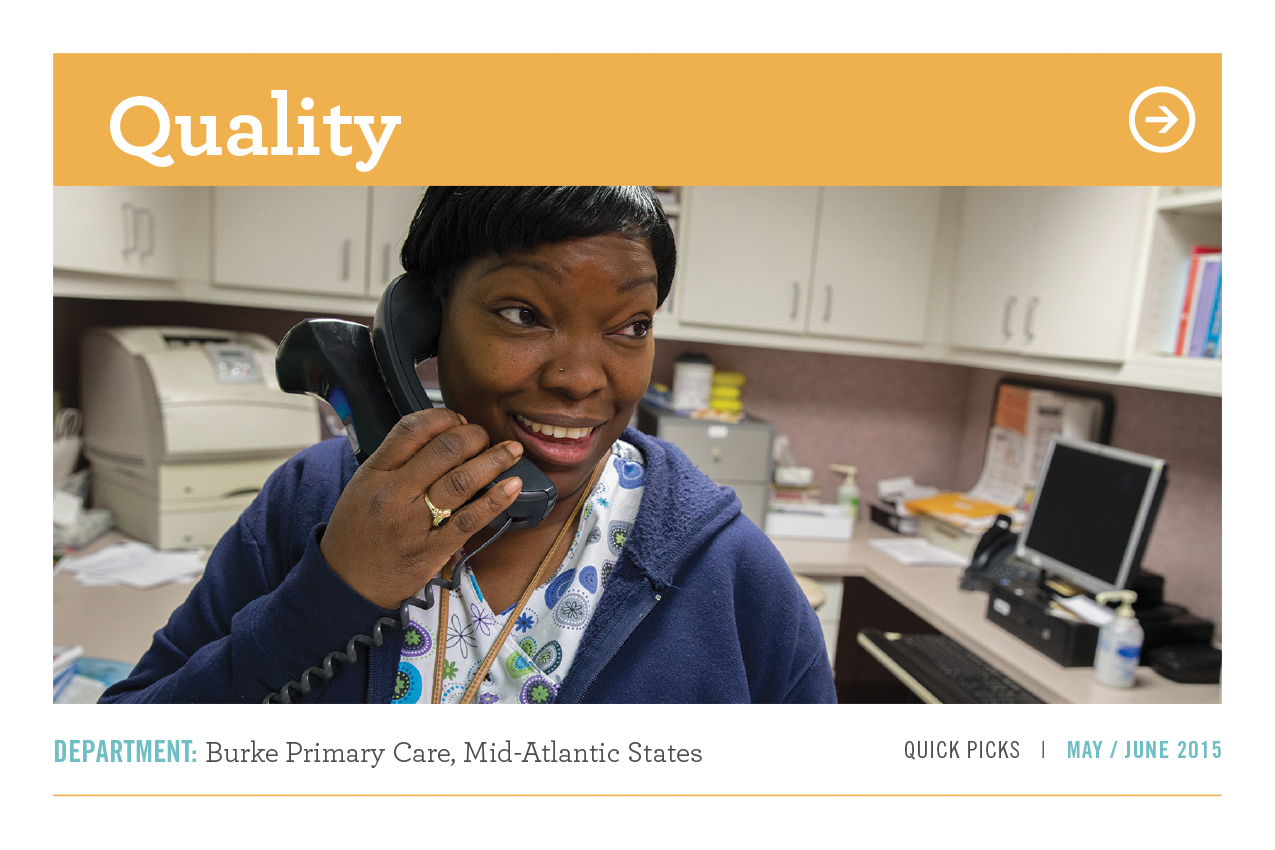
Postcard: Quality: Mid-Atlantic States Primary Care

Format:
PDF

Size:
8.5” x 11”

Intended audience:
Frontline employees, managers and physicians

Best used:
Share this on bulletin boards, in break rooms and other staff areas to gain ideas for increasing the percentage of patients whose blood pressure is under control. 

Read the story and share the PPT on this team's work.

Related tools:

Bargaining Team Takes On Operations, Service

Deck: 
Workers and managers propose ways to strengthen teams for performance improvement

Story body part 1: 

Improving performance and strengthening partnership is the work of the Operational and Service Excellence in Partnership subgroup—one of three subgroups in national bargaining.

At the third session of national bargaining, members of the subgroup made recommendations on topics including improving learning, accountability, problem solving, consistency, flexibility and support for unit-based teams.

The many perspectives represented at the table—with all regions and a wide range of job types in the mix—enriched the group’s discussions.

“We are really making progress. We’re having good discussions that can help people back at work overcome barriers in their day-to-day UBT work and make their lives easier and better,” says Holly Davenport, a union representative for UFCW Local 770 in Southern California. The group is investigating ways to improve the spread of practices from one team to another and to ensure that UBT assessments accurately reflect performance.

One LMP

The subgroup is also looking at ways to improve partnership at all levels of Kaiser Permanente and at the elements—from tools to training—that affect its success.

“Our group is trying to establish the principles of partnership and ensure they’re applied consistently across regions,” says Rita Essaian, an executive administrator with Southern California Permanente Medical Group.

“No matter what region you’re in, the partnership should be the same,” says Ruby Robley, a respiratory therapist at Antioch Medical Center in Northern California and an SEIU-UHW member. “We need One LMP, just like One KP.”

First-timers excel

Many of this year’s negotiators are new to bargaining in partnership, including manager Casper Yu, the director of Dental Sales and Marketing in the Northwest. “I love how this process works,” he says. “We negotiate and still come out with great personal and working relationships. I tell people, ‘This is what it truly means to be in partnership. I get it now.’”

Operational and Service Excellence in Partnership is one of three subgroups tasked with crafting the next National Agreement. The other two are Total Health and Workplace Safety and Work of the Future.

Visit bargaining2015.org for more information, videos and slideshows and to sign up for bargaining updates.

The Three Cs to Success

Deck: 
Consistency, collaboration and communication pay off for Woodland Hills ICU team

Story body part 1: 

Elizabeth Rollice, RN, always knew that the Intensive Care Unit at the Woodland Hills Medical Center in Southern California was a great place to work.

As a staff nurse there, she and her co-workers enjoy good teamwork and excellent communication, and they deliver high-quality care to the sickest patients.

Now they have proof of their success.

This spring, the unit received the Gold Beacon Award for Excellence from the American Association of Critical-Care Nurses, the world’s largest specialty nursing organization. The award recognizes hospital units that demonstrate exceptional care through improved outcomes and greater overall patient satisfaction.

The team will be honored at the National Teaching Institute & Critical Care Exposition in San Diego, May 18-21.

“I knew that we did a good job and that everyone worked well together,” says Rollice, a member of UNAC/UHCP and a representative on the department’s unit-based team. “This award validates the quality of our work and tells us, ‘Yes, we are doing a pretty good job.’ ”

What’s best for the patient

Superb communication and a culture of collaboration among all members of the care team are key to the team’s success, enabling the consistent practice of evidenced-based medicine that has improved the quality of care.

Daily multidisciplinary rounds, for example, involve everyone on the care team who touches the patient.

“It’s about working in partnership with physicians, nurses and other staff to deliver high-quality care based on the newest evidence,” said Lynne Scott, RN, a clinical nurse specialist for the Critical Care and the Definitive Observation Unit. “We’re constantly moving forward.”

Nurses say team rounding gives them an opportunity to speak up and influence care decisions that affect their patients.

“We’re able to talk together about what’s best for the patient,” said Erica Bruce, RN, a UNAC/UHCP member who is the team's union co-lead. “If I feel that something is inappropriate, then I get a chance to ask the doctor. Family members get to ask questions about their concerns, too.”

Multidisciplinary rounding has produced an unintended benefit—higher member satisfaction. “I started in the ICU in 2002. We didn’t have a big rounding team at the time. Families sometimes felt unsupported,” recalls Paramjeet Dhanoa, RN, a staff nurse and UNAC/UHCP member. “Now that we have a big team, our families are more satisfied, because they feel they are not alone in making decisions. They are more comfortable.”

Open communication

Communication is vital in a department where staff members work around the clock in rotating shifts. To ensure information is consistently shared from shift to shift, the team:

  • practices Nurse Knowledge Exchange Plus (NKE Plus)
  • holds monthly UBT meetings, with members of the representative team responsible for sharing information with individual staff members
  • holds quarterly staff meetings; those who miss the meeting must review the staff meeting binder and sign a form indicating they’ve read it
  • uses a bulletin board to post important news and activities

The bulletin board, sandwiched between the nurses’ station and the staff restroom, attracts passersby with colorful fliers and posters.

“Your eyes are drawn to that communication board,” Rollice says. “You pass by a wall full of fliers, notes and postings, you can’t help but stop and look. It’s in a prime location.”

Conducted at the patient’s bedside, NKE Plus provides nurses with a template for patient safety and communication.

“It helps promote open communication and it helps us understand what’s going on with the patient,” says Judy Stone, RN, a staff nurse and UNAC/UHCP member, of the structured, in-depth, face-to-face handoff between the outgoing and the incoming nurse.

Stone says an additional itemized checklist “forces us, as nurses, to have all the pieces of the puzzle ready in the morning for multidisciplinary rounding. It really focuses us on everything that is going on with the patient so that we can deliver the best care that we possibly can.”

Clinical successes

Building the culture of collaboration and openness has had a big payoff:

  • No ICU patient has contracted VAP since the first quarter of 2011.
  • There have been no central line-associated bloodstream infections since the fourth quarter of 2011.
  • The unit achieved the 86th percentile on the HCAHPS (Hospital Consumer Assessment of Healthcare Providers and Systems) patient satisfaction survey from January 2013 through August 2014.

“To consistently deliver the best patient outcomes, you must have the processes and structures in place,” says Kareem Younes, RN, nursing project coordinator for Woodland Hills. “It’s about doing the right thing at the right time, every time.”

Going for the gold

While earning the Beacon Award was hard work, completing the 50-page application was perhaps even tougher for the Woodland Hills ICU team.

Few on the six-member representative UBT had writing experience, and they were at a loss when it came to telling their story in a way that would satisfy the award committee.

That’s when the team turned to in-house consultants Scott and Younes. Even with their expert help, the team faced data collection challenges and grappled with complex questions about the quality of their clinical practice.

At times they failed to meet, making it difficult to complete the application. And at one point, members were forced to make a “course correction” and rewrite the application when the guidelines changed unexpectedly.

“The rewrites were really painful,” recalls Sharon Kent, RN, the department’s administrator and UBT management co-lead. “It was like writing a thesis.”

Despite the challenges, team members said the process was rewarding because it enabled them to see their work in a different light.

“It made us take a closer look at the work we do,” says Rollice. “It motivated us to do better. It made us want to achieve the gold-level standard of care.”


Process Curbs VAP and Central Line Infections

Deck: 
Teamwork helps fight potentially harmful conditions

Like ICUs around the country, the Woodland Hills team struggled to protect patients from contracting ventilator-associated pneumonia (VAP) and central line-associated bloodstream infections.

Both conditions, among the most common hospital-acquired infections, can lengthen hospital stays, complicate recovery and even cause death.

But care improved dramatically after the team took steps that focused on patient safety and quality, and they credited a culture of collaboration as the key component to their success.

“It’s about working in partnership with physicians, nurses and other staff to deliver high-quality care based on the newest evidence,” says Lynne Scott, RN, a clinical nurse specialist for the Critical Care and the Definitive Observation Unit. “We’re constantly moving forward.”

They had their nurses place patients at the optimal angle of 30 degrees to ensure that fluids didn’t collect in their lungs, and also made sure that patients received routine oral care.

For greater oversight, two nurses changed the dressing 24 hours after the line was placed and were responsible for changing it weekly. The charge nurses were also involved, checking the dressing, IV tubing and injection ports twice a day.

And in further support, ICU employees held daily multidisciplinary rounds. This involved everyone on the care team who touched the patient, including physicians, nurses, dietitians, pharmacists, medical social workers and family members.

As of this writing, the results were nearly immediate with no patients contracting VAP or central line-associated bloodstream infections since late 2011.

Their efforts netted the team the 2015 Gold Beacon Award for Excellence from the American Association of Critical-Care Nurses, the world’s largest specialty nursing organization. The award recognizes hospital units that demonstrate exceptional care through improved outcomes and greater overall patient satisfaction.

Read more about what the team did to improve communication and collaboration.

Don't Be Shy

Deck: 
It’s great to get and maintain good results—but spreading a proven practice and multiplying its benefits is even better

Story body part 1: 

After their letters to members went unanswered, the members of the Burke Primary Care team changed their approach.

Instead, clinical assistants called patients with the message, “Your doctor is concerned that your blood pressure is not being controlled,” says Angela N. Williams-Edwards, RN, a member of UFCW Local 400, the team’s lead nurse and former labor co-lead. “It worked better because it was more personal.”

This was in 2011, when the team had challenged itself to get more patients’ blood pressure under control and reduce their risk of a wide range of diseases. They succeeded—and their success mushroomed, with the other centers in Northern Virginia adopting it. All Primary Care teams share the goal of having more patients with blood pressure in a healthy range, and there was no reason for the other teams to start at square one since Burke had demonstrated its way worked—and worked well.

Four years ago, to entice members to come in more frequently to better manage their hypertension, the Burke team also made changes to make the visits for blood pressure checks as appealing as possible:

  • Patients could pop in almost any time for the mini-checks, so they could stop when they were at the medical center for other reasons. There was no copay for the quickie visits.
  • The members don’t have to wait long. “If they wait too long,” Williams-Edwards says, “their blood pressure will go up.”
  • If a member’s blood pressure reading was too high, the doctor came in during that same visit to discuss options—possibly making medication changes—and to urge the member to return for a follow-up within 10 to 14 days.

All of these factors helped the Burke unit-based team increase the percentage of patients whose blood pressure is under control from 75 percent in January of 2011 to 85 percent by August of 2011. Today, the team has not only maintained that improvement but surpassed it. As of November 2014, the team boasts that 90 percent of its patients with hypertension have their blood pressure under control.

“Burke worked so hard to have the results sustained,” says Eileen Chiama, who has been the team’s management co-lead and clinical operations manager for about three years. “We achieved these gains through the huddling process and by keeping focused on it. It became part of our normal workflow.”

Moreover, Chiama says, “The workflow process was shared with other medical centers. The way you spread is to find a champion—someone on the team who is so passionate about the goal.” She says Edwards-Williams is that champion at Burke. “Never underestimate the power of one to generate enthusiasm in the rest of the team.”

Marianne Henson, RN, who was the team’s manager when the project first started, says she met regularly with the area’s other internal medicine clinical operations managers. “We share best practices that way,” she says. Now, several Northern Virginia teams—including Henson’s current teams at Falls Church and Tysons Corner—have improved their rate of blood pressure control, too.

Pages

Subscribe to RSS - Frontline Managers