Affordability

Help Video

How to Find UBT Basics on the LMP Website

Learn how to use the LMP website:

LMP Website Overview

Learn how to use the LMP website:

How to Find How-To Guides

This short animated video explains how to find and use our powerful how-to guides

Learn how to use the LMP website:

How to Find and Use Team-Tested Practices

Does your team want to improve service? Or clinical quality? If you don't know where to start, check out the team-tested practices on the LMP website. This short video shows you how. 

Learn how to use the LMP website:

How to Use the Search Function on the LMP Website

Having trouble using the search function? Check out this short video to help you search like a pro!

Learn how to use the LMP website:

How to Find the Tools on the LMP Website

Need to find a checklist, template or puzzle? Don't know where to start? Check out this short video to find the tools you need on the LMP website with just a few clicks. 

Learn how to use the LMP website:

TOOLS

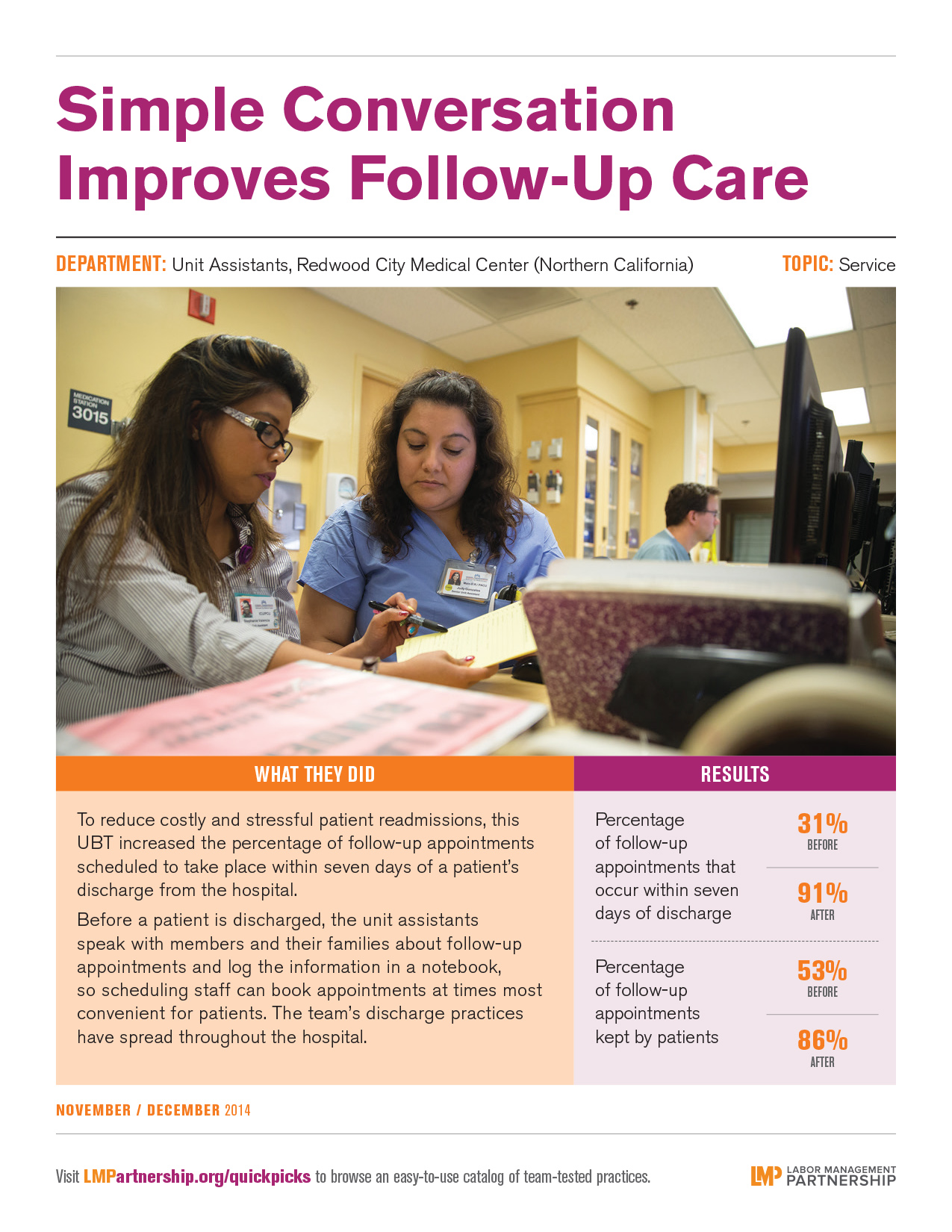
Poster: Simple Conversation Improves Follow-up Care

Format:
PDF

Size:
8.5” x 11”

Intended audience:
Frontline employees, managers and physicians

Best used:
This poster highlights unit assistants who worked to reduce costly and stressful patient readmissions by increasing the percentage of follow-up appointments within seven days of discharge. Post on bulletin boards, in break rooms and other staff areas.


Related tools:

TOOLS

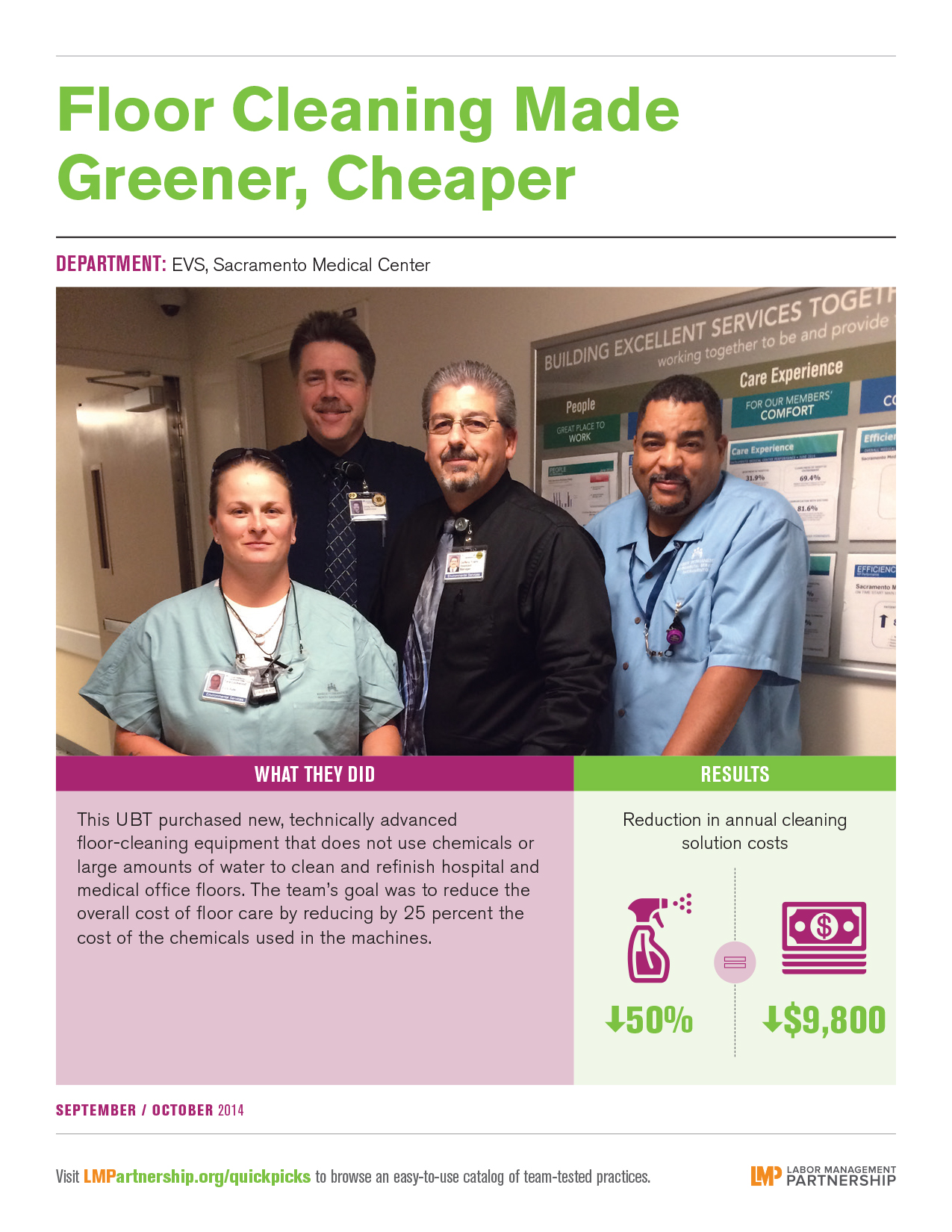
Poster: Floor Cleaning Made Greener, Cheaper

Format:
PDF (color and black and white)

Size:
8.5” x 11”

Intended audience:
Frontline employees, managers and physicians

Best used:
Share this piece on an EVS team that maximized costs, worker safety and environmental concerns with your UBT to inspire discussion of cutting costs while being green.


Related tools:

TOOLS

Poster: Inpatient Pediatrics Team Reduces Linen Costs

Format:
PDF (color and black and white)

Size:
8.5” x 11”

Intended audience:
Frontline employees, managers and physicians

Best used:
Hang this poster highlighting a UBT that reduced linen costs while maintaining a proper supply on bulletin boards, in break rooms and other staff areas. Share with teams to spark ideas about how they can save.


Related tools:

Work With Patients to Ensure Follow-Up Appointments

Deck: 
Unit assistants help avoid costly readmissions

Story body part 1: 

Timely follow-up appointments can help prevent costly and stressful hospital readmissions.

But making these appointments can prove difficult during hectic hospital discharges, or after a patient has returned home.

Even when appointments are made, they aren’t always kept.

The Unit Assistants UBT at Redwood City Medical Center took on the challenge of increasing the number of follow-up appointments scheduled to occur within seven days after discharge.

Team members knew they could increase the likelihood of patients keeping these appointments by working with them and their family support members before they left the hospital.

“Obviously we can’t force a patient to go to an appointment, but we can try to make appointments when it’s suitable for them,” says union co-lead and senior unit assistant Judith Gonzales.

Starting with one hospital floor, unit assistants spoke with patients before they were discharged, taking notes on which days and times they preferred for appointments, and then passed the written information on to the staff members responsible for scheduling.

In eight weeks, the percentage of patients who kept their follow-up appointments jumped from 50 to 60 percent and soon the whole hospital was on board.

“We piloted in July 2013, and two months later we rolled it out to all the floors,” says management co-lead Amelia Chavez, director of operations, Patient Care Services. “Our percentages climbed and climbed. It was phenomenal.”

By January 2014, 86 percent of follow-up appointments at Redwood City were taking place in the seven-days, post-discharge window.

“The patients loved it; we included them in the process,” Gonzales says. “This improved our patient satisfaction scores as well.”

Summits Supercharge Performance Improvement Efforts

Deck: 
In addition to the training they provide, the events build energy and communicate priorities

Story body part 1: 

Want to supercharge efforts to improve performance and help reach Kaiser Permanente’s strategic goals? Then bring unit-based team leaders together for a summit.

UBT consultants at several facilities in Southern California have organized summits that focused on Performance Sharing Program (PSP) goals, performance improvement strategies and affordability projects. All say they are seeing results in the forms of more robust UBT projects, clearer SMART goals, and stronger alignment between top medical center leadership and the work of UBTs.

After seeing teams improve service scores, reduce workplace injuries and save more than $160,000 in just four months in the San Diego service area, Sue Smith, a senior UBT consultant, concludes, “The overall experience was wonderful. Many teams had an exciting opportunity to network with other teams and learn new skills in a fun way.”

This spring, San Diego Medical Center hosted a UBT affordability summit, which brought together co-leads for a half-day to build the skills to tackle a new PSP goal for 2014 in the region: to increase the percentage of UBTs that successfully complete a project with hard dollar savings or improved revenue capture. (The projects are reviewed by finance departments to ensure they could lead to cost savings.)

Seated around large tables, UBT co-leads played a spirited game of “KP-opoly,” which offered a crash course in the organization’s finances. They heard from a UBT whose work resulted in cost savings. And they had time to work on driver diagrams and process maps for their own team’s affordability projects.

Co-leads gain PI skills

The year before, San Diego leaders—inspired by an event at the Riverside Medical Center—had held a more general, daylong UBT summit. That event brought UBT co-leads together for intensive training on performance improvement tools and created a space for them to refine their existing projects. Deadlines were set for finalizing driver diagrams and process maps, beginning tests of change and formulating sustainability plans.

The effort culminated in a UBT fair that showcased the projects that had begun as mere inklings at the summit: The ultrasound UBT demonstrated how it had gone injury-free for six months (it had been having at least one injury per month); the diagnostic imaging department boosted patient satisfaction scores from 87 percent in May 2013 to 93 percent in December.  

Leaders at the Woodland Hills Medical Center followed the same playbook, hosting an LMP summit in April that launched an array of of affordability projects to be showcased at a UBT fair scheduled for mid-July.

Mobilizing on PSP

At Fontana and Ontario medical centers, UBT staff used the summit model to mobilize the workforce around all of the region’s PSP goals. Top leaders from both management and the unions kicked off the day, then gave subject matter experts each 10 minutes to discuss the goal (whether it be service, workplace safety, attendance, etc.) and challenge co-leads to take on a performance improvement project to tackle it. A highlight was an impassioned and dramatic account from Roy Wiles, president of Steelworkers Local 7600, about a union member who did such a good job of saving up unused sick time that he recently retired with a five-figure nest egg in his Health Reimbursement Account.

The key to attracting co-leads to the summits, the consultants say, is to plan well in advance and to enlist top leadership to encourage participation. That lets managers and employees make plans for attending while ensuring their departments’ operational needs are met.

“This is part of their work,” says Priscilla Kania, senior UBT consultant at Ontario. “Your leaders are inviting you. People are excited to be in the room with top leaders.”

Has your facility or region held a summit? Let us know all about it!


TOOLS

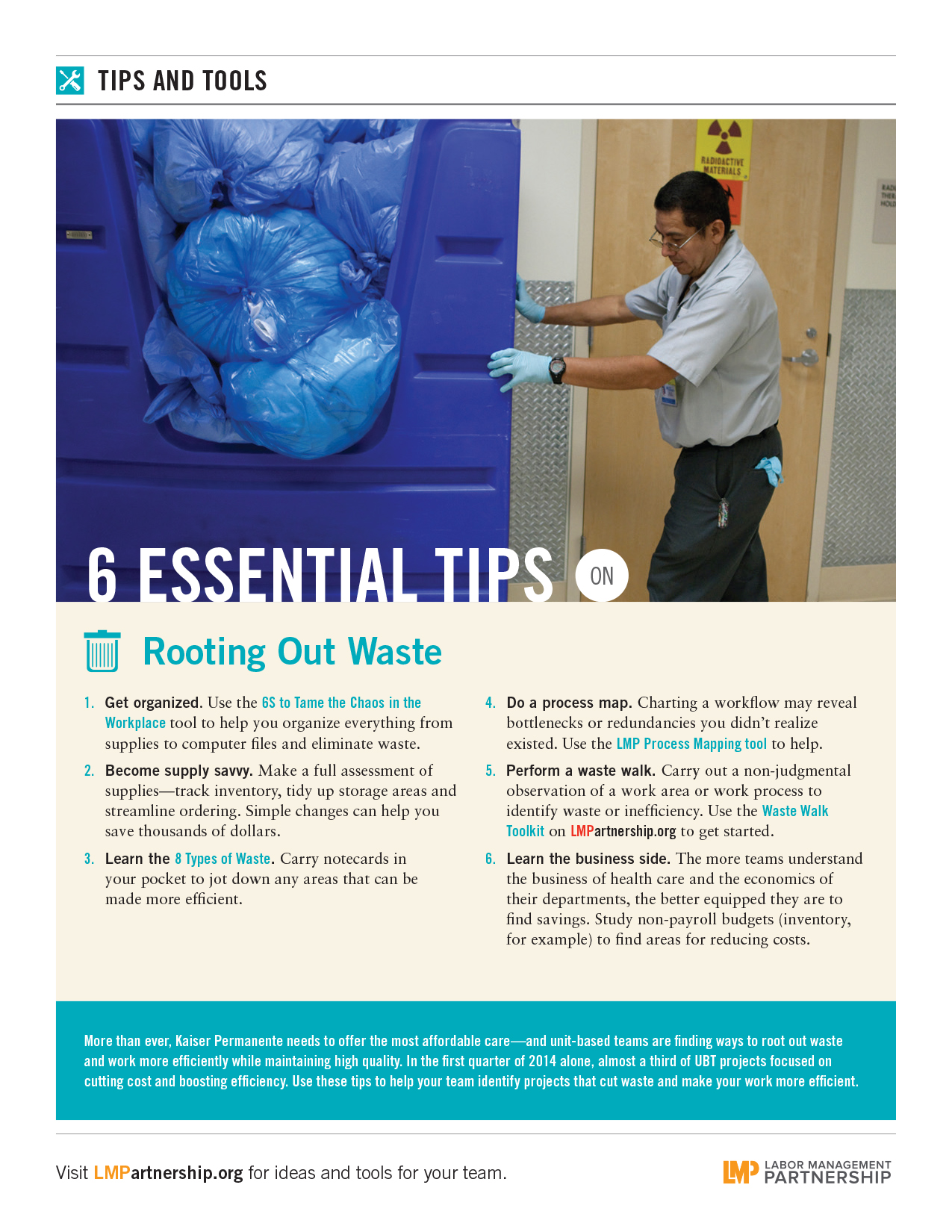
6 Essential Tips on Rooting Out Waste

Format:
PDF

Size:
8.5" x 11"

Intended audience:
Unit-based team members, co-leads, sponsors and consultants

Best used: 
This quick guide, which includes descriptions of tools available on LMPartnership.org, will help teams plan and carry out projects to reduce waste and improve efficiency of work processes.

You may also be interested in:

Related tools:

Simple Tool Helps Teams Track Savings

Deck: 
Using this spreadsheet enabled a pharmacy team to see it saved three times more than expected

Story body part 1: 

As more and more unit-based teams answer the call to improve affordability for health plan members, they are finding new tools that can help manage their cost-improvement projects.

One such tool, a handy spreadsheet, can help teams track and report their cost savings.

Teams track own savings

Developed by UBT consultants and financial analysts in Colorado and later adopted by UBTs in the Northwest, the tool can help teams determine the economic benefits of a performance improvement project with little or no assistance from a consultant or sponsor.

“It’s a great add-on to teams’ reporting in UBT Tracker,” says Luanne Petricich, chief pharmacist, Pharmacy Professional Affairs, in Colorado and a sponsor of 12 UBTs in the region. “It can be a very impactful way for co-leads to show their teams and others what their savings were and how they achieved them.”

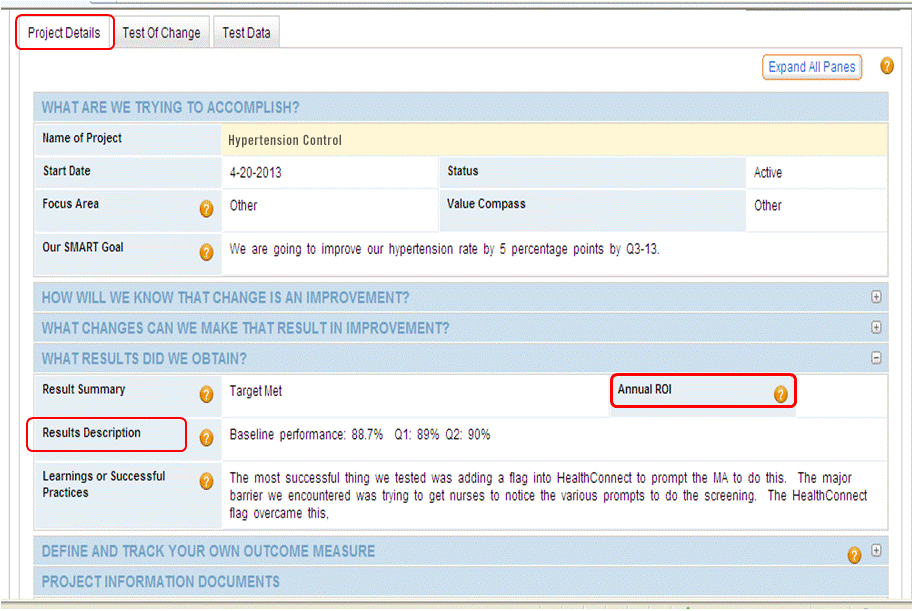
In addition, teams can now record their financial results directly into UBT Tracker thanks to a new data field, Annual ROI, that allows teams to share how much money a project saved or generated. The field can be found under the Project Details tab (see graphic below).

Tool use spreads

Petricich sends the spreadsheet to any of her teams working on a cost-reduction or efficiency project to help them document their results.

One team that used the tool was the pharmacy UBT at Baseline Medical Offices in Boulder. The team had completed an inventory-reduction project that far surpassed its goal—which was to reduce its drug inventory by 10 percent, or $50,000, in three months. By adjusting order quantities to better match usage and returning overstocked medication to the mail order pharmacy for use before the expiration date, the team saved $143,000—nearly three times its original goal.

“It’s important to track your results, and this tool can help teams do that in a simple way,” says Don Larson, Baseline’s pharmacy supervisor. “It’s something we would use the next time we do a similar project.”

TOOLS

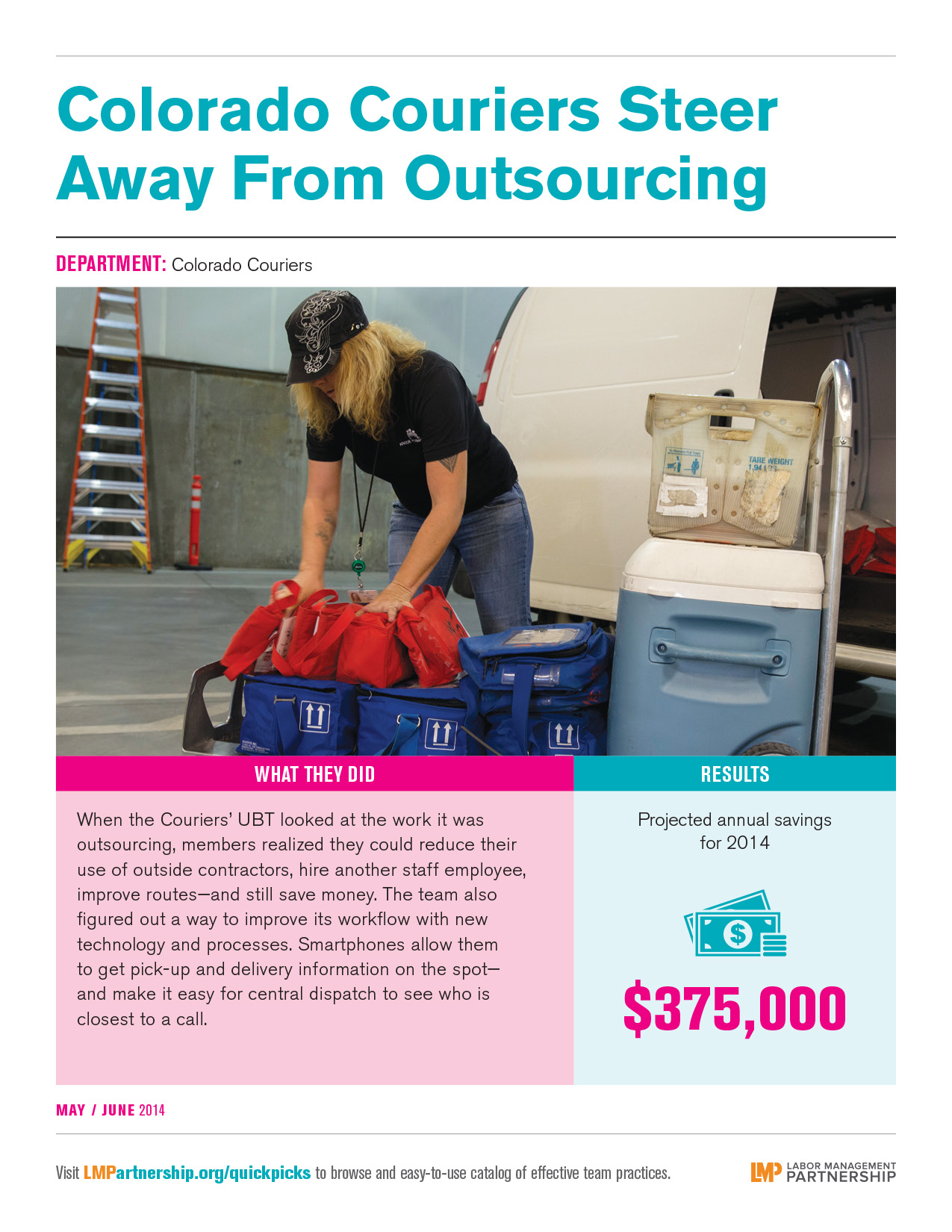
Poster: Colorado Couriers Steer Away from Outsourcing

Format:
PDF

Size:
8.5” x 11”

Intended audience:
Frontline employees, managers and physicians

Best used:
Show your staff these money-saving tips to improve workflows, upgrade technology and increase revenue. 

Related tools:

TOOLS

Handy Spreadsheet to Gauge UBT Savings

Format:
XLS (spreadsheet)

Size:
1 page

Intended audience:
UBT co-leads or team members

Best used:
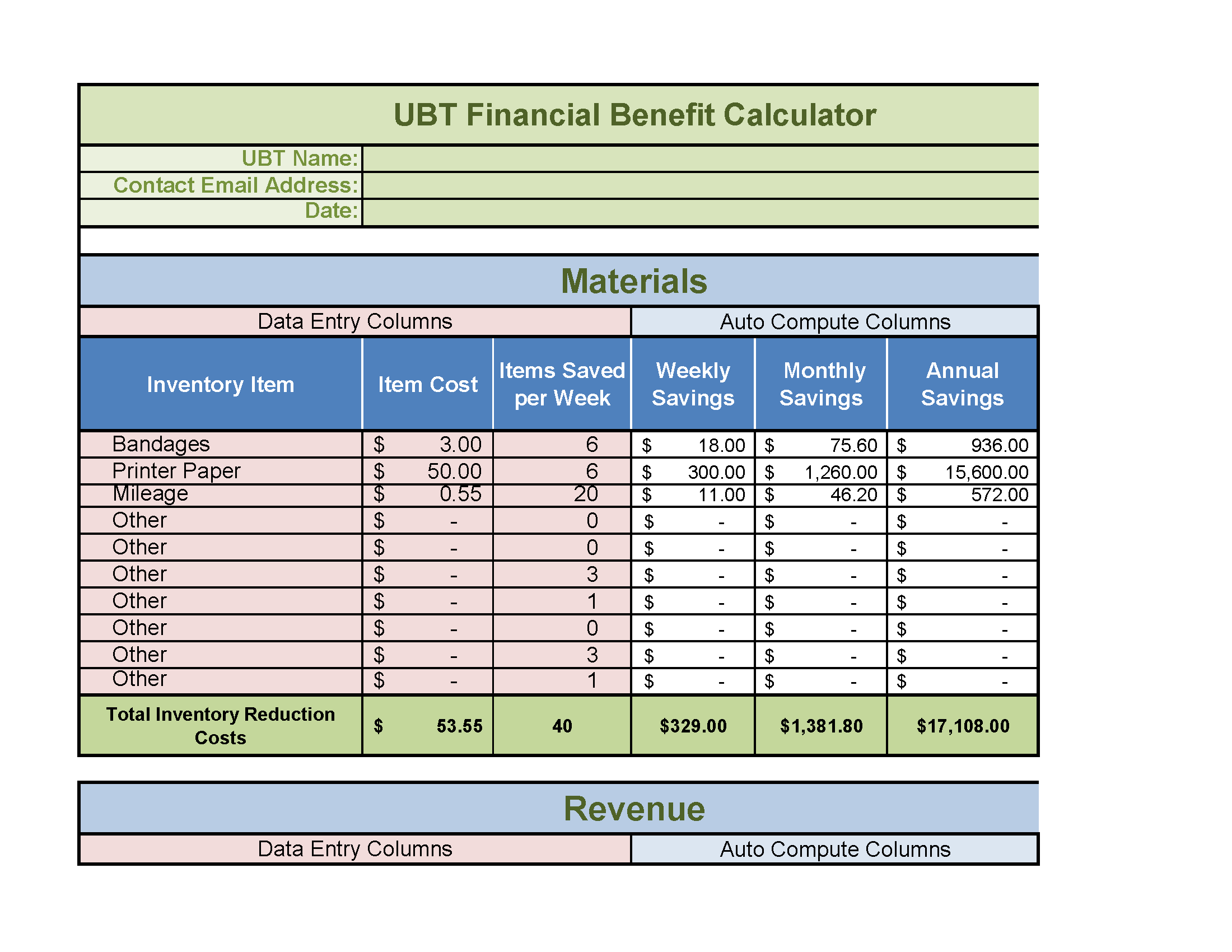
Use this spreadsheet to track and determine the economic benefits of your team's performance improvement projects—you can easily see the impact of your efforts on the bottom line.

Note: Entries are placeholders; delete them and add your own information.


Related tools:

TOOLS

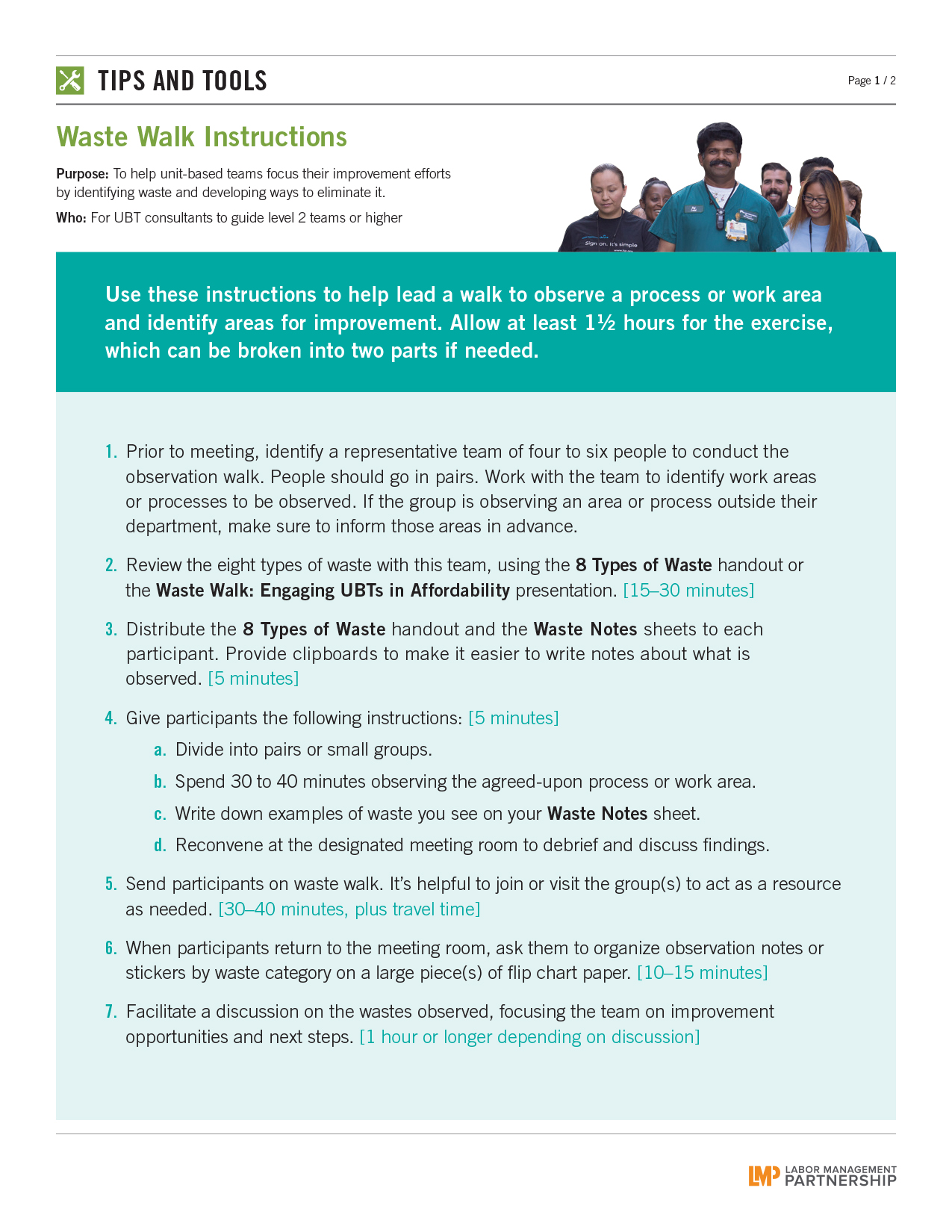
Waste Walk: Instructions

Format:
PDF

Size:
8.5” x 11”

Intended audience:
Level 2 and higher unit-based teams

Best used:
UBT consultants and UPRs can use these instructions to guide teams on finding projects that solve for affordability. Allow 1½ to 2 hours for the full exercise.

Use with:


Related tools:

Pages

Subscribe to RSS - Affordability