Affordability

Help Video

How to Find UBT Basics on the LMP Website

Learn how to use the LMP website:

LMP Website Overview

Learn how to use the LMP website:

How to Find How-To Guides

This short animated video explains how to find and use our powerful how-to guides

Learn how to use the LMP website:

How to Find and Use Team-Tested Practices

Does your team want to improve service? Or clinical quality? If you don't know where to start, check out the team-tested practices on the LMP website. This short video shows you how. 

Learn how to use the LMP website:

How to Use the Search Function on the LMP Website

Having trouble using the search function? Check out this short video to help you search like a pro!

Learn how to use the LMP website:

How to Find the Tools on the LMP Website

Need to find a checklist, template or puzzle? Don't know where to start? Check out this short video to find the tools you need on the LMP website with just a few clicks. 

Learn how to use the LMP website:

Training Workers to Go Green

  • Negotiating education funding as part of the national agreements between Kaiser Permanente and the Coalition of Kaiser Permanente Unions
  • Carving out time for workers to attend classes in how to reduce waste and use non-toxic cleaning products
  • Mobilizing environmental services workers to educate other KP employees and managers about green practices in a variety of departments

What can your team do to build career resiliency and adapt to change in the workplace? What else could your team do engage everyone in lifelong learning?

Got Backlogs? Expand the Night Shift!

  • Acknowledging and addressing resistance to change as the team experimented with changes
  • Setting a clear goal of wanting to reduce excessive overtime 
  • Deploying more workers to the night shift

What can your team do to improve workflow and enhance the experience of our members and patients? What else could your team do to make KP the best place to work and receive care?


What to Do When Packages Pile Up

  • Conducting a motion analysis of sorting and delivering packages
  • Purchasing more carts and hand trucks
  • Enforcing an existing agreement with suppliers to split deliveries among departments

What can your team do to engage co-workers in a conversation about safety? What else could your team do to identify the next potential injury for employees and patients?  

Affordability

The increasing cost of health care prevents millions of Americans from getting the care they need. But providing affordable, high-quality care is key to Kaiser Permanente’s social mission. Unit-based teams across KP have made waste reduction and efficiency part of their everyday work — and are saving millions of dollars a year. See how.

Teamwork Eases Pain of Change

Deck: 
Faced with a major change in protocol, this med-surg UBT united to help its patients—and its own staff

Story body part 1: 

The new goal was dramatic: Reduce hospital stays to 23 hours for total joint patients.

Renee Portillo, RN, was worried.

“It was a shocker. Our staff was used to patients going home in two to three days,” says Portillo, former assistant clinical director and management co-lead of the 7 South medical-surgical team at Fontana Medical Center in Southern California.

The accelerated time frame meant that the unit’s nurses, who care for total joint patients following surgery, would have less time to prepare them for discharge. They’d also need to help choreograph care across multiple departments—Orthopedics, the operating room, Physical Therapy, Home Health—from pre-admission to discharge.

Who best to help the team through this change? The team itself.  

“We used our UBT to help change the culture,” Portillo says.

Wave of the future

“We helped our nurses be successful by having them anticipate patients’ needs and prepare them for discharge,” says Enrique Rivero, RN, a surgical nurse and UNAC/UHCP member who is the team’s union co-lead.  

Fontana is among a growing number of hospitals across the United States to offer a combination of shorter hospital stays and more outpatient care for hip and knee replacement patients. The trend is driven by less-invasive surgical techniques, improved pain management and rehabilitation practices, and patients’ desire to return home as soon as possible.

“There were a lot of challenges. A lot of it had to do with bringing people together,” says Mary Hurley, MD, chief of Orthopedics, who championed the new approach. “They all had to buy in and be willing to support this in order to have a successful program.”   

The new approach, which Fontana introduced in January 2014 after months of researching best practices, gets patients walking within hours of surgery and enables them to recover within the comfort of their own homes. The initiative takes advantage of Kaiser Permanente’s integrated model of care and is designed to improve clinical outcomes and reduce costly hospital stays.

Check-In Sheet Improves Copay Collection—and More

Story body part 1: 

Like casts and splints, X-rays are a routine part of patient care in the Orthopedics department at South Bay Medical Center. Unfortunately, missed copays for those X-rays were becoming common as well.

“Patients will get their X-rays done at the end of the visit—and then walk out without realizing that they owe a copay,” says Christopher Kresch, department administrator for Orthopedics and the team’s management co-sponsor. At other times, patients will unexpectedly need X-rays during their visit, and because the orders are placed during the exam, the charges are not captured during check-in.

So the team borrowed a practice from the Los Angeles Medical Center and developed a check-in sheet that shows, at a glance, if a patient has an outstanding X-ray copay. The team also adjusted its workflow to ensure that a staff member walks the patient to the front desk to pay the fee by the end of the visit.

Here’s how the process works:

The receptionist gives the check-in sheet to each patient at the start of the visit. As patients travel through the clinic to receive care, the form goes with them, enabling staff to conduct “warm hand-offs” by writing notes to each other about the patient’s care. When a copay is owed, the last person to interact with the patient escorts him or her to the receptionist.

“It helped us in a lot of different ways, much more than we thought it would,” says Naomi Guerrero, an Orthopedic technician and SEIU-UHW member who is the team’s union co-lead. “Now we can’t live without it.”

Side benefits

After introducing the check-in sheet, the team saw almost immediate improvement in copay collection. In July 2014, missing copays—known as the total collected variance—totaled $2,166. Between August and November 2014, the total collected variance fell to just $533, a whopping 75 percent improvement. Those numbers are holding steady. The department is averaging a 50 percent increase in copay collections through third quarter 2015.

Besides boosting copay collection, the check-in sheet helped the team improve patient care. Unexpected benefits include:

  • Keeping patients informed of delays and expected wait times improved patient satisfaction scores. Positive patient responses about staff communication on the Ambulatory Satisfaction Questionnaire (ASQ) rose from 48.67 between August and December 2013 to 57.74 for the same time frame in 2014. The regional target is 54.5.
  • Direct booking—when a staff member makes the first appointment for a patient referred to a specialty department—soared from 38 percent of all referrals in July 2014 to 68 percent by November 2014, exceeding the regional goal of 40 percent.
  • An increased percentage of patients who receive bone density screenings. In 2013, 89.7 percent of eligible patients received the screening; that rose to 91.9 percent in 2014. The regional target is 85 percent.

Finding the right solution

Before adopting the check-in sheet, the team sought input from a group of staff members and physicians in the department. Incorporating their voices gave them ownership of the project and enabled the team to create a check-in sheet that worked for everyone. For example, physicians rejected an early draft featuring a detailed checklist in favor of blank space to write their orders. And receptionists vetoed an early color-coding system as “too confusing.”

“We learned a lot as we went through our tests of change,” says Guerrero. “We learned there are changes that don’t work out.”

Adoption takes time

Once team members were happy with the check-in sheet, they spread it to the rest of the department. Convincing their peers to consistently use the check-in sheet took time.

“The medical assistants were resistant because they saw the check-in sheet as an extra step,” says UBT representative Zackry Ellis, a physician assistant and member of UNAC/UHCP.

Some providers also were hesitant to use the form, preferring to speak with staff. That’s when the team turned to Anthony Leone, MD, the department’s physician chief, for help.

“He helped us sway others to try it out,” Guerrero says.

Once staff members understood the benefits of the check-in sheet—enhanced copay collection, improved workflow and better patient care—they all began to use it consistently.

Patients are reaping the benefits of the new form, too.

“Because of the check-in sheet, we’re communicating more with our members,” says UBT representative Esmeralda Montes, a lead medical assistant and SEIU-UHW member. “They feel happy and cared for, and that’s our ultimate goal.”

Lead From Where You Stand

Deck: 
Helping teams make sense of their data

Story body part 1: 

When it comes to metrics, even the best teams can get muddled.

At such times, a good team realizes it needs help—that it’s time to ask for assistance from someone with specialized skills. In the Northwest region, teams can turn to Ed Vrooman.

His enviable strength? An ability to crunch numbers, connect the dots and break down the complexity of the data so that unit-based teams get the information they need to do their work.

“It’s easy for teams to fall into analysis paralysis, where they dissect every data point. I work with them to know the why and the what,” says Vrooman, who started as a part-time phlebotomist 18 years ago at Portland’s now-long-gone Bess Kaiser Hospital. Today, he does double duty as a union partnership representative (UPR) for the Coalition of Kaiser Permanente Unions—he’s a member of SEIU Local 49—and as an improvement advisor.

A broad perspective

His atypical career path has given him an unusual outlook. In 2003, Vrooman took an extended leave of absence to work for Local 49, helping organize KP employees and other health care workers. After returning to KP, he became a labor partner and brought the coalition’s interests to the building of the new Westside hospital and other major regional projects.

“Partnership has allowed me to touch nearly every function within this organization,” Vrooman says. Working on the large initiatives got him more intrigued with the data side of the house—and led to his current position, which gives him an opportunity to use his skill with data and analytics. 

When he heard from the region’s UBT consultants that teams didn’t have the data they needed to work on projects, Vrooman became—along with the data analytics department and health plan leaders—a driving force in the creation of the region’s scorecards for teams. The STATIT scorecards (named after the electronic system that hosts them) enable teams to see their goals online and how they line up with the regional and PSP goals.

Co-leads’ gathering

Every year, Vrooman, along with the other two UPRs in the region—Bruce Corkum, RN, an OFNHP/ONA member, and Mariah Rouse of UFCW Local 555—present information on regional goals and budgets in one of the quarterly Steward Councils, which bring together the region’s UBT union co-leads and representatives from its four partnership unions. For the meeting on regional goals, the management co-leads are invited as well, providing a chance for team leaders to learn together how their teams can have an impact.

When he’s working directly with a team, Vrooman mentors and coaches its members on using improvement tools, from understanding the fundamentals such as SMART goals and entering projects into UBT Tracker to more advanced tools like process mapping. He asks his team members what they need to be successful.

“You don’t need a title to be a leader,” Vrooman tells them. “You lead from where you stand.”

Reusable Bins Can Save You Money

Deck: 
Team ditches wasteful cardboard boxes for plastic

The bustling front office of Northern California’s regional Claims Administration department moves a lot of paper.

Based in Oakland, they’re responsible for sorting and scanning paper claims into digital format, storing the paper forms in boxes for the required 30 days, and then destroying them.

The team members call themselves “The Frontliners.”

But the cardboard storage boxes that hold all of that paper could only be used once. The department’s unit-based team wanted to make the job less wasteful.

So, a couple of team members suggested switching to reusable plastic bins and the idea immediately energized the UBT.

They jumped in with a plan to research and test different models of plastic storage containers. They chose an industrial-strength model sold by a KP-approved vendor, which brought the price down. The plastic bins, which have lids that securely snap shut, also eliminated the cost of packing tape and labels that had been used on the cardboard boxes.

The department rolled out the bins in September 2013 and in a year they figured a savings of $1,100.

Given the distributor was a KP vendor, the team was able to cut their purchase price by 30 cents. And since the team won’t need to replace the bins every year, their savings were expected to reach $3,500, which includes hiring an outside firm to come onsite to destroy old paper claims instead of transporting them elsewhere.

Management and union representatives agree the team effort made it a success. 

“My motto is, teamwork is dream work,” says union rep and support lead Arnetta Williams. “We’re a really close team. It’s a partnership. Without this, you can’t accomplish anything.”

The new approach required thinking through changes in staff schedules and workflow, as well as ensuring that the changed procedures complied with all relevant regulations.

And the Frontliners’ UBT initiative was selected as a finalist in Kaiser Permanente’s 2014 MSSA (Marketing, Sales, Service and Administration) Innovates Program, a competition to encourage new ideas and efficiency.

Judy Cummings, a statewide manager with Claims Operations and Encounters, likened her role to that of a coach instead of a boss.

“The team is doing the work. They’re the ones out there who know what to do and how to do it,” she says. “I try to support them in being successful.”

TOOLS

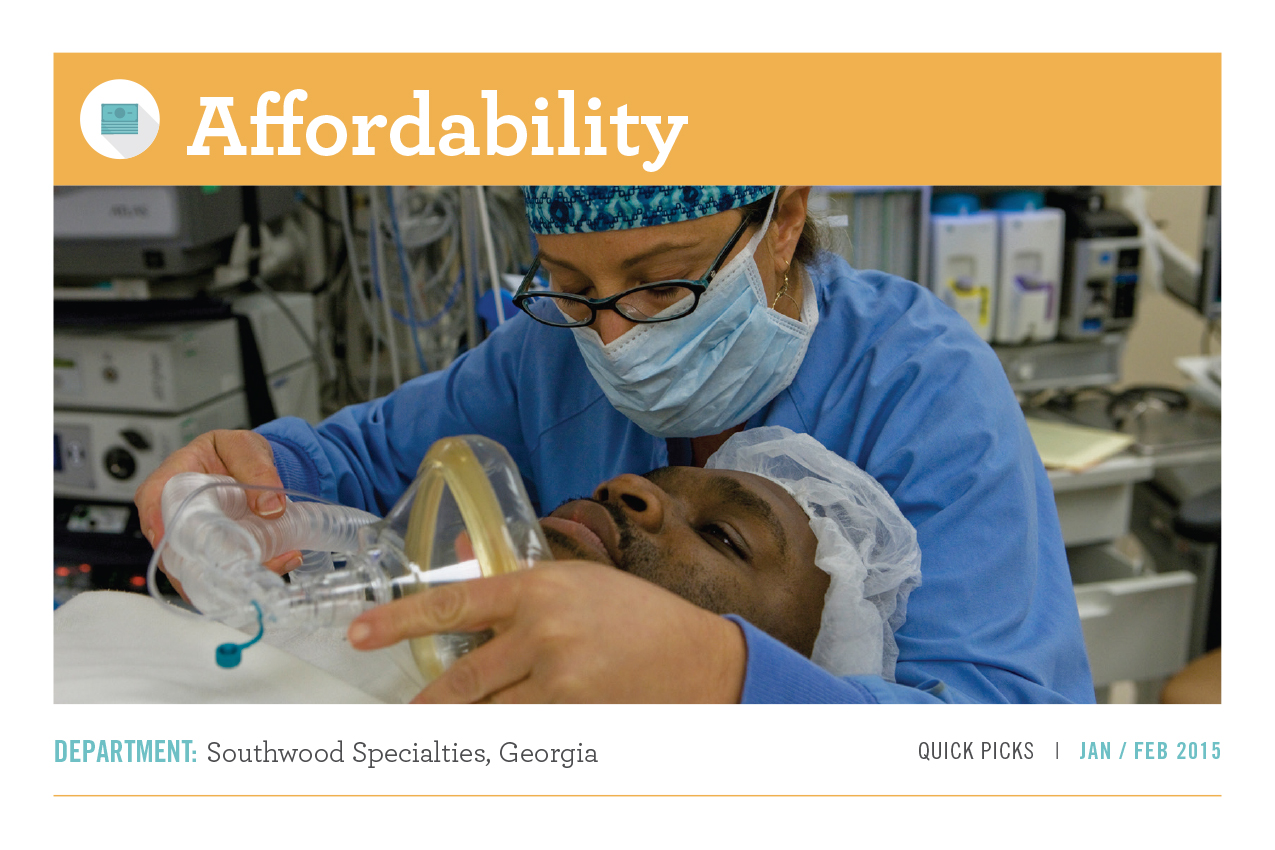
Postcard: Affordability: Georgia GI Team

Format:
PDF

Size:
8.5” x 11”

Intended audience:
Frontline employees, managers and physicians

Best used:
This postcard features a GI team and how it cut costs by hiring fewer contract physicians and refining scheduling of staff and patients. Post and use it to spur discussion in UBT meetings.

Related tools:

TOOLS

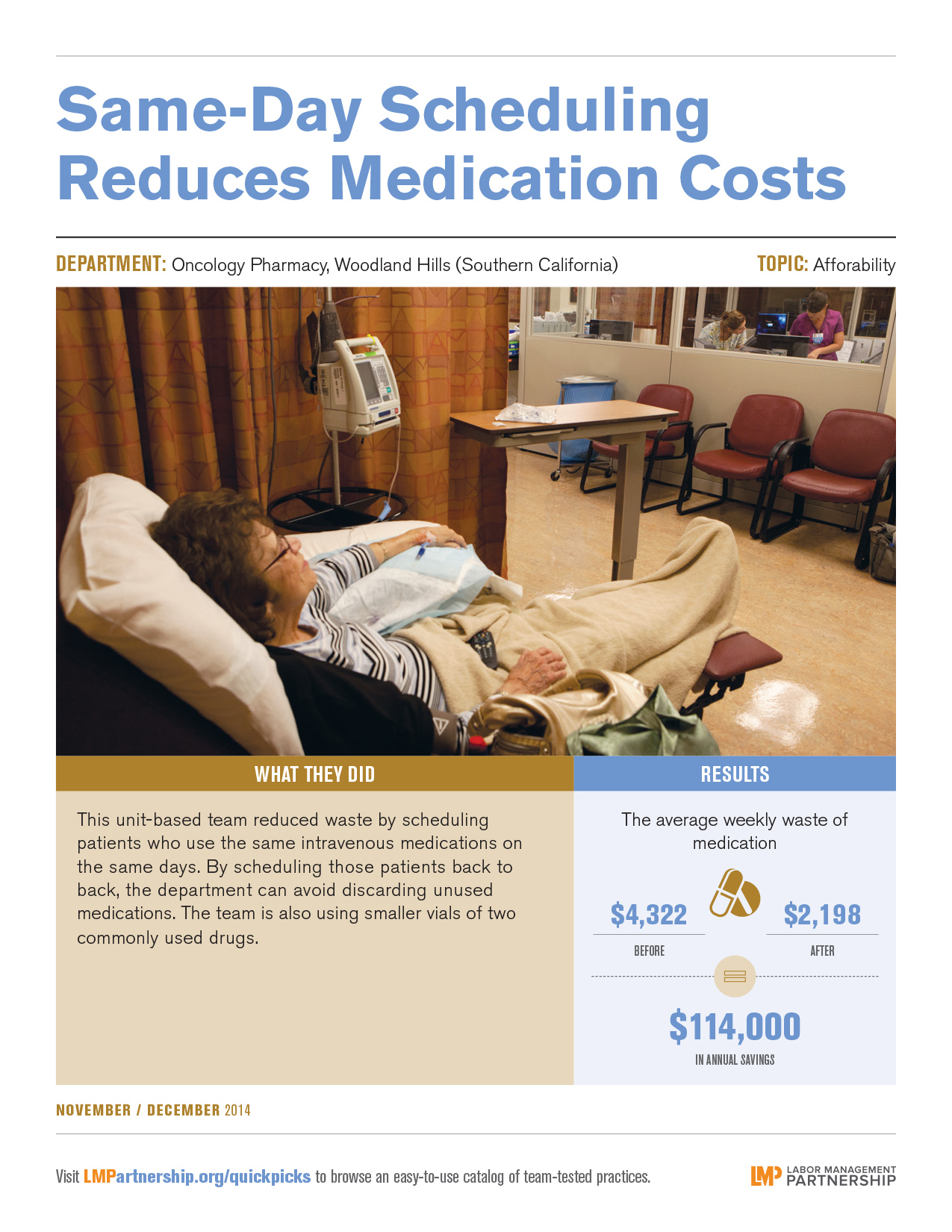
Poster: Smart Scheduling Reduces Medication Costs

Format:
PDF

Size:
8.5” x 11”

Intended audience:
Frontline employees, managers and physicians

Best used:
Share this story of a UBT that cut waste by scheduling same-medication patients on the same days with your team to spark waste-reduction discussions and suggestions.


Related tools:

Pages

Subscribe to RSS - Affordability