
Affordability

Help Video

How to Find UBT Basics on the LMP Website

Learn how to use the LMP website:

LMP Website Overview

Learn how to use the LMP website:

How to Find How-To Guides

This short animated video explains how to find and use our powerful how-to guides

Learn how to use the LMP website:

How to Find and Use Team-Tested Practices

Does your team want to improve service? Or clinical quality? If you don't know where to start, check out the team-tested practices on the LMP website. This short video shows you how. 

Learn how to use the LMP website:

How to Use the Search Function on the LMP Website

Having trouble using the search function? Check out this short video to help you search like a pro!

Learn how to use the LMP website:

How to Find the Tools on the LMP Website

Need to find a checklist, template or puzzle? Don't know where to start? Check out this short video to find the tools you need on the LMP website with just a few clicks. 

Learn how to use the LMP website:

Turning Copay Collections Into a Team Effort

Deck: 
Southern California admitting team becomes one of the highest copay collectors in the region

When the Anaheim Medical Center Admitting department unit-based team set out to increase its collection of inpatient hospital copayments, it had several hurdles to overcome.

Some staff members had to get comfortable with asking for money from patients. Others had to learn how to calculate copayments. They also needed to notify Admitting of a patient’s pending discharge so copayments could be collected at the point of service.

And since the team goal of collecting copayments didn’t always dovetail nicely with individualized goals, that put some staff members at odds.

“We had created this unhealthy competition,” admitting supervisor/manager and union co-lead David Jarvis says.

They also had the problem of convincing staff members in other departments that collecting copayments from hospitalized patients was not a bad thing.

"They used to think of me as Public Enemy No. 1," says Patti Hinds, a financial counselor and member of SEIU UHW.

To educate and motivate staff members about the importance of collecting copayments, the unit-based team held a kickoff meeting in January 2010.

Staff members who were good at collecting and calculating copayments were deemed “master users” and received training so they could help their peers learn to correctly calculate amounts due. They also got pointers on speaking with patients about the money they owed.

"We wrote scripts, we role-played and, as people did it more, they became more comfortable with asking for money and with knowing when it is appropriate to do so," admitting clerk, SEIU UHW Patricia Hartwig says.

The team also had to teach staff members in other departments about the benefits of copayment collection.

"We showed them the bottom-line connection between revenue collection and their paychecks," Hartwig says.

Better working relationships developed between admitting department staff and the nursing units, prompting nurses to contact admitting staff more consistently before patients are discharged.

"They came to realize we’re not the 'bad guys,' " says financial counselor Marcela Perez, an SEIU-UHW member.
TOOLS

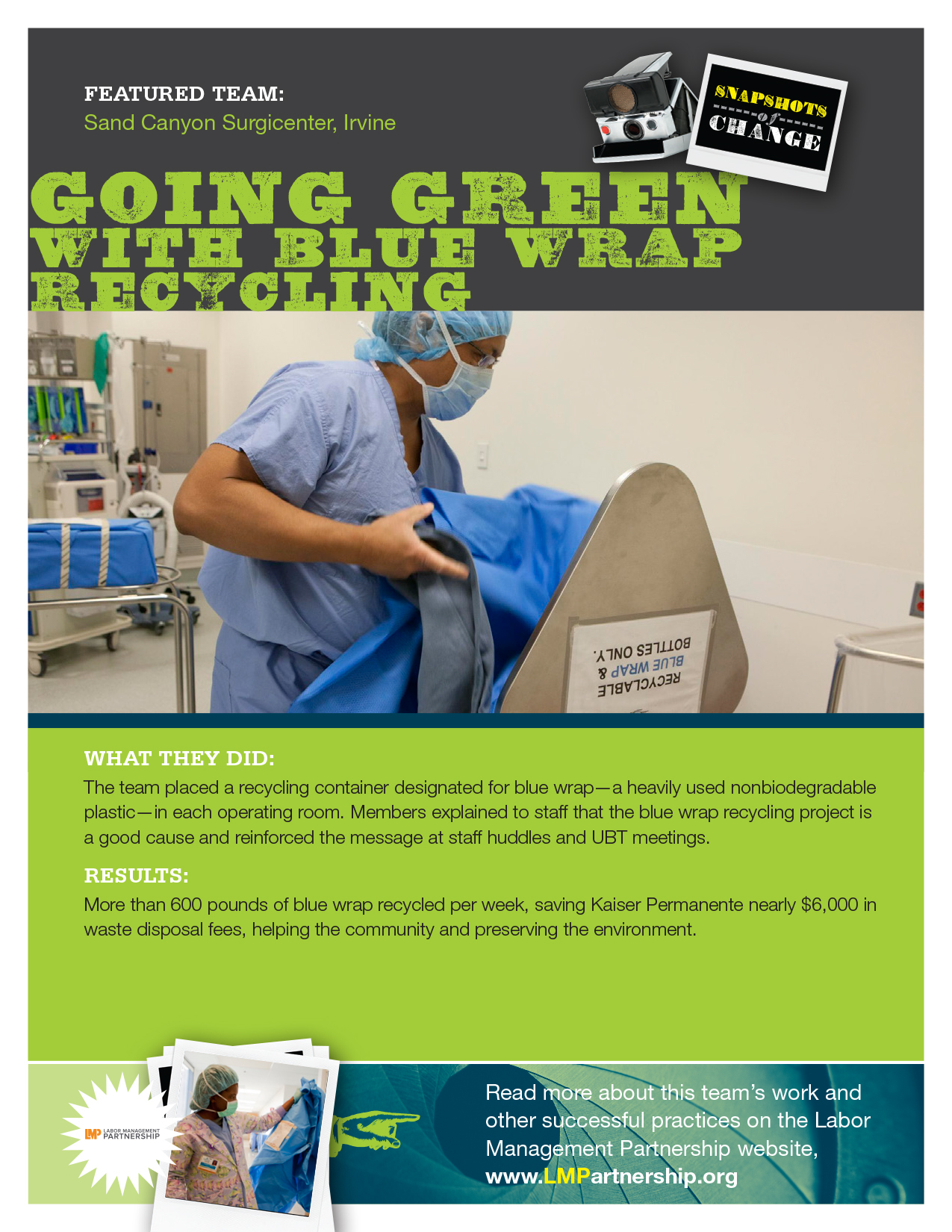
Poster: Going Green With Blue Wrap Recycling

Format:
PDF (color and black and white)

Size:
8.5” x 11”

Intended audience:
Frontline workers and managers

Best used:
Use this to encourage your surgery team colleagues to help make Kaiser Permanente more affordable and at the same time, preserve the environment. Post it on bulletin boards, in break rooms and other staff areas. 


Related tools:

Sand Canyon Goes Green With Blue Wrap Recycling

Deck: 
Project saves money and helps the environment--and assists local disabled adults, too

Story body part 1: 

Looking for ways to make the Sand Canyon Surgicenter in Irvine more efficient, Albert Olmeda wound up learning a lot about blue wrap—like the fact that it makes up nearly 20 percent of the waste generated by hospital surgical services. 

The lead Central Services technician and SEIU UHW member also learned that this heavily used hospital product, an industrial strength plastic used to maintain the sterility of medical and surgical instruments until opened, is not biodegradable and persists in the environment. 

But recycled blue wrap can be sold as raw material for use in the production of other plastic products. Today, the surgicenter’s unit-based team has gone green with a blue wrap recycling project that is not only saving money and protecting the environment, but also aiding the community. 

“The biggest problem with the blue wrap is when we throw it in the landfill, it’s there forever,” says Olmeda. “That’s a big concern especially considering how much blue wrap we use.” 

How recycling works

About 600 pounds of blue wrap is collected every week from the center’s six operating rooms. It is picked up free of charge and sorted by Goodwill of Orange County, which sells it to a Houston recycling services company. The company reprocesses the plastic into beads that are used in various products, including railroad ties, pallets and artificial siding for decks, docks and houses. 

The surgicenter has been recycling its blue wrap and plastic bottles since September 2009, reducing the facility’s solid waste disposal fee by 10 percent annually. The savings amount to a modest $5,880—but there’s a greater payoff. Proceeds from the sale of blue wrap and other recyclable products enable Goodwill to provide education and training programs for developmentally and physically disabled adults, including a state-of-the-art fitness center. 

Peter Bares, business development manager for Goodwill of Orange County, says the relationship with Kaiser Permanente has gone beyond expectations. “It is kind of the perfect storm because of the nature of what we do and why we do it and the materials that the hospital generates,” he says. 

Getting buy-in

As the frontline staff person responsible for the surgery center’s blue wrap disposal, Olmeda—and his fellow UBT members—championed the recycling cause, educating the staff at weekly in-services and UBT huddles.  The team got the rest of the department on board by integrating the blue wrap recycling process without creating additional tasks. 

“We figured if we changed workflows, staff wouldn’t want to do it.” says UBT co-lead Nicole Etchegoyen, a surgery scheduler and SEIU UHW steward. “But if we asked them, ‘How would this work best for you?’ then everyone would get involved, and they did.” 

The team members designated a single container for blue wrap in each operating room. They also placed a larger bin for collecting multiple bags of discarded blue wrap near the soiled utility room, where the trash is taken on its way out of the surgery center. 

“It’s not a big deal,” EVS worker and SEIU UHW member George Sollars said, hoisting bags. “We just carry it over here on our way out this door. It’s one of the easiest jobs. And it’s for a really good cause.” 

No trash, just recycling 

The hardest part was making make sure that other trash didn’t make it into the blue wrap recycling containers accidentally. Labeling the containers with signs reading ‘Recycling Blue Wrap Only’ helped, as did regular reminders by UBT members. 

Now, everyone in the operating rooms—from doctors, nurses and surgical techs to nursing assistants and EVS workers—makes sure that the blue wrap containers aren’t contaminated with other trash, Etchegoyen says. 

Olmeda does periodic spot checks. “Everybody who plays a role in the operating room has to look out to make sure no trash is going inside the containers,” he says. “It’s a team-building thing.” 

“If it wasn’t for the UBT, this wouldn’t be happening,” said Ramin Zolfagar, MD, department head and UBT member. “We are helping the environment by ‘going blue,’ so to speak, and the end result is gym equipment for the disabled—which makes it all the more worthwhile.” 

After learning about the project at a recent Orange County UBT fair, other departments are thinking about emulating it. 

Visit the Goodwill of Orange County website to find out more about their work.

Improved Process Helps to Reduce Bed Sores

Deck: 
Team cuts incidence of pressure ulcers to 0

The medical/surgical staff at Fontana Medical Center had a problem with pressure ulcers. The 59-bed unit averaged about 10 of these hospital-acquired bed sores a quarter.

It's painful for the patient and costly for the hospital, which can average about $43,000 per incident. But pressure ulcers are also preventable, and that can lead to shorter hospital stays and improved patient satisfaction scores. Reducing the rate of pressure ulcers can also eliminate inquiries from the California Department of Health Services.

Based on recommendations from the UBT, the staff implemented an education program and provided one-on-one training on how to spot, rate and reduce bed sores.

The team established a strict regimen that included rating patients on the Braden Scale, which helps identify those at risk for pressure ulcers. They performed morning assessments, and used waffle mattresses and moisture-protective barriers for at-risk patients.

They also rounded hourly for turning and got patients out of bed three or four times a day to decrease their risks. This allowed patients to use the restroom and to keep them clean.

“It’s pretty much a collaborative effort among nurses, nutritionists and wound specialists,” says charge nurse and UBT co-lead Toni Leonen. “The nurses are receptive to implementing the various methods we use to prevent pressure ulcers.”

In a span of two years, the new process helped the team reduce the number of bed sores to 0.

“We’ve created this environment where the staff thinks safety and thinks patient comfort,” Kathy Smith, RN, assistant department administrator says. “It’s automatic. They just come in and make sure patients are turned. Nobody has to remind them.”

Coming up with a new process to combat pressure ulcers helped the team build a sense of unity and staff satisfaction, but they also know the work continues.

“Sustaining our success is the biggest challenge because you can revert back to old practices,” Smith says. “You have to keep emphasizing what we’re doing and what the reasons are. Make sure they know you appreciate them so they continue to do well.”

Pages

Subscribe to RSS - Affordability