TOOLS
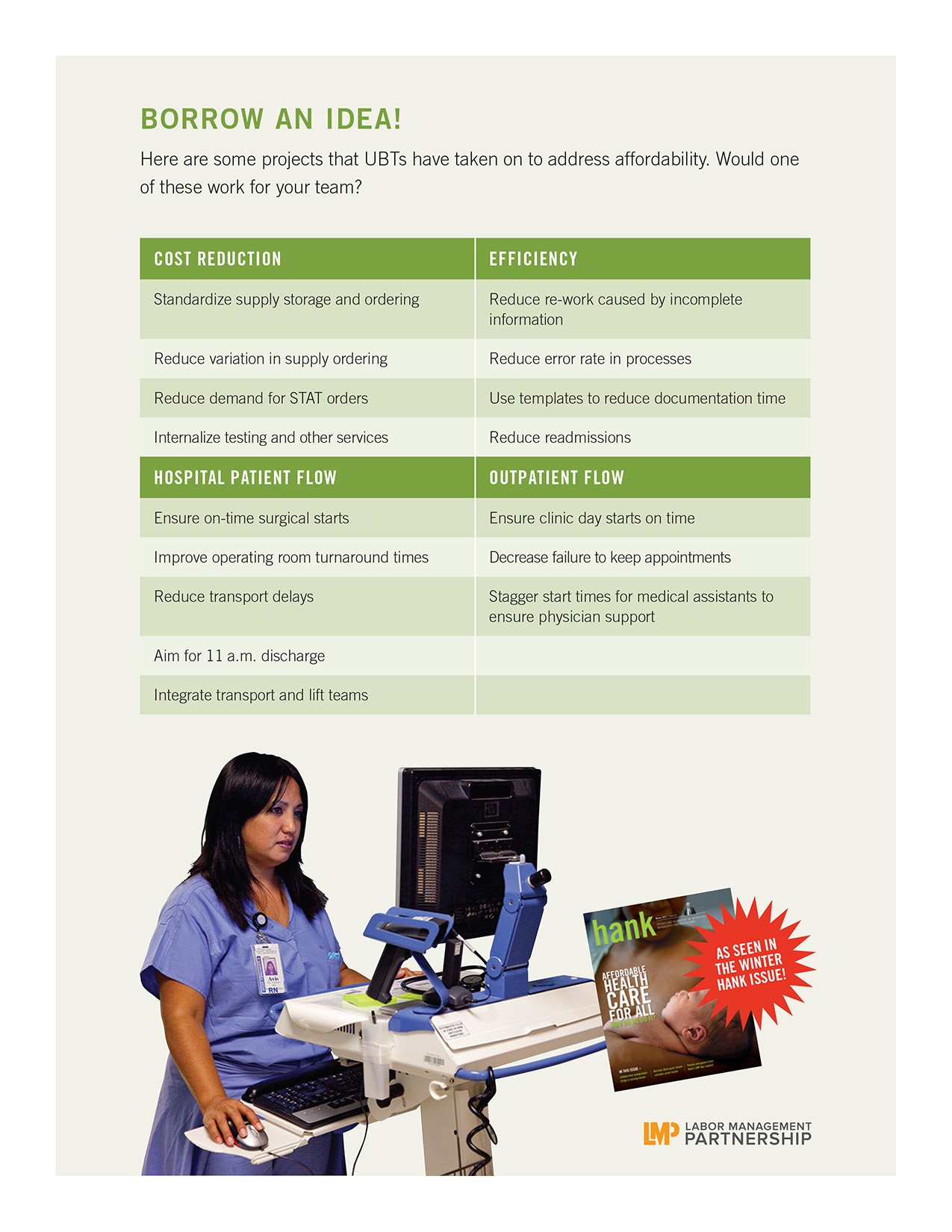
Borrow an Idea
Format:
PDF
Size:
8.5" x 11"
Intended audience:
Managers and union members
Best used:
Review this list at your UBT meeting to see if your team could adapt one of these projects to improve affordability.
This short animated video explains how to find and use our powerful how-to guides
Does your team want to improve service? Or clinical quality? If you don't know where to start, check out the team-tested practices on the LMP website. This short video shows you how.
Having trouble using the search function? Check out this short video to help you search like a pro!
Need to find a checklist, template or puzzle? Don't know where to start? Check out this short video to find the tools you need on the LMP website with just a few clicks.
Format:
PDF
Size:
8.5" x 11"
Intended audience:
Managers and union members
Best used:
Review this list at your UBT meeting to see if your team could adapt one of these projects to improve affordability.
Format:
PDF
Size:
8.5" x 11"
Intended audience:
Unit-based team managers and union members
Best used:
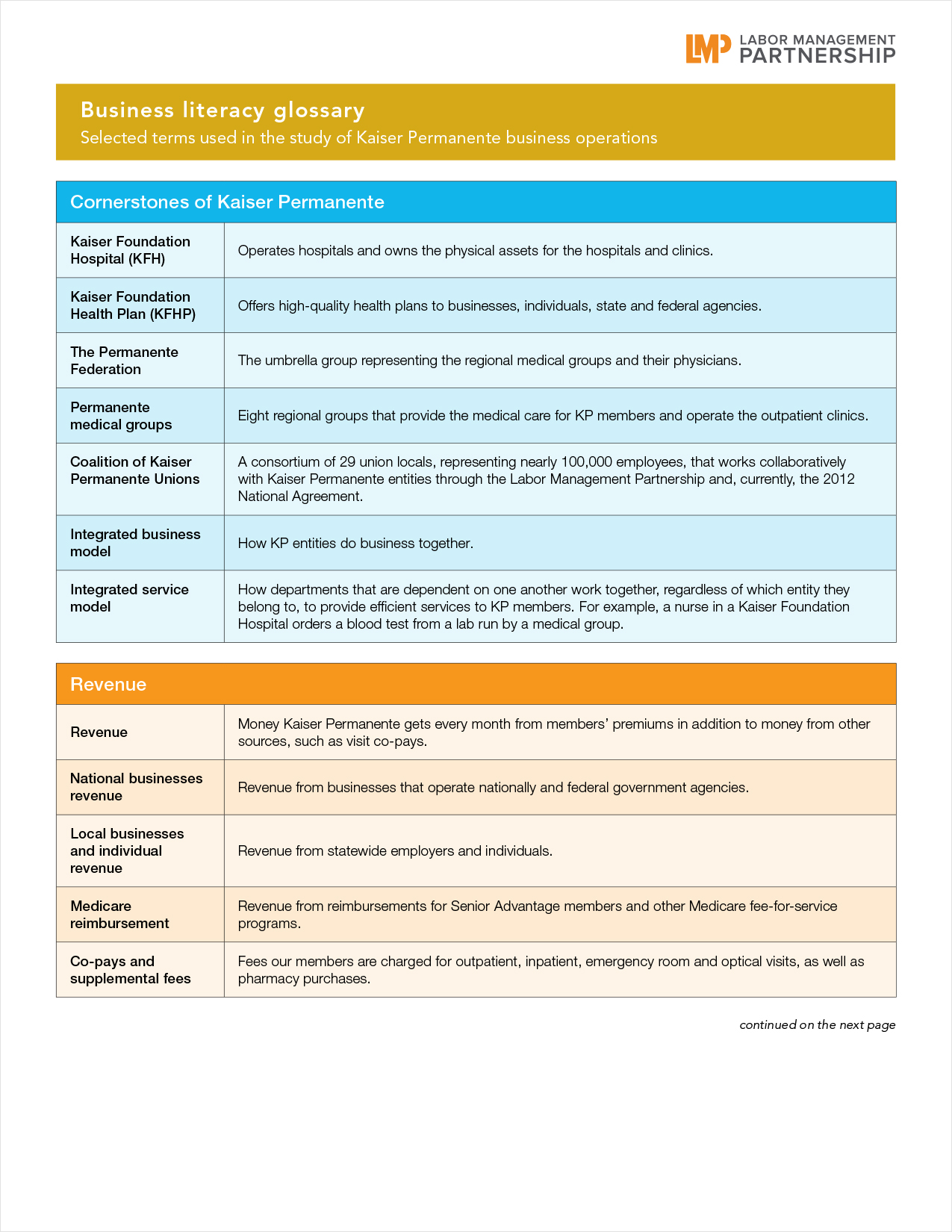
Share these terms used in the study of Kaiser Permanente business operations with team members to inspire discussion of budgets and to help generate ideas to serve patients while saving money.
Format:
PDF (color and black and white)
Size:
8.5" x 11"
Intended audience:
Frontline managers and workers
Best used:
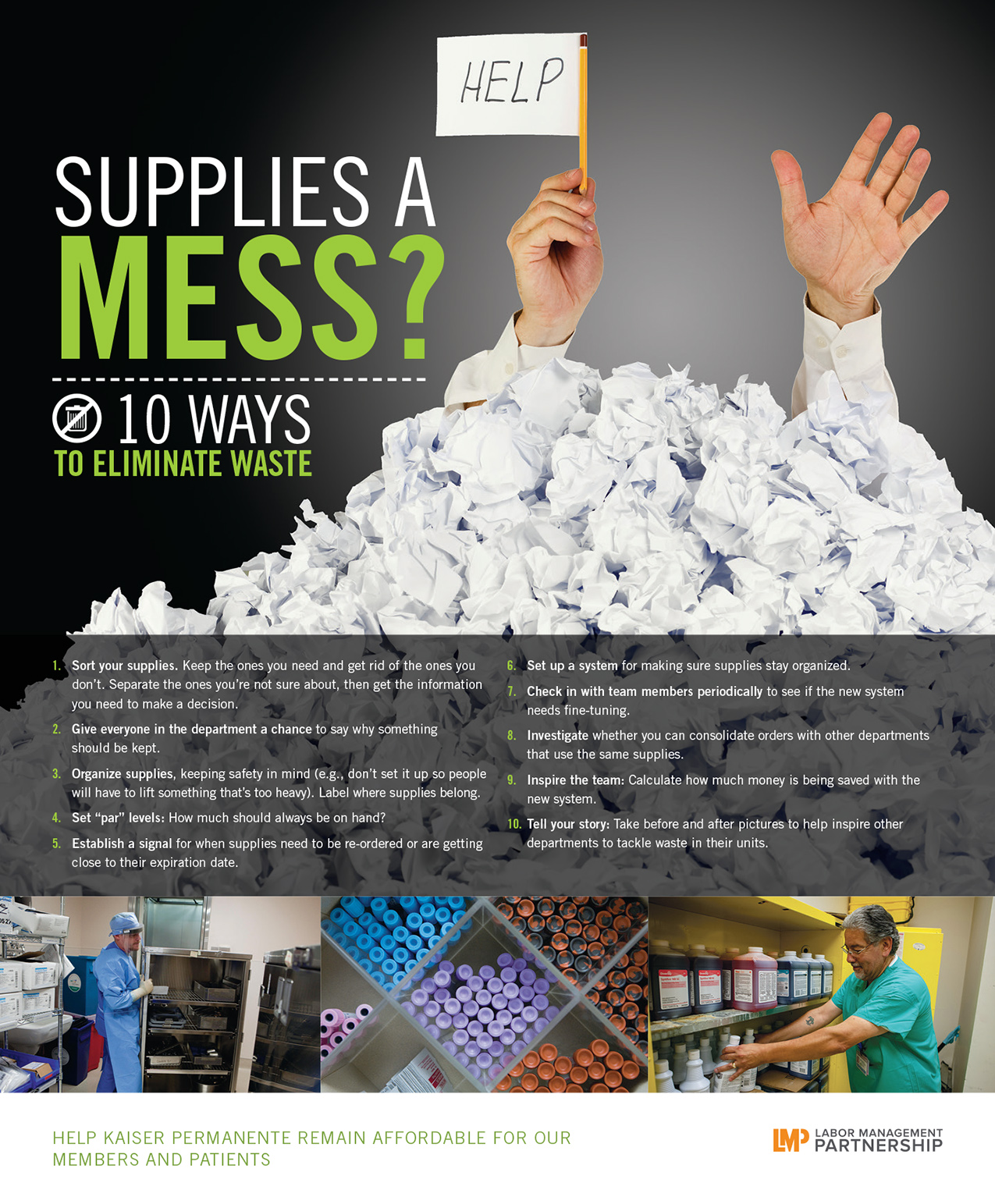
This poster lists 10 ways to eliminate waste. Post on bulletin boards in break rooms and other staff areas.
Format:
PDF
Size:
8.5" x 11"
Intended audience:
Frontline workers and managers
Best used:
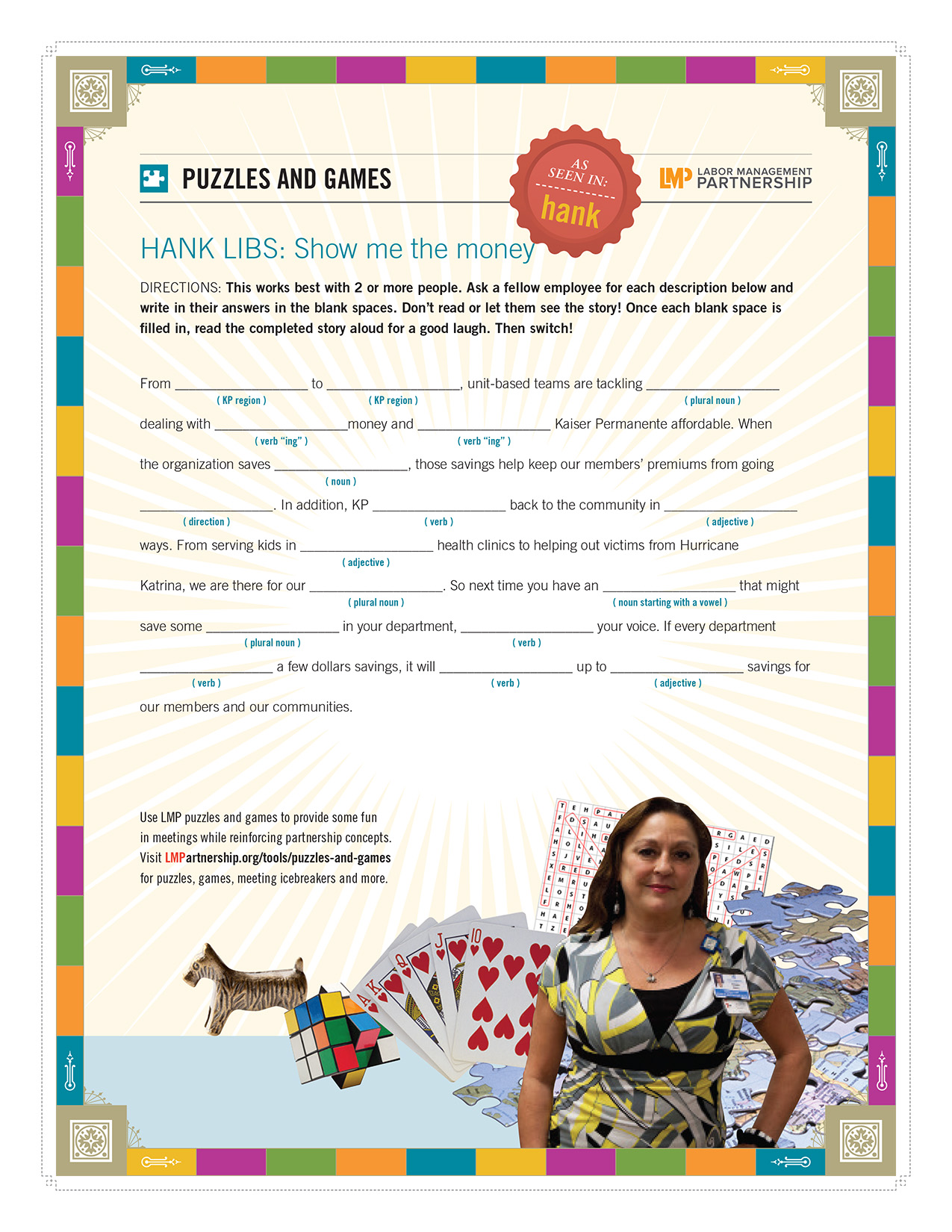
This Hank Lib from Winter 2013 can provide variety and fun at a team meeting while highlighting waste reduction and savings.
Cutting waste and saving money for Kaiser Permanente members and patients is good. But 350 Environmental Service workers in Southern California are taking that mission a step further by tending to Mother Earth as well.
Kaiser Permanente and two Labor Management Partnership-funded workforce development trusts are among the health care partners nationwide that are training frontline workers and managers in improved recycling, waste disposal, energy conservation and other green practices. The U.S. Department of Labor and the Healthcare Career Advancement Program, a national partnership of unions and hospitals, are leading the effort.
“‘Carbon footprint’ is a phrase that’s thrown around a lot,” says Milford “Leroy” Alaman, EVS operations manager at the Los Angeles Medical Center. “Now our staff is able to understand that when you are talking about conserving energy, water and electricity, you are talking about looking at the resources we have in our facility and holding on to just what we need instead of creating more waste for us and the planet.”
Along the way, these “green teams” also are reducing operating costs, enhancing employee skills and morale, and improving patient and workplace safety.
For example, the EVS department is now using environmentally friendly microfiber mops to clean a single patient room. This has the benefit of not spreading infections between rooms and preventing lifting and straining injuries caused by wringing traditional mops and hauling buckets of water.
The department also has started a project that is reducing the cost and trouble of replacing the 500 D-cell batteries used in the hospital restrooms’ automatic towel dispensers. The traditional batteries wore out in a matter of weeks—costing about $3,000 a year to replace and adding some 6,000 batteries a year to local waste or reprocessing streams. Starting in February 2012, workers installed new rechargeable batteries. Overall, EVS' green projects, including the use of rechargeable batteries, are saving an estimated $12,000 a year.
“I feel better having conversations with anyone…doctors, nurses, I can tell them how to be green,” says EVS attendant Jose Velasco, an SEIU UHW member and a recent graduate of a green certification course offered at West Los Angeles Community College.
The program also was piloted at KP Riverside Medical Center, where the EVS unit-based team is reaching out to others with its newfound expertise. Now an EVS member is embedded with the Operating Room UBT—with others to follow—to help tackle waste and hygiene problems there.
The SEIU UHW-West & Joint Employer Education Fund and the Ben Hudnall Memorial Trust have helped underwrite the cost of the training for Kaiser Permanente’s LMP-represented workers. Eventually, frontline workers may be able to use their certifications for higher pay and promotions as medical center “green leads,” a program that would be negotiated between KP and the unions.
But the training already is making a difference to workers as well as to KP and the community. “They have more tools, more knowledge, so they are able to catch things,” says Angel Pacheco, management co-lead of the EVS UBT at Riverside. “We talked about saving the environment for future generations.”
Format:
PDF
Size:
8.5" x 11"
Intended audience:
Frontline employees, managers and physicians, and UBT consultants
Best used:
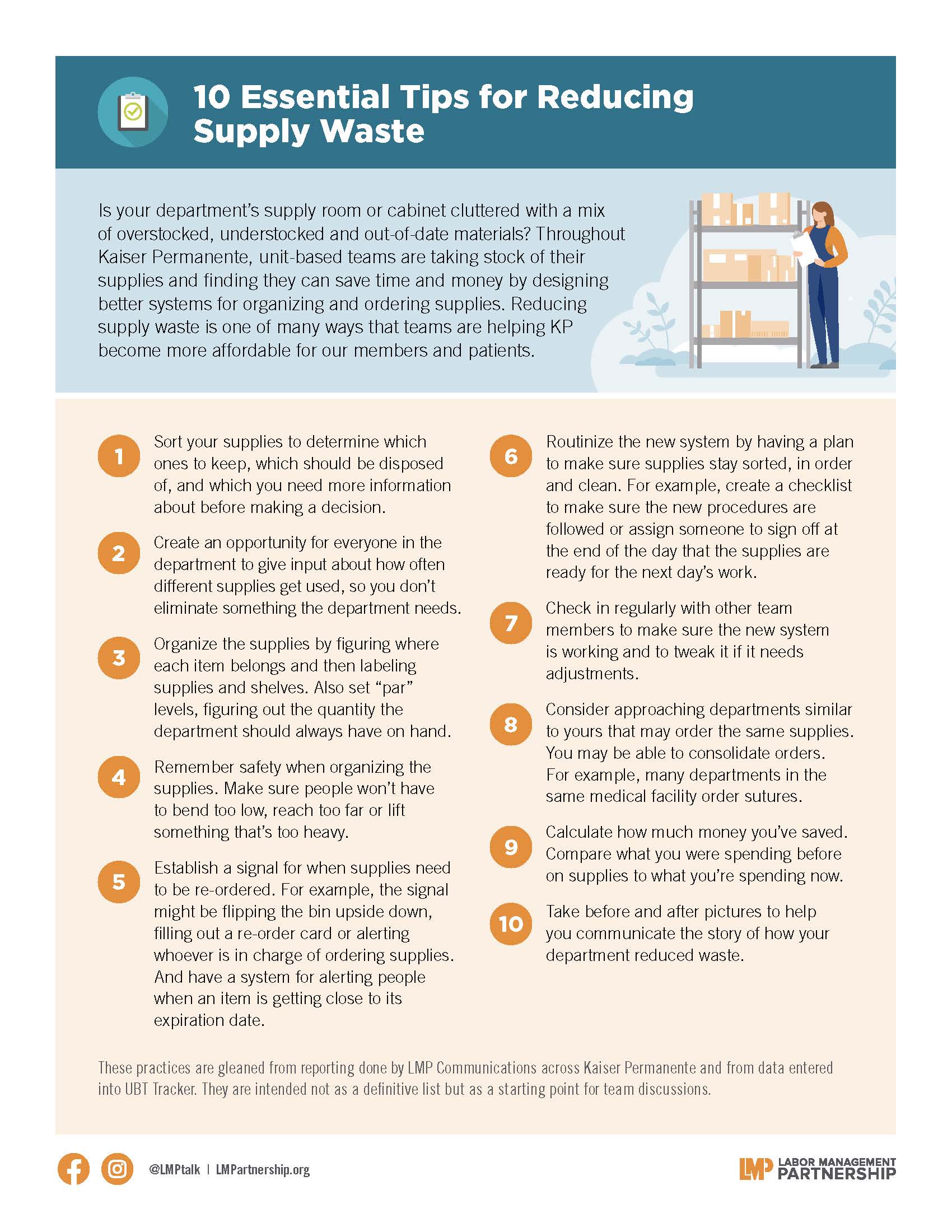
Post this tip sheet in a breakroom, or use it as a starting point for team discussions and brainstorming on how to reduce supply waste.
See how teams have put these tips to use:
Format:
PPT
Size:
1 slide
Intended audience:
LMP Staff, UBT consultants, improvement advisers
Best used:
This PowerPoint slide highlights a business services team that discovered a glitch, corrected it, and brought in $10 million in Medicare reimbursements. Use in presentations to show some of the methods used and the measurable results being achieved by unit-based teams across Kaiser Permanente.
Format:
PDF (color and black and white)
Size:
8.5" x 11"
Intended audience:
Frontline employees, managers and physicians
Best used:
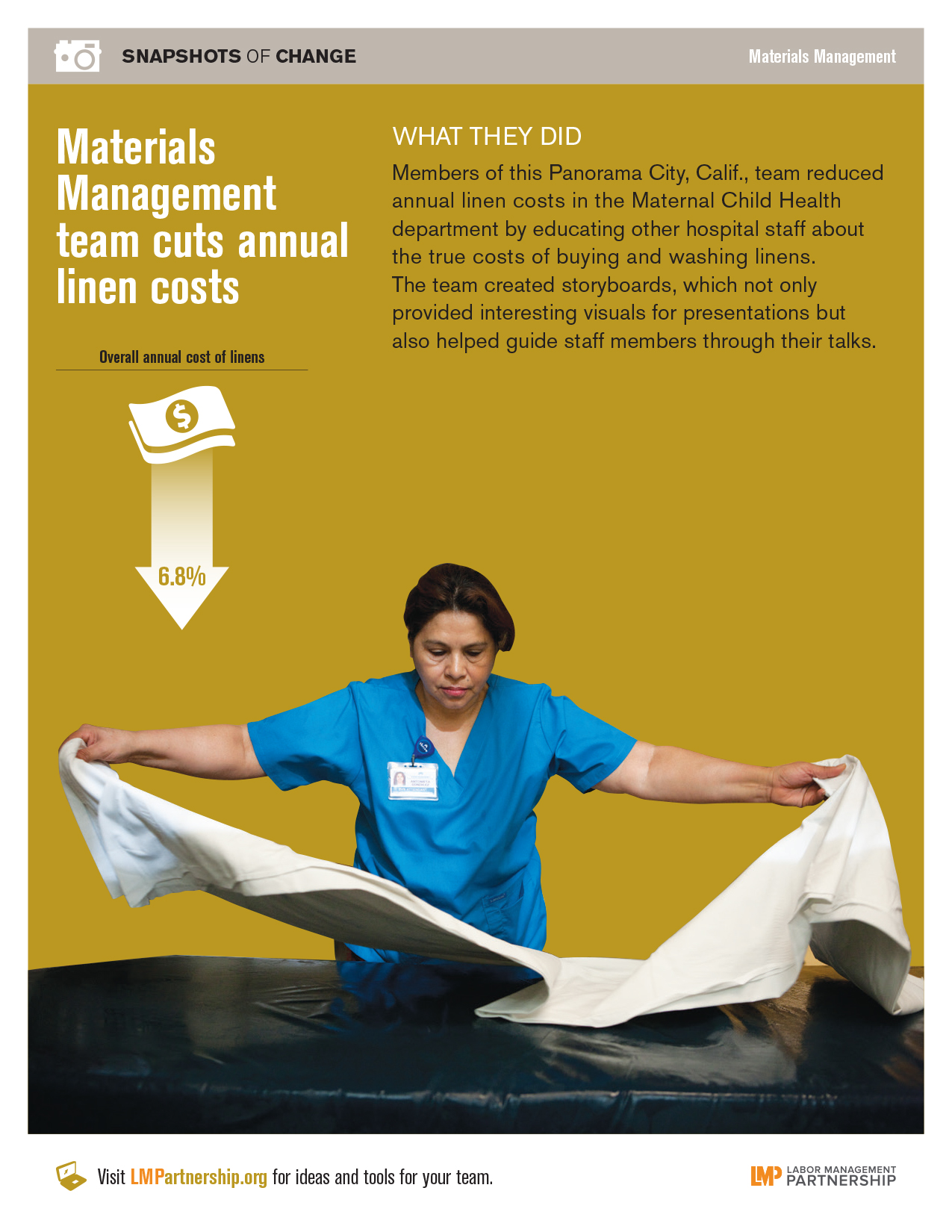
This poster, for use on bulletin boards in break rooms and other staff areas, features a Materials Management team that found a way to save in linen costs.
Format:
PDF
Size:
8.5" x 11"
Intended audience:
Frontline employees, managers and physicians
Best used:
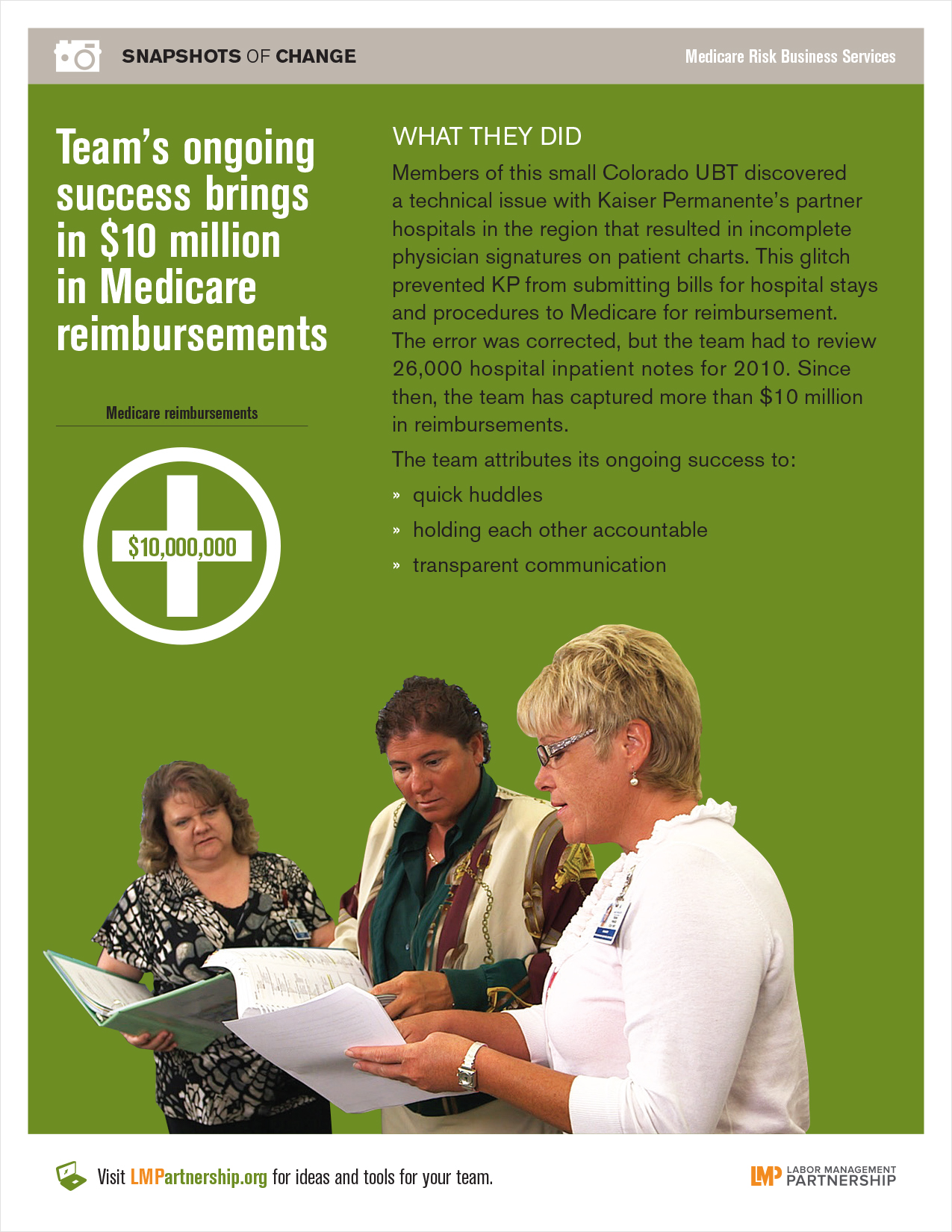
This poster highlights a business services team that discovered a glitch, corrected it, and brought in $10 million in Medicare reimbursements. Post on bulletin boards, in break rooms and other staff areas.
Colorado’s “small team with the big impact” has surpassed even its own expectations, reporting an additional $7 million in Medicare reimbursements last year. That brings the total capture to $10.3 million for Medicare Advantage visits in 2010.
The Medicare Risk Business Services unit—made up of five auditors, a data analyst and a manager—is in charge of auditing all inpatient Medicare Advantage charts to make sure the agency is billed correctly.
Two years ago, a technical issue with Kaiser Permanente’s partner hospitals in the region resulted in incomplete physician signatures on patient charts—which prevented KP from submitting the bills for hospital stays and procedures to Medicare for reimbursement. The error was corrected, but the team had to review 26,000 hospital inpatient notes for that year.
When it first began correcting the error, the unit-based team predicted collecting an additional $2 million to $3 million for 2010 and team members are pleased that their efforts netted KP an additional $7 million.
“It amazes me what the UBT is able to harness and have such great outcomes,” says management co-lead Treska Francis.
The department has worked through the backlog and is now able to submit bills to Medicare within 10 days of a patient’s discharge.
The small team attributes its ongoing success to:
“On a daily basis, we know what needs to be completed for the day, (we) set a goal and we go for it,” says labor co-lead Stephanie White, a Medicare risk auditor and SEIU Local 105 member.