lmpartnership.org

Help Video

How to Find UBT Basics on the LMP Website

Learn how to use the LMP website:

LMP Website Overview

Learn how to use the LMP website:

How to Find How-To Guides

This short animated video explains how to find and use our powerful how-to guides

Learn how to use the LMP website:

How to Find and Use Team-Tested Practices

Does your team want to improve service? Or clinical quality? If you don't know where to start, check out the team-tested practices on the LMP website. This short video shows you how. 

Learn how to use the LMP website:

How to Use the Search Function on the LMP Website

Having trouble using the search function? Check out this short video to help you search like a pro!

Learn how to use the LMP website:

How to Find the Tools on the LMP Website

Need to find a checklist, template or puzzle? Don't know where to start? Check out this short video to find the tools you need on the LMP website with just a few clicks. 

Learn how to use the LMP website:

TOOLS

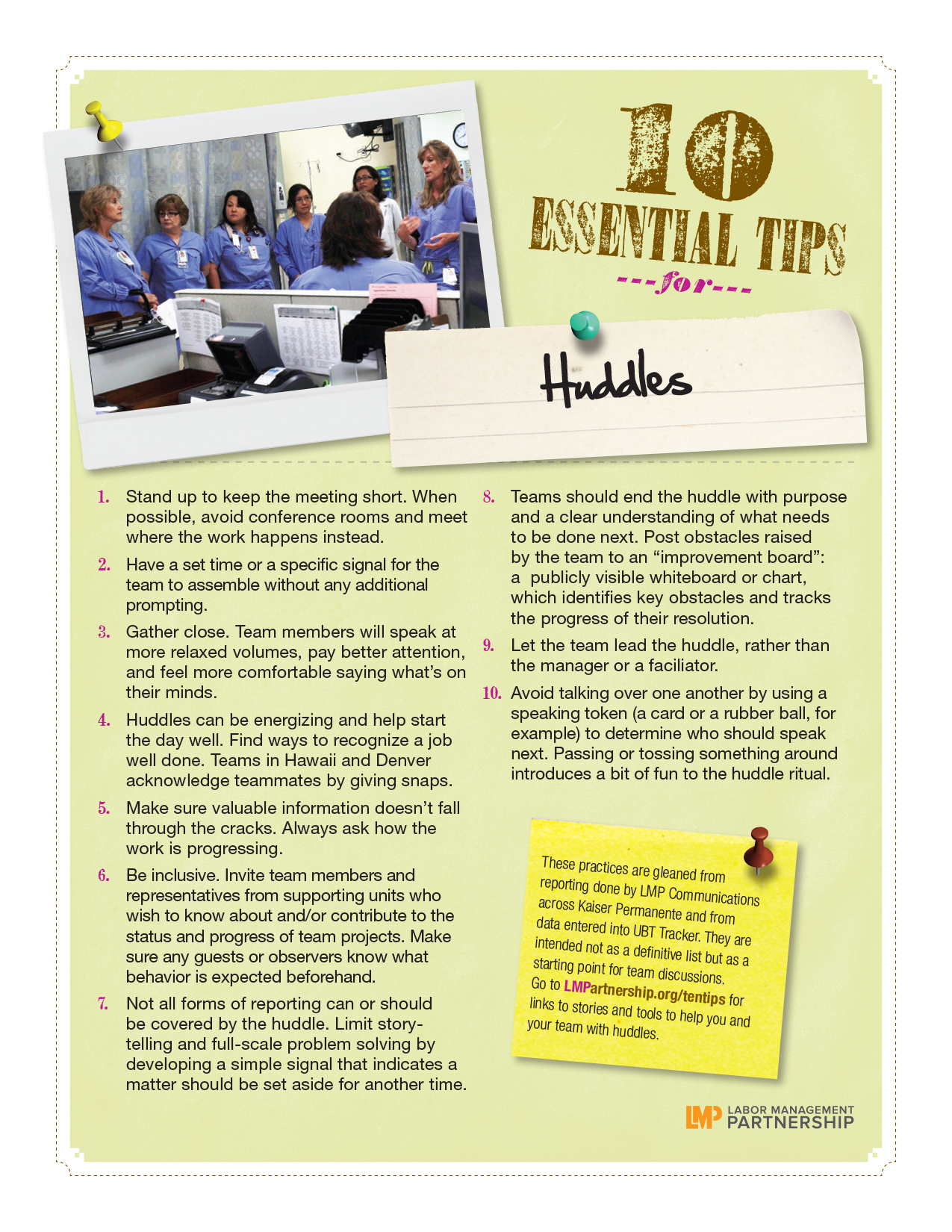
10 Essential Tips for Huddles

Format: 
PDF

Size: 
8.5" x 11"

Intended audience: 
Frontline employees, managers and physicians, and UBT consultants

Best used:
Post these 10 tips on successful huddles on bulletin boards and discuss in team meetings; use this tipsheet as a starting point for team discussions and brainstorming. 

Related stories/videos:
See how teams have put these tips to use.


Related tools:

TOOLS

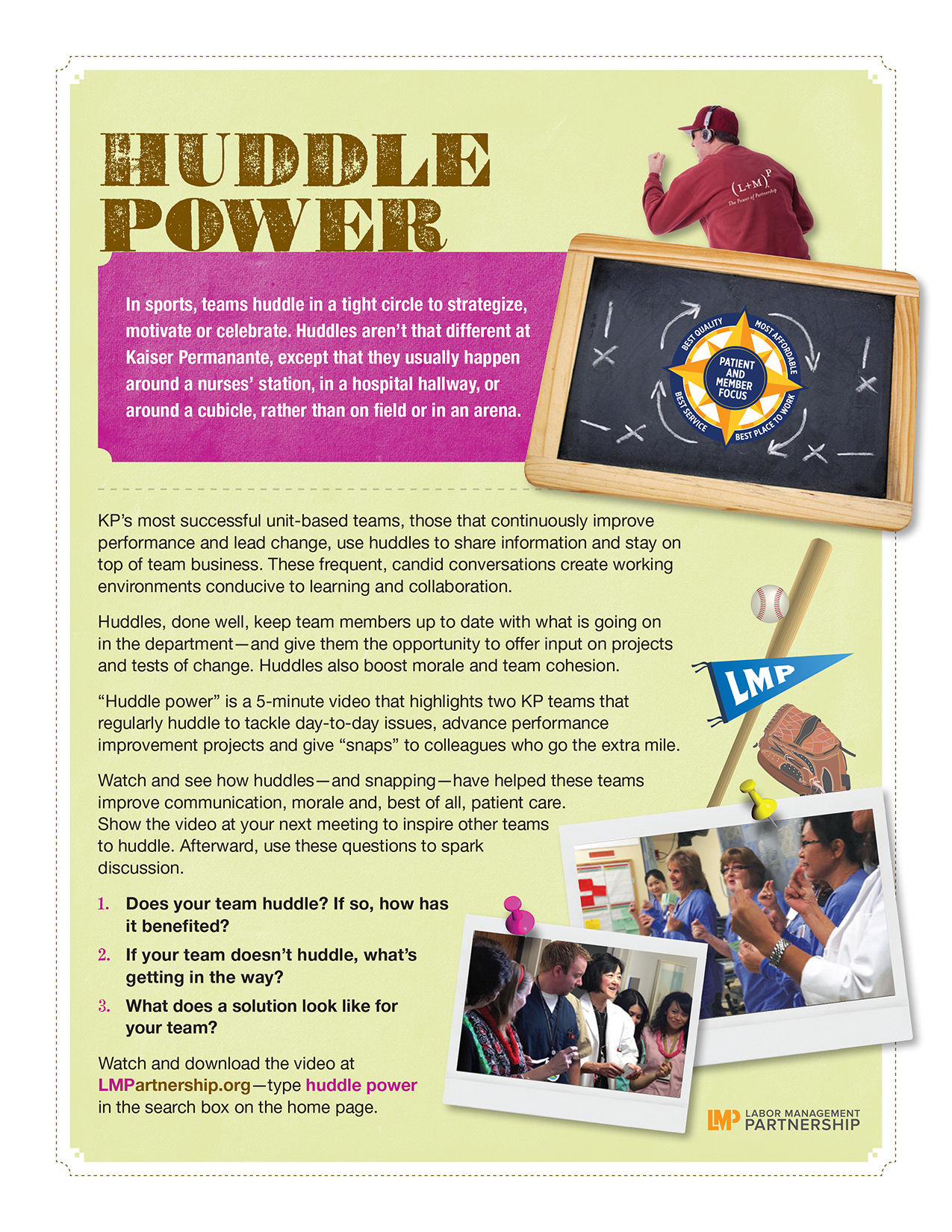
'Huddle Power': Video User's Guide

Format: 
PDF

Size: 
8.5" x 11"

Intended audience: 
Frontline employees, managers and physicians, and UBT consultants

Best used: 
Show the "Huddle Power" video and pass out this guide at UBT meetings and trainings to inspire your team to use daily huddles as one way to improve performance. 

Click here to watch the "Huddle Power" video.

Related tools:

Team’s Ongoing Success Brings in $10 Million in Medicare Revenue

Deck: 
Fixing one error leads to continued improvement

Story body part 1: 

Colorado’s “small team with the big impact” has surpassed even its own expectations, reporting an additional $7 million in Medicare reimbursements last year. That brings the total capture to $10.3 million for Medicare Advantage visits in 2010.

The Medicare Risk Business Services unit—made up of five auditors, a data analyst and a manager—is in charge of auditing all inpatient Medicare Advantage charts to make sure the agency is billed correctly.

Two years ago, a technical issue with Kaiser Permanente’s partner hospitals in the region resulted in incomplete physician signatures on patient charts—which prevented KP from submitting the bills for hospital stays and procedures to Medicare for reimbursement. The error was corrected, but the team had to review 26,000 hospital inpatient notes for that year.

When it first began correcting the error, the unit-based team predicted collecting an additional $2 million to $3 million for 2010 and team members are pleased that their efforts netted KP an additional $7 million.

“It amazes me what the UBT is able to harness and have such great outcomes,” says management co-lead Treska Francis.

The department has worked through the backlog and is now able to submit bills to Medicare within 10 days of a patient’s discharge.

The small team attributes its ongoing success to:

  • quick huddles
  • holding each other accountable
  • transparent communication

“On a daily basis, we know what needs to be completed for the day, (we) set a goal and we go for it,” says labor co-lead Stephanie White, a Medicare risk auditor and SEIU Local 105 member.

Wasted Linens Are an Unnecessary Expense

Deck: 
Team cuts annual costs by almost 7 percent

For a nurse on a hospital ward, it might seem quick and easy to grab the nearest sheet to mop up a spill or grab a huge stack of blankets to put in a patient’s room.

But for the Materials Management department at Panorama City Medical Center, that can be really wasteful.

And they should know. They’re the team responsible for purchasing and cleaning linens, and keeping patients comfortable.

With savings in mind, the materials UBT looked to educate other hospital staff about the true costs of buying and washing linens.

Managers and union members worked together to create a storyboard featuring photos of bed sheets used as a tablecloth at a barbeque, and price lists of supplies and laundering charges. And because the team piloted its effort in Maternal Child Health departments, it also included pictures of babies.

As the materials staff worked with the other teams, the storyboard was a big confidence booster to those who were not public speakers.

“At first I was really nervous,” says Sandra Hernandez, the team’s labor co-lead. “But then I saw people I knew in the room and that put me at ease.”

The team also reviewed linen usage and stocking levels with departments.

And their efforts paid off as they reduced the overall annual cost of linen in the Maternal Child Health department by 6.8 percent, more than three times the original goal.

They also were able to increase customer satisfaction scores in a year from 48 to 65 percent from internal clients such as inpatient units at the hospital,.

“It is important to be prepared with the data,” says management co-lead Steve Spickler. “But, you need to tell a story in addition to the charts. That’s how the UBTs make the connection between their contribution and the financial success of the organization.”

For more about this team's work to share with your team and spark performance improvement ideas, download a poster or powerpoint.

TOOLS

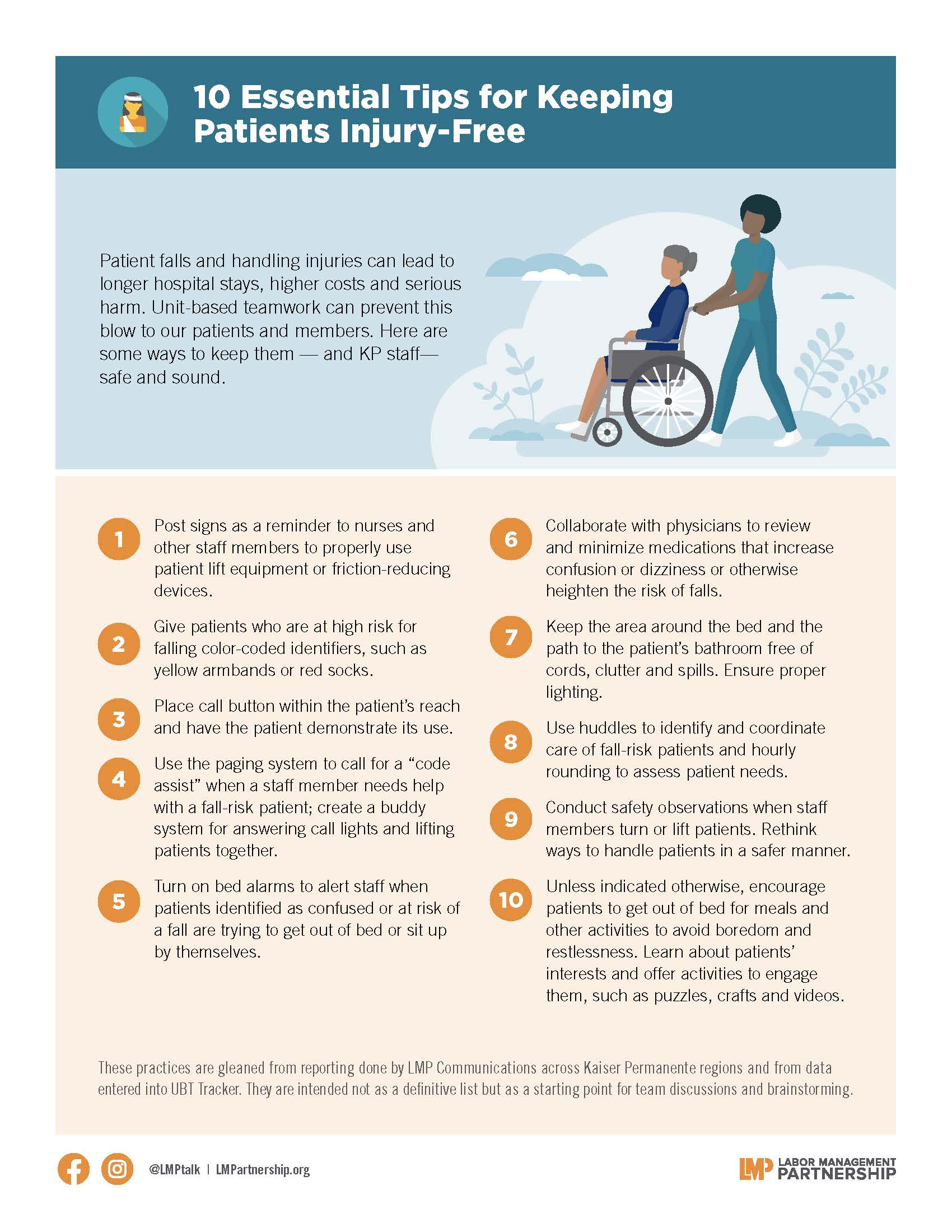
10 Essential Tips for Keeping Patients Injury-Free

Format: 
PDF

Size: 
8.5" x 11"

Intended audience: 
Frontline employees, managers and physicians, and UBT consultants

Best used:
Use these tips from UBTs that have reduced patient injuries as a starting point for team discussions and brainstorming. Post on bulletin boards and discuss in team meetings.

Related tools:

TOOLS

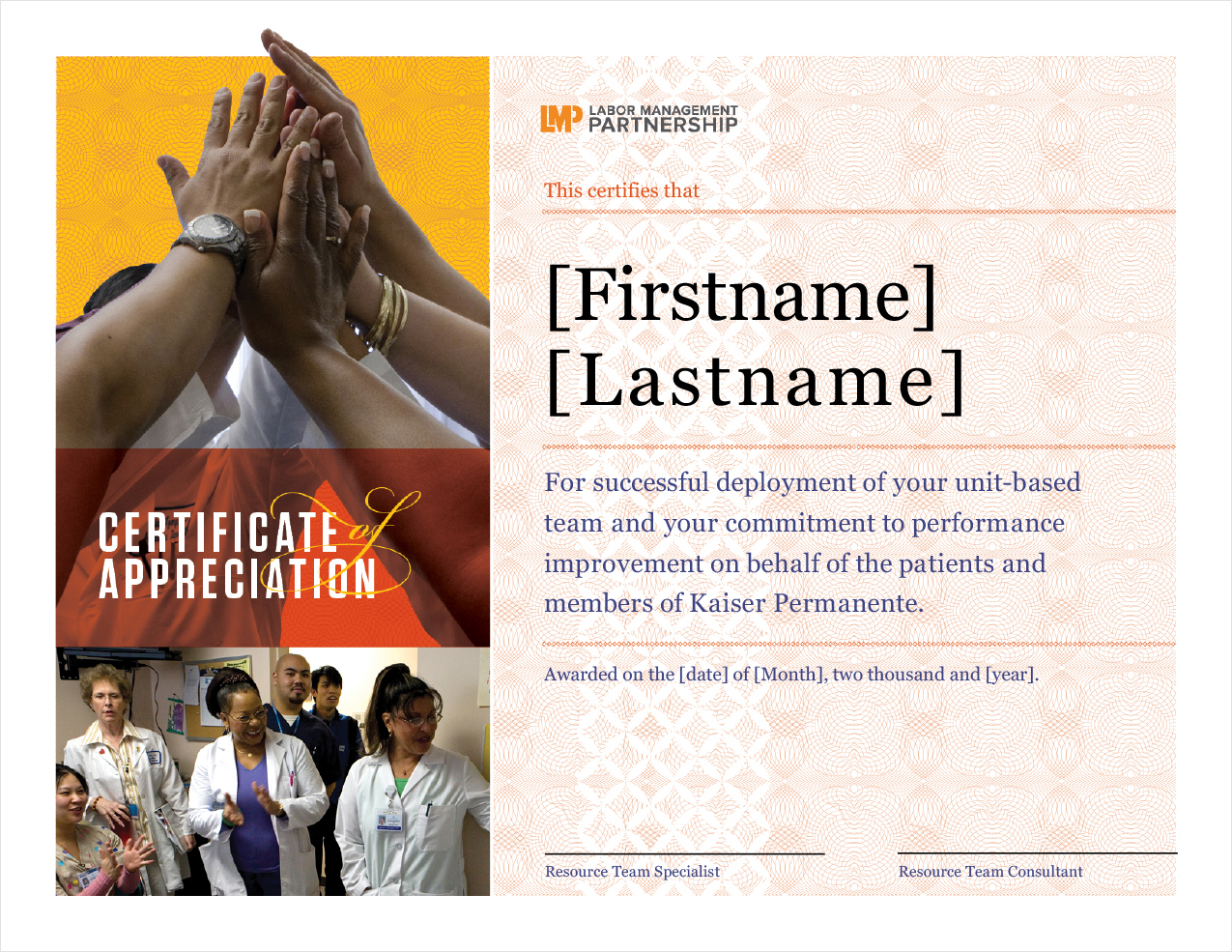
Certificate of Appreciation—Version 1

Format:
Word document (color and black and white)

Size:
One 8.5" x 11" page

Intended audience:
UBT co-leads and sponsors

Best used:
Customize this certificate to reward and recognize individuals and teams who've improved performance. Celebrating and recognizing achievement builds morale and inspires your team.

Related tools:

TOOLS

PPT: Bolder Communication Helps Diagnose Malnutrition

Format:
PPT

Size:
1 Slide

Intended audience:
Frontline employees, managers and physicians; LMP staff, UBT consultants, and improvement advisers

Best used:
This poster features a Northern California team that improved communication and its ability to diagnose malnutrition. Use in presentations to show some of the methods used and the measurable results being achieved by unit-based teams across Kaiser Permanente. 

Related tools:

TOOLS

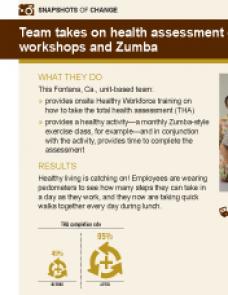
PPT: Zumba Helps Team Meet Health Assessment Goal

Format:
PPT

Size:
1 Slide

Intended audience:
LMP staff, UBT consultants, improvement advisers

Best used:
This poster features a Fontana UBT in which 95 percent of members have taken KP's health assessment. Use in presentations to show some of the methods used and the measurable results being achieved by unit-based teams across Kaiser Permanente. 

Related tools:

Beyond 'Teamwork'

Deck: 
Teaming as the essential skill for innovation, learning

Story body part 1: 

“Team” is a noun. “Teaming” is a verb, defined by the woman who coined it as teamwork on the fly, coordinating and collaborating across boundaries, without the luxury of stable team structures.

That woman, Harvard Business School Professor Amy Edmondson, talked to the 2012 Union Delegates Conference about why teaming is such a crucial skill, especially for those in health care settings where work is complex and unpredictable.

“In health care, many times people are interacting with each other in an emergency room, for instance, now, for five minutes, but they don’t know each other,” says Edmondson. “The catch is we have to act as if we trust each other…because we often don’t have the luxury of having a lot of time to get to know each other.”

A “team” is a static, stable entity. But, says Edmondson, “In health care, if we wait until we have the perfectly designed ‘team,’ the moment has passed. We have to get together quickly, do what needs to be done, and then disband and do other things.”

In the absence of long-term work relationships, Edmondson says allegiance to an organization with a compelling vision can be the glue that holds these teams-on-the-fly together. “There is the pride in working for KP,” for instance, she says. “That is a real bond.”

Looking at the performance improvement work of unit-based teams at Kaiser Permanente, the principles of teaming still apply. While not as fluid as an emergency room, UBTs still see plenty of flux. Just think about the manager that gets promoted or retires, or the labor co-lead who rotates out of that role. The team has to be able to keep focused on improving performance even as the cast of characters changes.

UBTs can be stable teams that do great work. They are a very powerful tool,” Edmondson says. “And yet, I also want people to be able to quickly get up to speed, do what needs to be done with other people in the absence of those stable structures.”

A UBT needs to be a scaffold that is strong enough to withstand the flux, says Edmondson.

“If there is clarity about what the structure looks like—independent of the people who are in that structure—you are better off,” says Edmondson, a point explored in research she’s conducted with Harvard colleague Melissa Valentine. “We won’t always have the same human beings in those roles, but the roles are reasonably static.”

Behaviors that support teaming

  • Speak up: ask questions, acknowledge errors, offer ideas.
  • Listen intensely.
  • Integrate different facts and points of view.
  • Experiment: take a step-by-step approach, learning as you go.
  • Reflect on your ideas and actions.


Contradictions That Foster Innovation

Story body part 1: 

Amy Edmondson says innovation depends on a culture of focused chaos.

Those words sound like opposites. They are. Don’t worry. It’s not a mistake.

In fact, innovation depends on four pairs of seeming opposites. As unit-based teams ramp up, involving frontline managers, physicians and employees in finding new ways to improve performance and transform health care, they can benefit from creating a culture of innovation. This is how Edmonson, a professor at Harvard Business School, defines the four cultural contradictions of innovation:

  • Chaotic/focused
  • Playful/disciplined
  • Deep expertise/broad thinking
  • Promotes high standards/tolerates failure

Let's take a more detailed look.

Chaotic/focused

“An innovation culture is focused,” says Edmondson. “It is really intent on improving a process or inventing a new business model or coming up with a new product.” At the same time, it is chaotic. “Any idea is welcome and possible—at least until we sort it out. No idea is a bad idea—at least early in the process.”Chaos, says Edmondson, “is about welcoming all ideas, even ‘wacky’ ideas.” Only in a psychologically safe learning environment will employees feel open enough to offer these “wacky” ideas, she adds.

Playful/disciplined

The Labor Management Partnership offers a disciplined process for innovation in the form of the Rapid Improvement Model (RIM) and the plan, do, study, act cycle. But, Edmondson emphasizes, teams use these tools “without knowing in advance what the answer is.” There is a careful and well-managed process, but the content of the conversations about improving performance must be open and inclusive. As teams begin a performance improvement project, UBT leaders need to be very clear about what aspect of performance they are trying to address—not on how the team is going to do it.

Deep expertise/broad thinking

An innovative team is one that values those who bring deep expertise (in a specific topic, subject area or clinical specialty, for instance) and people who are broad, general thinkers who span boundaries. “Both of those skill sets are absolutely essential at the same time,” says Edmondson.

Promotes high standards/tolerates failure

In an innovative work culture, “We hold very high standards but we are also very tolerant of failure,” says Edmondson. “That sounds ‘wrong,’ at first,” she admits, “but it is essential because, in innovation, you will never get it right the first time. You try something, test it out, it’s not going to work quite right and then you either tweak it or throw it out altogether and try something else.”

Spreading new ideas that get results throughout a large organization such as Kaiser Permanente, says Edmondson, requires finding ways to “shine a very quiet spotlight”—another seeming contradiction!—on innovators so others become aware of what they are doing and are drawn to try it too. 

“In today’s world, there are two ways to get the word out,” she says. The first is face-to-face communication, “positive buzz that starts locally and spreads.” The other is internal online social networks as “a way to listen, motivate and share practices that are potentially better.”

“It can catch on,” says Edmondson. “When there are pockets of effectiveness, other people see them, and they want to play too.”

Pages

Subscribe to RSS - lmpartnership.org