lmpartnership.org

Help Video

How to Find UBT Basics on the LMP Website

Learn how to use the LMP website:

LMP Website Overview

Learn how to use the LMP website:

How to Find How-To Guides

This short animated video explains how to find and use our powerful how-to guides

Learn how to use the LMP website:

How to Find and Use Team-Tested Practices

Does your team want to improve service? Or clinical quality? If you don't know where to start, check out the team-tested practices on the LMP website. This short video shows you how. 

Learn how to use the LMP website:

How to Use the Search Function on the LMP Website

Having trouble using the search function? Check out this short video to help you search like a pro!

Learn how to use the LMP website:

How to Find the Tools on the LMP Website

Need to find a checklist, template or puzzle? Don't know where to start? Check out this short video to find the tools you need on the LMP website with just a few clicks. 

Learn how to use the LMP website:

TOOLS

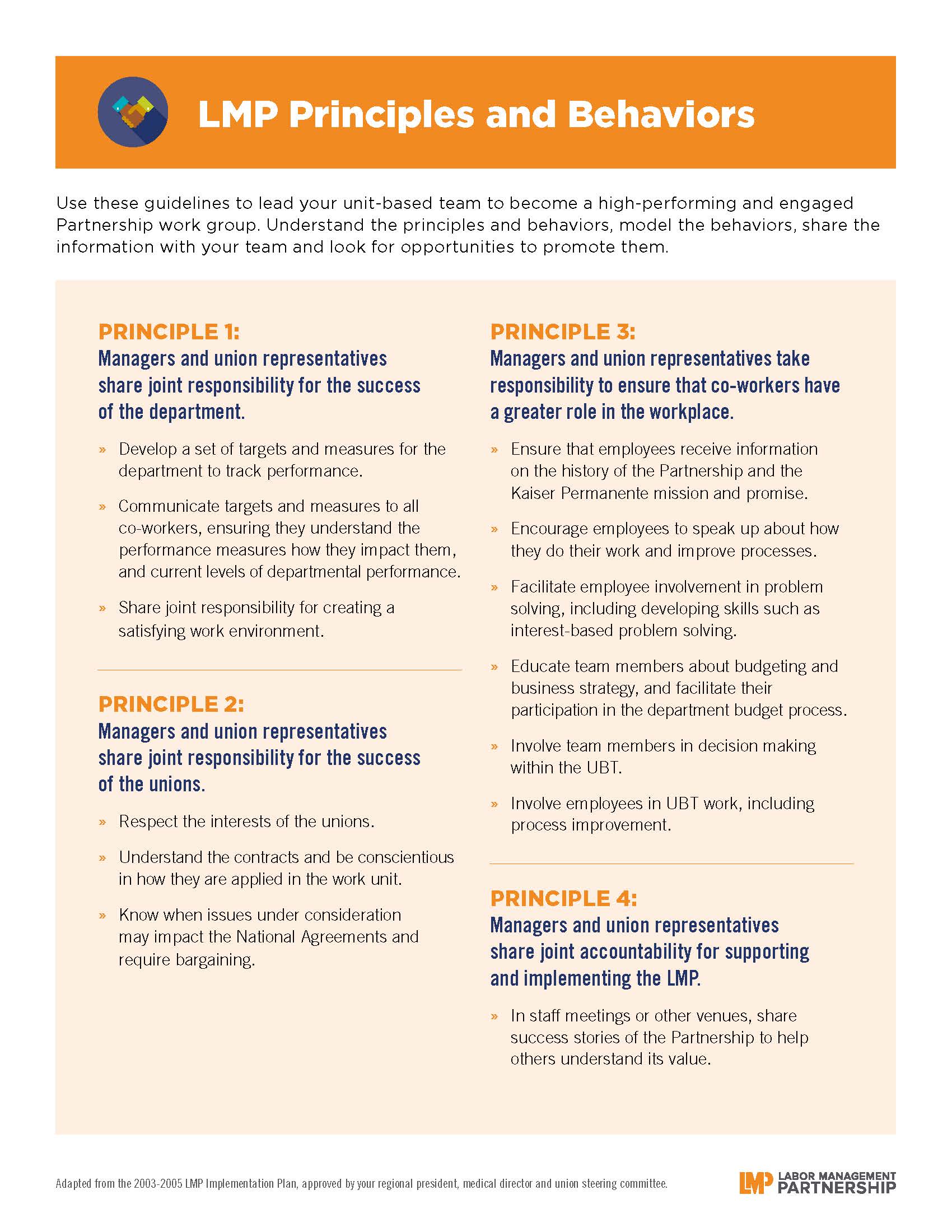
LMP Principles and Behaviors

Format:
PDF

Size:
2 pages, 8.5" x 11" (designed for 2-sided printing)

Intended audience:
Managers and stewards

Best used:
Supervisors and stewards can use this checklist to discuss how to fulfill their joint responsibilities for leading their teams. It includes 7 main principles and 37 related behaviors.


Related tools:

Turning Copay Collections Into a Team Effort

Deck: 
Southern California admitting team becomes one of the highest copay collectors in the region

When the Anaheim Medical Center Admitting department unit-based team set out to increase its collection of inpatient hospital copayments, it had several hurdles to overcome.

Some staff members had to get comfortable with asking for money from patients. Others had to learn how to calculate copayments. They also needed to notify Admitting of a patient’s pending discharge so copayments could be collected at the point of service.

And since the team goal of collecting copayments didn’t always dovetail nicely with individualized goals, that put some staff members at odds.

“We had created this unhealthy competition,” admitting supervisor/manager and union co-lead David Jarvis says.

They also had the problem of convincing staff members in other departments that collecting copayments from hospitalized patients was not a bad thing.

"They used to think of me as Public Enemy No. 1," says Patti Hinds, a financial counselor and member of SEIU UHW.

To educate and motivate staff members about the importance of collecting copayments, the unit-based team held a kickoff meeting in January 2010.

Staff members who were good at collecting and calculating copayments were deemed “master users” and received training so they could help their peers learn to correctly calculate amounts due. They also got pointers on speaking with patients about the money they owed.

"We wrote scripts, we role-played and, as people did it more, they became more comfortable with asking for money and with knowing when it is appropriate to do so," admitting clerk, SEIU UHW Patricia Hartwig says.

The team also had to teach staff members in other departments about the benefits of copayment collection.

"We showed them the bottom-line connection between revenue collection and their paychecks," Hartwig says.

Better working relationships developed between admitting department staff and the nursing units, prompting nurses to contact admitting staff more consistently before patients are discharged.

"They came to realize we’re not the 'bad guys,' " says financial counselor Marcela Perez, an SEIU-UHW member.

TOOLS

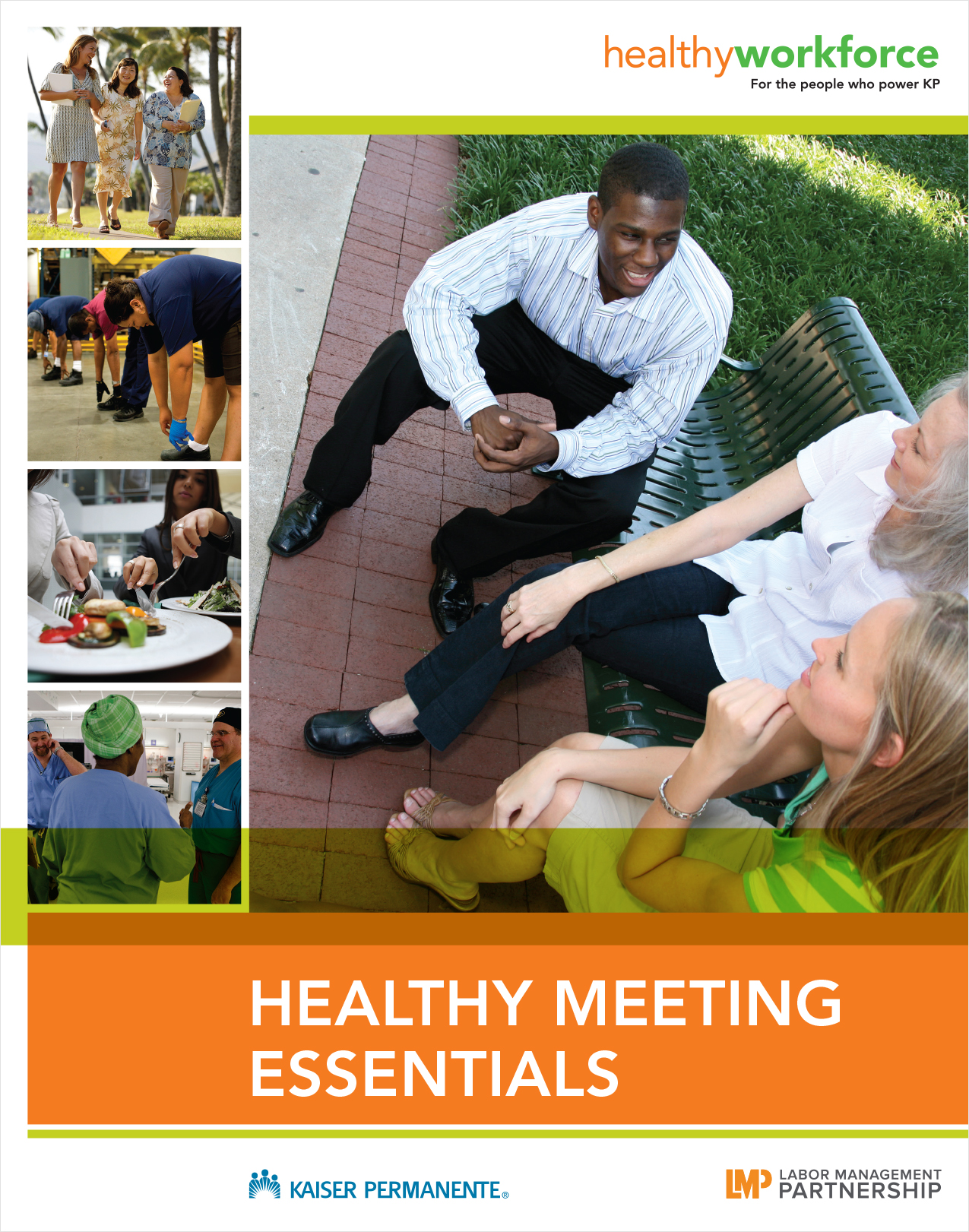
Healthy Meeting Essentials Guide

Format:
PDF

Size:
8.5" x 11"

Intended audience: 
Meeting planners, team leaders and support staff

Best used: 
Inspire your team to hold better, healthier meetings with these tips on activities, snacks and green products.


Related tools:

TOOLS

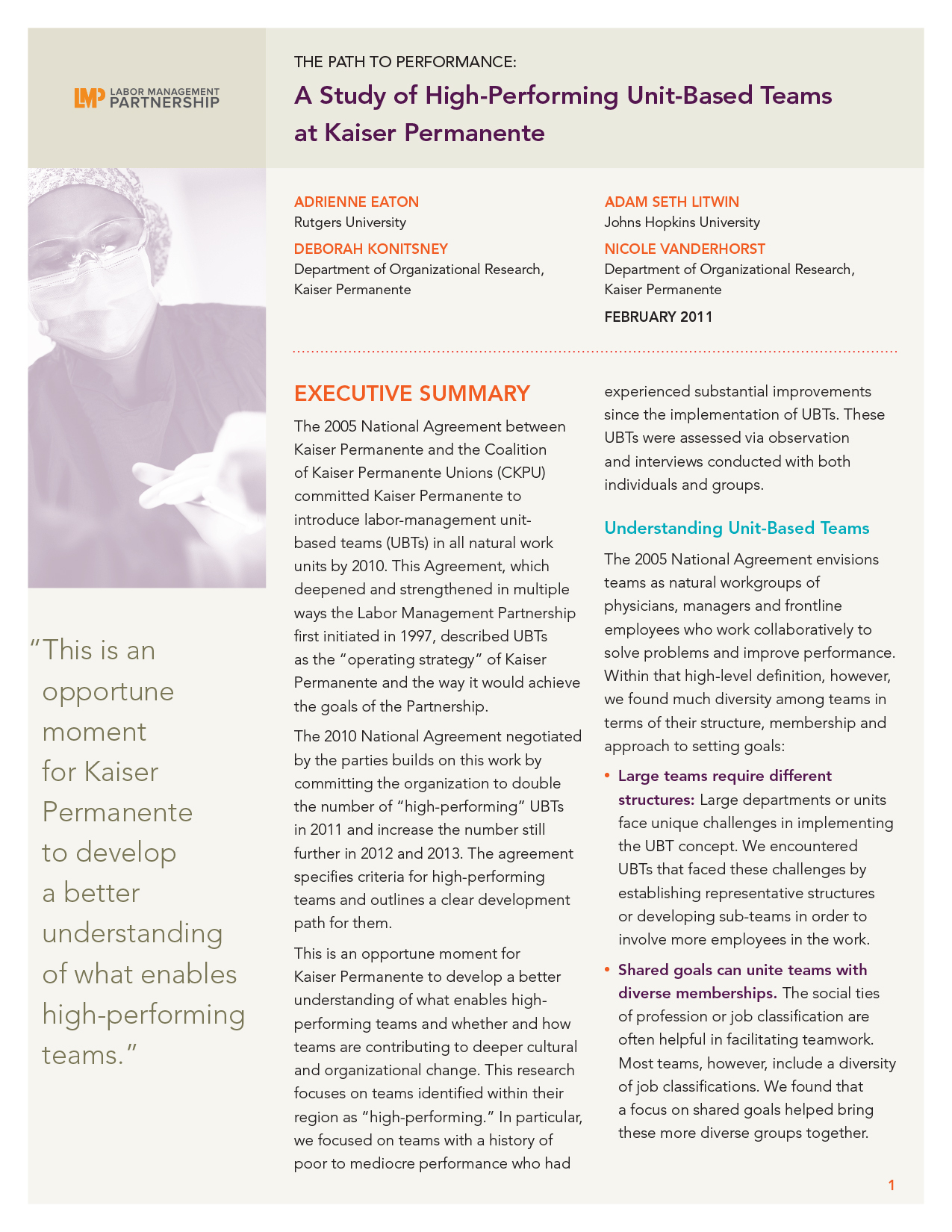
Study of KP's High-Performing Unit-Based Teams

Format:
PDF (15 or 3 pages)

Size:
8.5" x 11"

Intended audience: 
UBT sponsors, co-leads and members; KP and union leaders

Best used: 
To help unit-based team leaders and sponsors—and UBT members—better understand five elements that enable team performance and development.

Two options for reading:

  • The 15-page study by Rutgers University, Johns Hopkins and Kaiser Permanente researchers identifies five key enablers of unit-based team performance and development: leadership; line of sight; team cohesion; processes and methods; and infrastructure and support. The report includes examples of successful team practices in each area. It includes an executive summary and conclusions.
  • The 3-page executive summary of the study provides an overview of the findings, focusing on the five enablers of high performance. A good choice for those wanting a quick takeaway of these issues and for teams wanting to address issues raised by the study.
Related tools:

A Child-Friendly Environment Helps With Healing

Deck: 
Team lifts spirits with toys, trains, clubhouse and books

The Pediatric Neurosurgery team in Oakland couldn’t figure out why their staff courtesy scores were low.

They had a new office building and felt providing exceptional care was part of the routine.

Then union co-lead Tanya Johnson noticed there was very little for the department’s young patients and their families to do in the waiting room.

“Kids would be running up and down the hallway,” says Johnson, who is a medical assistant and SEIU UHW member. “Parents would be chasing after them and not being able to focus. It was crazy.”

The department of Pediatric Neurosurgery cares for children with a full spectrum of disorders, including tumors of the brain, spinal cord and peripheral nervous system.

“These kids are the sickest of the sick,” says service manager Jim Mitchell, RN PNP. “They have serious, serious conditions. Anything we can do to make their visit a little brighter, we do.”

So the team decided to create a child-friendly environment, and went to senior leadership for funding.

The improvements included a large, colorful playhouse, a treasure chest, books and toys in each of the patient rooms—as well as a custom-built train set.

“Everyone on the team had input as to how the clinic would be set up and where the items would be placed,” union co-lead and receptionist Leap Bun says of the improvements that cost about $18,000.

To ensure infection control, the toys are wiped down on a regular basis by Environmental Services employees.

And the atmosphere does a lot to ease tension for their medically fragile patients and their families. 

“The children are less threatened and want to come here to play,” Mitchell says. “It seems like every day we have parents on a regular basis having to coax their children to leave the clinic.”

In three quarters, department scores for staff courtesy increased from 69.6 percent to 90.3 percent.

“In addition to our MPS scores we can measure the change in the faces of the children we interact with,” Mitchell says.

For other teams interested in this type of project, they suggest field trip to other facilities doing the same work. The Oakland team visited Sacramento and Roseville to refine their workflow processes.

And the team also found that families with children choose to wait in the clinic, even if their appointment is elsewhere or they’re picking up a prescription from the nearby pharmacy.

"They tell us it’s a nice place to relax and to calm their kids down while waiting,” Bun says.

Smaller Teams Help Radiology Department Improve Performance

Story body part 1: 

After a false start, the diagnostic imaging department at Woodland Hills Medical Center has found its stride. Its results are impressive: By drawing on the wide experience of the team, it’s improving workflow and boosting attendance.

To get those results, the department created one large UBT with several subcommittees and involved a physician champion. Two radiology summits, which were held to set priorities, included the whole team: 

  • More than 160 employees and physicians who see a quarter-million patients a year.
  • Staff in eight far-flung clinics as well as throughout the medical center. They range in age from late teens to 40-year veterans of Kaiser Permanente.
  • Team members in eight areas of expertise, including ultrasound, MRI, CAT scan, nuclear medicine, mammography, general x-ray, and special procedures.  

From confusion to clarity

At first, the team’s diverse skills and experience flummoxed the department-based team (the term Woodland Hills uses instead of unit-based team).  

“We didn’t know the scope of our work,” says Selena Marchand, a lead sonographer and labor co-lead. “The old DBT got stalled talking about things like the doctors’ parking lot.”

Lessons for large teams

  • Ensure your representative group is truly representative: strive to create a structure that includes someone from each location, modality, shift, etc.
  • Include physicians
  • Reach out to trained facilitators for help
  • Focus on what your department has the power to change

A secret society?

In addition, says Marchand, the representative group—which was working without a facilitator—didn’t communicate with its co-workers about the DBT’s projects. “They thought we were some sort of secret society,” says Marchand, a member of SEIU UHW. 

The team restructured in October 2009, electing one delegate from each “modality,” as the areas of expertise are known, to the representative group.

“Pushing responsibility and accountability back to different modalities has been one of our successes,” says Mike Bruse, the department administrator and management co-lead. “We’re focused on things that we can control in our department.”

Summits get everyone involved

The co-leads convened two department-wide summits to focus on improving team performance and set priorities. Staff members brainstormed about what the challenging issues facing the department were and wrote them on flip chart pages on the wall. Then, each employee attached a sticky note to the issues that most concerned them. The team and managers set out to tackle the seven issues that received the most tags. As the work got under way, progress reports were posted in the employee break room to keep everyone on the team—not just the representatives—informed.

Better workflow

The department also improved the way it distributes film to radiologists, so that patients’ results get to primary care physicians faster. Before the change, technicians were forced to constantly interrupt doctors to read films. Now, there is a tally sheet on each radiologist’s door indicating how many films he or she is reading. This allows techs to know who is available to read a film—and allows radiologists to work undisturbed. An aide to the technologists tracks the process, acting as a traffic controller.

“It was a relatively simple thing that improved satisfaction and patient care a lot,” says Mark Schwartz, MD, who represents physicians on the UBT. “And it didn’t cost any money.”

Better attendance

The team also improved attendance, decreasing last-minute sick calls by 14 days from the end of 2009 to October 2010. They beat the Lab Department in a friendly competition two quarters in a row and were rewarded with a barbeque. To do this, team members simplified presentation of attendance data and posted up-to-the-minute metrics.  

Beyond these gains, management co-lead Bruse says the most significant change is employees’ confidence in their own ability to make improvements.

“Our meetings used to be ‘complain to Mike,’ ” he said. “These days, when people see a problem, they take steps to solve it themselves.”

How to Be an Effective Union Co-Lead

Deck: 
Commit to the time it takes and to collaboration and planning

Story body part 1: 

I am one of the chairs the LMP leadership team, along with a union colleague from UFCW and two management leaders. I’m also the co-lead of the Woodland Hills’ union coalition. In addition, I’m a full-time certified registered nurse anesthetist in the operating room. To be an effective labor co-lead takes three things: time, collaboration and planning.

Time

I have been doing partnership work at Woodland Hills for 10 years. People respect the time I’ve invested. You have to be on fire for this because it’s an enormous responsibility. It’s going to cost you time, angst and effort. And you can’t build relationships passing in the hall. You have to make the investment of face time. That means showing up at the LMP council meetings, monthly, from 8:00 a.m. to noon.

Planning Ahead

It is important to bring in and plan for new blood. At Woodland Hills, we rotate the labor co-chair in our leadership team every two years. I believe this allows everyone to have a say. It builds trust and experience. And it ensures buy-in from each union—and each segment of each union. We build-in mentorship. For three months, the new person sits in and the current co-lead shows that person the ropes.

We also did this in the Kaiser Permanente Nurse Anesthetist Association when I was president in 2006. I would go with new facility reps to meetings. 

Collaboration

We really foster union efforts at the medical center level. We’ve got a group of long-term union coalition people and our unions speak with a single, powerful voice. There have been issues between unions, and we had to work things out until cooler heads prevailed. People say ‘I’m sorry’ and move on.

Working with management is both easy and difficult. It’s easy because they are so partnership oriented and respectful of the unions, and they welcome input. They lead by influence—not by authority by virtue of where they are on the food chain—just like we do. It is difficult sometimes because it requires us to work hard as partners. Sometimes it would be easier to just go along with their recommendations, but then we wouldn’t really be doing our jobs as union leaders. At certain points, you have to say, ‘Well, let me think about that,’ and ask your constituents what they think.

Hospitals are traditionally very hierarchical. The partnership is such an opportunity to have a voice.

Improving Patient Care by Speaking Spanish

Deck: 
Team helps provide culturally competent care by speaking Spanish from reception to examination

Story body part 1: 

Imagine developing a severe cough and teeth-chattering chills. You want to be seen by a doctor but no one really understands you: Not the call center operator with whom you try to make an appointment; not the receptionist who checks you in; not the medical assistant who takes your temperature and blood pressure. Not even the doctor who speaks quickly and uses complicated medical terms.

“When you come in for medical care, it’s already like a foreign land,” says Kathleen Kearney, the manager and the UBT co-lead for the Obstetrics and Gynecology department at San Jose Medical Center.  “If you don’t speak English, it can be downright frightening.”

Giving patients better access

Kaiser Permanente has long been committed to providing language access in the form of interpretive services for its non-English speaking members. The Ob/Gyn unit-based team in San Jose has taken the additional step of creating a Spanish-speaking module, a sort of one-stop shop for Spanish-speaking patients.

The idea for the module came from Joseph Derrough, MD, who recognized that good patient care involves more than just the patient and the physician in the exam room. It includes each interaction, from making an appointment to checking in and being assigned a room.

“I realized that we had a significant percentage of patients who only spoke Spanish, and we could do better service to them by providing linguistic and culturally competent care,” Dr. Derrough says. “We had staff that spoke Spanish, but they weren’t all in the same place. My vision was that we could create a clinic module where, from registration to examination, the patient was spoken to in her own language.”

Making it happen

The unit-based team made it happen.

“From the time they walk in the door, every patient should receive the same level of care regardless of the language they speak,” says Glenda Morrison, a medical assistant, SEIU UHW chief shop steward and the UBT co-lead.

But in the beginning, the frontline staff members, including Morrison, were skeptical.

“Since we were already serving Spanish-speaking patients in our clinic, the question we were asking was, ‘Why is this needed?’ ” Morrison says.

But a visit to the Spanish-speaking Medicine module at the Santa Clara campus made them believers. That module has been in place for five years.

“When I saw it in action, a light went off—and I realized that by not speaking to our Spanish-speaking members in their own language, we weren’t providing them with the same care as we were our English-speaking members,” Morrison says.

Overcoming obstacles

Once the team decided to take on the project, it faced some challenges. Offices had to be moved and medical assistants had to be reassigned.

“We had a lot of meetings and a lot of nervous people,” Morrison says.

But again, the Santa Clara example eased fears: “Once they saw how it worked in Santa Clara, we got by-in from the staff and it was easier,” Kearney says.

The module, which opened Sept. 29, includes signage and literature in Spanish. The staff members, from the receptionists and medical assistants to the doctors, are fluent Spanish speakers.  Word about the new module went out through Spanish-speaking television news and newspaper reports. And there was a grand opening.

It’s going well so far, Kearny says, noting that “we have three Spanish-speaking providers each day, and they have appointment capacity for about 20 patients.”

Next steps

Now, the team is looking for ways to quantify the benefits of the new module. It’s hoping to be able to collect patient satisfaction data specifically from Spanish-speaking members to assess the impact, Kearney says.

“If it shows success, we’ll pass the idea on to other teams,” she says.

Meanwhile, the unit is looking at how it can provide culturally competent care for its other monolingual patients.

“We don’t what a certain group to feel singled out,” Morrison says. “We just want them to feel comfortable.”

A UBT Sponsor Explains How to Support Change

Deck: 
Removing barriers and providing perspective are key

Story body part 1: 

When you get to the leadership level it’s easy to become disconnected and to forget that where the rubber meets the road is at the front line. Sponsoring a unit-based team helps me stay connected—and that helps me be a better manager.

Staying connected

As a sponsor for the Medical Secretaries and Scanning Center, I help the teams see where they fit in the bigger picture—and they help me see the challenges that teams face every day.

I check in with the teams and their co-leaders regularly, make sure they’re accomplishing their goals and doing work that meets regional and national goals. They have their own ideas for improving department operations and doing their own small tests of change. I help them think strategically about how they can impact the region and Kaiser Permanente as a whole.  

There will always be the manager-employee relationship, but when you walk into a UBT meeting, you leave the hierarchy at the door. To build credibility, everyone on the UBT must have an equal voice at the table. I believe in the partnership and, yes, there are a few times when a manager shoulders the responsibility and has to make decisions about regulatory compliance issues, regional strategic direction and planning, scope of practice discussions about licensures and policies, and personnel management. But there are a lot of other decisions that staff can be a part of making in a group setting, and getting buy-in from the folks who do the work makes all the difference in the world.

Removing obstacles

Because I’m in a leadership role, it is important that I help the teams overcome barriers. If they need help understanding a goal, metric or budget, I can gather the information and package it in a way that is most helpful to the team.  When I started working with these teams in 2007, they were already doing good work despite some major obstacles. The chartroom transitioned to the scanning center, and the medical secretaries had a lot of manager and staff turnover, and had difficulty meeting performance metrics. Now both teams are high functioning. They have accomplished so much in the last two years.

So to other sponsors I say, don’t be afraid to jump in. It’s so rewarding to see your teams grow. If we are going to improve performance, we’ll need engagement at all levels of the organization, and the UBT process allows that to happen.

Many Small UBTs Do What One Large One Can’t

Deck: 
The Charitable Health Coverage Operations department reorganizes—and achieves a goal that had eluded it for years

Story body part 1: 

The employees in Charitable Health Coverage Operations (CHCO) felt good about their Northern California department’s mission—but not so good about how long it took sometimes to help the thousands of low-income children who benefit from KP-subsidized health care.

The department handles the eligibility paperwork for a KP program that provides health coverage to people who don’t qualify for employer-based health coverage or public programs like Medicaid. At the team’s low point in 2005, it had a six-month applications backlog.

“Our primary customers are children,” said Nancy Waring, CHCO customer care manager. “We have over 80,000 children, most of them low income. About 50 percent of our population is Spanish speaking. And the program is completely subsidized by Kaiser.”

Too large a group

In the past, one representative unit-based team encompassed the whole department.  Because employees within the same department were doing very different types of work—processing mail, entering data, processing enrollments, providing customer service, and servicing the regions outside of California—they didn’t share a single set of problems. So the UBT tended to work on departmentwide problems like attendance.

But the single UBT struggled.

 “We basically failed from 2006 to 2009 to do anything,” says Suber Corley, the department’s director, “simply because we were looking at too large a group trying to solve too large a problem.”

So they reorganized. The department now has five UBTs that correspond with employees’ functions.

Setting priorities

The smaller teams set their sites on a number of changes, but they also coordinated with each other on one common goal: to process every application by the 20th of the month.

In their UBT, the mail-room employees decided to look at priorities differently.

“We identified that what we really needed to do was to have a prioritization scheme for every week of the month,” says Victor Romero, CHCO operations manager. He explains that during the first week of January, a recertification application that’s due on April 1 would be low priority in the mail room, whereas a new application—which would need to be processed by January 20 for insurance coverage to begin on February 1—would be high priority. After the 20th, attention moves to the low-priority documents.

The data entry, scanning and enrollment UBTs came up with other solutions, too.

“We instituted several changes in how the application is handled,” says Carl Artis, an enrollment processor team lead and OPEIU Local 29 shop steward. “If we couldn’t process an application, the application was sent back to the customers very early so they could make necessary corrections. We also streamlined our process—there were some things we were doing twice, which wasn’t necessary.”

Artis emphasizes that the changes were developed jointly by frontline workers and managers.

“I have to admit they (the managers) have some really great ideas,” he says, “and they were really able to listen to some great ideas.”

It worked. In October, for the first time in the department’s history, the team was able to process all its new applications by the 20th, so coverage for those applicants could start in November.

“The end result is that poor children did not go without health coverage,” Romero says.

Addressing burnout

In addition to the project to reduce the amount of time it takes to process new applications, the smaller teams have taken on other projects, like reducing burnout among customer service agents who spend all day answering phone calls. They’ve also done charity work together, raising funds to provide school supplies for low-income students at a local high school.

Artis passes on the story of his department’s flourishing UBTs to other members of Local 29.

“I’ve heard some people say, ‘Oh, that’s too much work to take on,’ or, ‘We don’t have the resources we need to address the issue’ or ‘Management would never go for that,’ ” Artis says. “But what I’ve learned is—just try it, and don’t be afraid to fail.”

Pages

Subscribe to RSS - lmpartnership.org