lmpartnership.org

Help Video

How to Find UBT Basics on the LMP Website

Learn how to use the LMP website:

LMP Website Overview

Learn how to use the LMP website:

How to Find How-To Guides

This short animated video explains how to find and use our powerful how-to guides

Learn how to use the LMP website:

How to Find and Use Team-Tested Practices

Does your team want to improve service? Or clinical quality? If you don't know where to start, check out the team-tested practices on the LMP website. This short video shows you how. 

Learn how to use the LMP website:

How to Use the Search Function on the LMP Website

Having trouble using the search function? Check out this short video to help you search like a pro!

Learn how to use the LMP website:

How to Find the Tools on the LMP Website

Need to find a checklist, template or puzzle? Don't know where to start? Check out this short video to find the tools you need on the LMP website with just a few clicks. 

Learn how to use the LMP website:

Five Tips to Help Teams Achieve Their Goals

Deck: 
Senior Orange County executive share keys to success

Story body part 1: 

I have worked at Kaiser Permanente for 33 years, starting as a distribution worker in materials management. Being on the front lines helped me better understand the challenges staff face—and helped me, in my current role, see what it takes to spread and sustain change in a complex organization.

When we launched our first unit-based teams in 2007, I knew they could give our managers and teams a powerful tool for change. But to achieve their full potential, UBTs need the support of leaders at every level. In working with UBTs every day, I have found five practices that can help teams achieve their goals, and have helped me be a more effective leader.

Have patience

I’m not a patient person by nature, and it took a visit to the world-class health care system in Jonkoping, Sweden, for me to see that it takes patience to sustain meaningful change. When you’re solving problems in a team-based workplace, real systemic change takes time. But it also takes hold deeper into the organization.

Really see the work

Spend time with a UBT, or hear teams present their test of change, to understand what they’re working on and how you can support them. There’s no way you can feel the excitement and energy from the team members and not feel proud and motivated by their work.

Spread good work

In Orange County—which has two large hospitals, in Irvine and Anaheim—we expect all teams to continually test and then spread their ideas and successful practices. We call it “One OC” and we talk about it all the time. You’re never going to achieve greatness globally if you don’t spread good work locally.

Provide tools

Early on we formed an Integrated Leaders group of senior labor and management leaders who meet monthly to monitor and assist our 107 UBTs. If a team is struggling, the IL group doesn’t descend on them and try to fix the problem. We provide tools and resources that help the team work through a problem and get results. For instance, we put together a UBT Start-up Toolkit with information on everything from setting up teams to finding training. We’re also looking at toolkits on fishbone diagramming, conducting small tests of change and providing rewards and recognition. And we’re asking how to make it easier for teams to access resources quickly—for instance by identifying go-to people for questions on budgeting, patient satisfaction metrics and so on.

Then, get out of the way

 I have a saying: “Hire great people, give them the coaching and mentoring they need, then get the heck out of their way and let them do what they were hired to do.” I think that works at all levels of the organization, whether or not people are your direct hires. You don’t tell people to make a change or streamline a process without any encouragement or support, but you don’t need to micromanage them either. Delivering great health care is not just a job. It is a calling. Whether you’re a housekeeper preventing infection or a surgeon treating cancer, people’s lives are in our hands. That shared mission drives us to be the best.

TOOLS

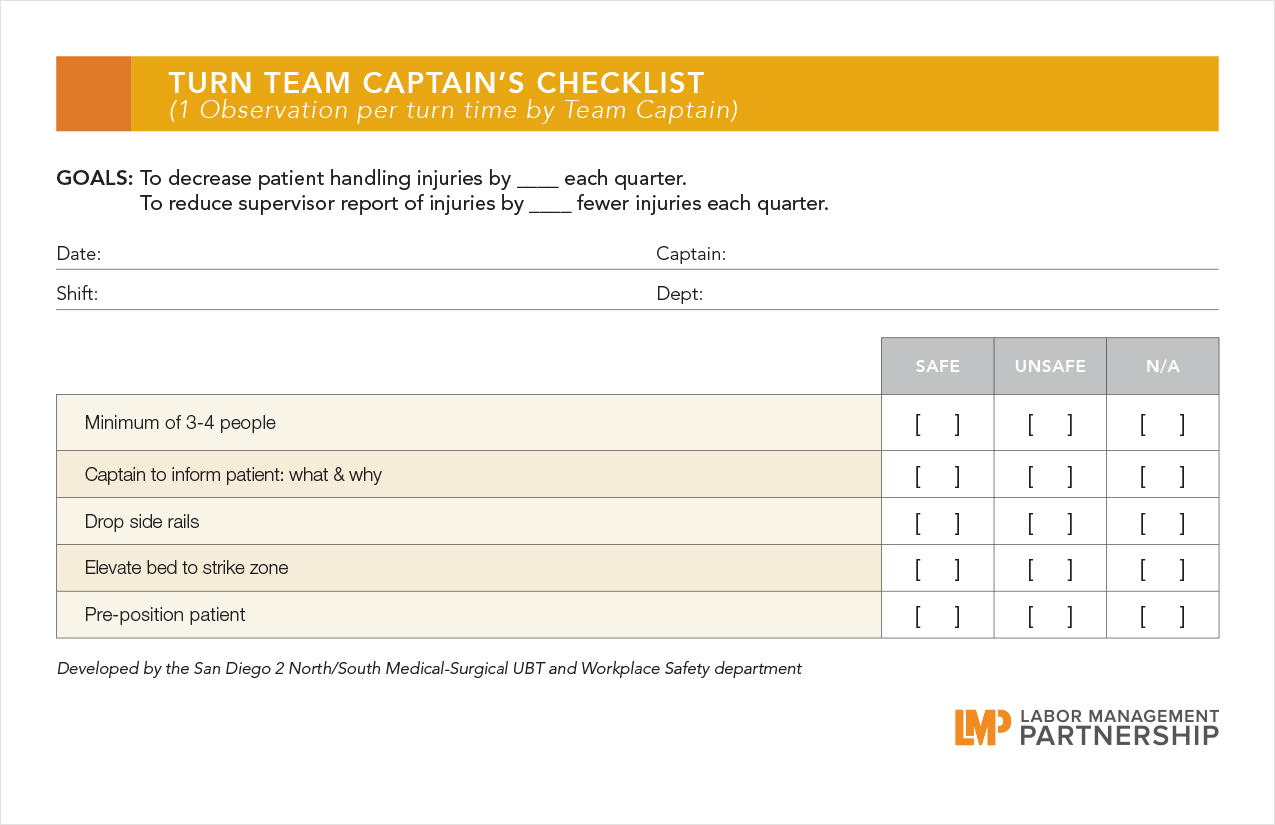
Checklist for Turn Team Captains

Format: 
PDF and Word DOC

Size:
8.5” x 11”

Intended audience:
Captains of turn teams

Best used:
Use this checklist when turning a patient to ensure the procedure is done safely and the chance of injury is minimized. 


Related tools:

Cracking the Case of the Missing Lab Orders

Deck: 
Enforcing the law of the lab improves workflow

Patients and specimen samples showing up without orders was a common occurrence at the East Denver Medical Office lab.

In some cases, orders weren’t in the system because there was confusion between the provider and the nurse about who ordered the test. Other times, patients were directed to the lab without verification of a lab order; and orders simply expired.

This lack of follow-through was inconvenient for the patient, who would have to go back to his or her doctor, or wait for a lab employee to contact the department. In some cases, the patient would have to make a second trip.

So, the East Denver team decided to crack down and got a little creative.

They developed an “enforcement” theme and dressed up in police uniforms to issue citations to “violators” as they tracked patients with no orders.

Departments with the most improvement were honored with coffee and donuts. Those that met the criteria for sustained success were recognized with lunch.

OB/GYN went from 42 “violations” in a seven-week period to 34 in a 10-week period. Pediatrics went from 16 occurrences to a single one in similar time frames.

“At first, we didn’t give them (other departments) the specific data,” lab clinical manager Lucy Tyler says. “Then OB asked for it so we started giving it to everyone.”

The team found by tracking the data, they discovered who needed help, and they worked with that team to solve the problem. By showing each department when they were sending patients and specimens to the lab without orders, they could see they were part of the problem.

In some cases it was a surprise.

“This work supports X-ray and pharmacy, too,” phlebotomist Alma Lahti says. “It’s improving orders in other departments.”

TOOLS

2010 National Agreement: A Summary

This eight-page summary of the 2010 National Agreement focuses on several key areas including:

  • The economic package
  • Performance improvement
  • The Performance Sharing Program (PSP)
  • Attendance
  • Workforce Planning and Development


You can also download the full 2010 National Agreement.

Related tools:

TOOLS

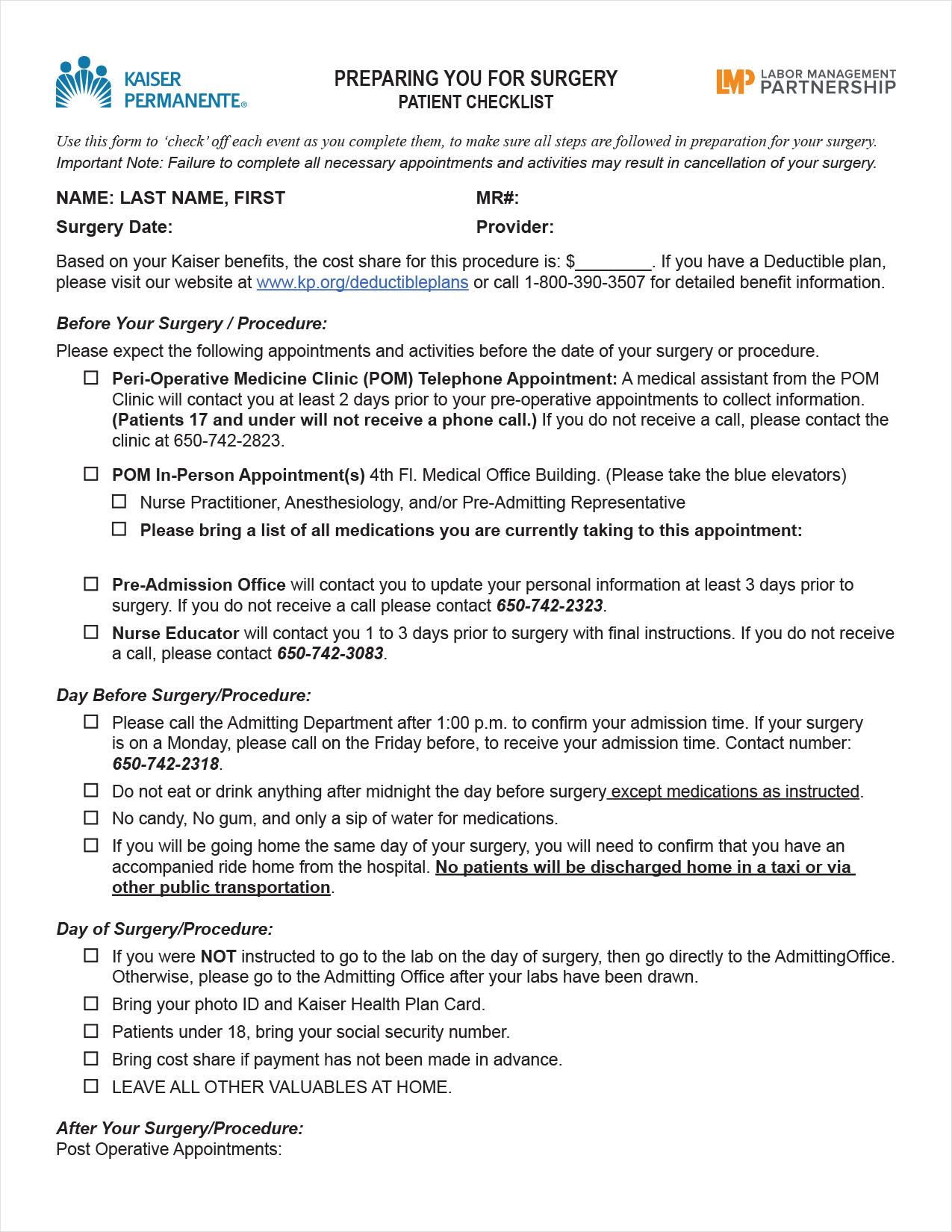
Preparing You for Surgery

Format:
PDF and Word DOC

Size:
1 page, 8½” x 11”

Intended Audience:
Teams working on improving the pre-surgery process for patients.

Best used:
Use this document as a model to consider how your facility might revamp the presurgery process and create your own one-page checklist for patients. 
This checklist was developed by a multidepartmental team in South San Francisco that wanted to streamline the presurgery process for patients. As a result of using it, 80 percent of patients are now being confirmed as pre-admitted 24 hours before surgery and the completeness and accuracy of admissions rate has hit 99.4 percent.

Read more about the process in the Fall 2010 Hank.


Related tools:

TOOLS

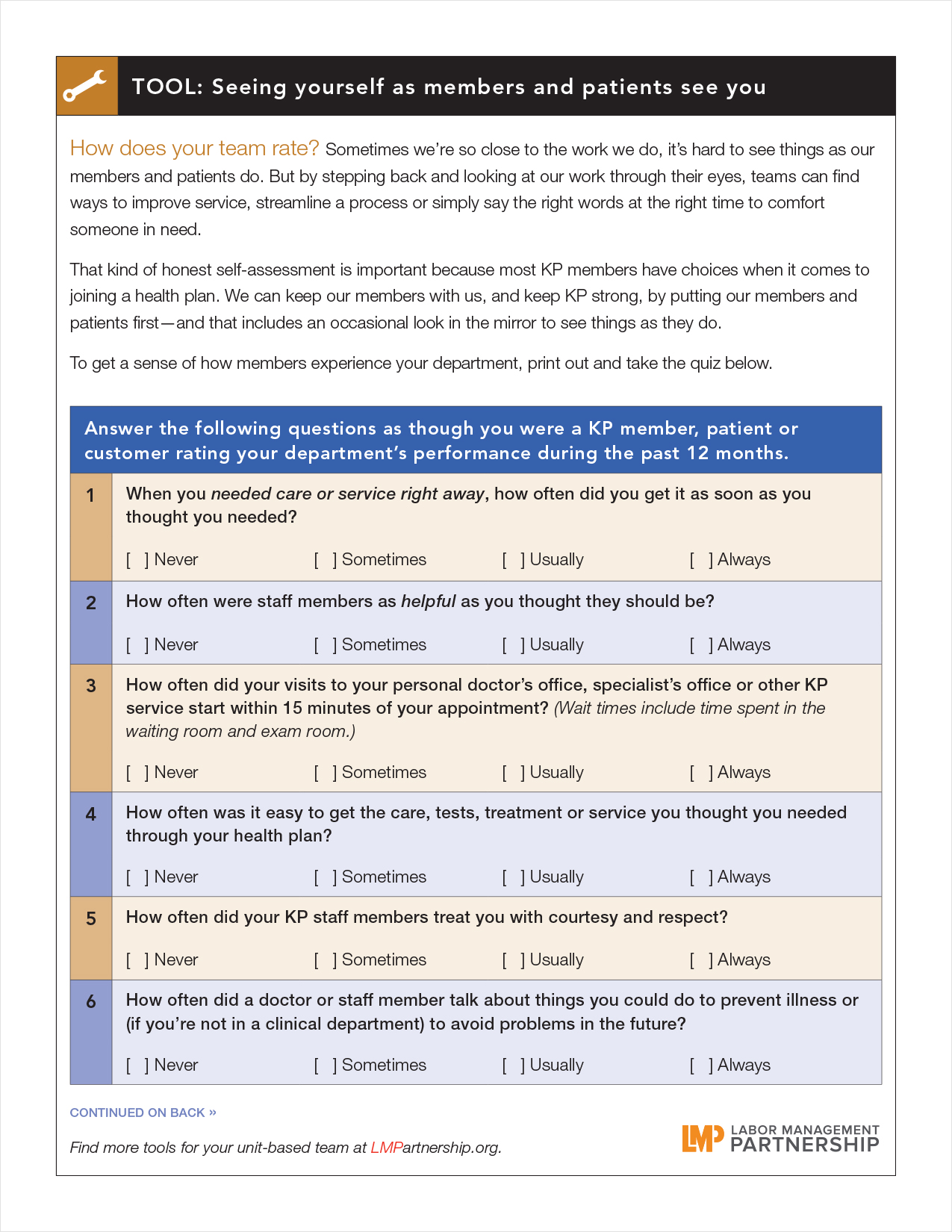
How Does Your Team Rate?

Format:
PDF

Size:
8.5" x 11" 

Intended audience:
Frontline managers

Best used:
Get a sense of how members experience your department by responding to these sample questions as though you were a KP member or patient rating your team's performance.

Related tools:

UBT Sends Message on Colon Cancer Screening

Deck: 
Union City team effort helps save lives

Various interventions have been implemented to increase the rate of colon cancer screenings, including at-home Fecal-Immunochemical Tests or FIT kits. These kits are mailed or handed to patients identified as age- or risk-appropriate and can be completed in the privacy of the member’s own home.

The FIT kit doesn’t require a doctor’s appointment and is returned directly to the lab in a prepaid envelope. Patients who have positive FIT kit results for occult blood are referred for further testing.

“A long time ago, there was no way to track these people,” Kari Russitano, medical assistant, SEIU UHW, says. “Kaiser has done a lot to improve cancer screenings.”

But getting members to take and return the test remains a problem.

In 2009, the Union City Medical Center fell short of its 71 percent return rate goal for colorectal screenings. Kaiser Permanente routinely mass mails the kits to members identified through the electronic medical records database. But many members either don’t return the tests or the ones they return aren’t legible.

“Thirty percent were thrown away because we couldn’t read their name or the medical record number,” Deborah Hennings-Cook, RN, manager, Internal Medicine, says.

Clinical coordinator, Vimi Chand, Department of Internal Medicine, adds, “Obviously mailing alone wasn’t working, so we decided to contact members by phone or secure email. And it worked.”

Of the 1,754 members contacted, more than 63 were referred for further screening. 

Having the medical assistants and receptionists make the calls was a hard sell at first, but their peers in the unit-based team stressed the preventive nature of the test.

“It didn’t seem like extra work, because we collaborated together and educated each other to think of it as if ‘this could be your family member,’” Sophia Opfermann, receptionist, OPEIU Local 29, says. “A lot of staff didn’t know what the FIT kits were for, so we educated them about that, too.” 

Then frontline staff came up with the idea for the note cards—bright fluorescent notes that read: “This test detects early signs of COLON CANCER.”

“Knowing that many people don’t understand the importance of the test, they made the verbiage strong about ‘saving lives’ and ‘help us help you,’" Hennings-Cook says. "It was something they wanted to do, and it worked.”

One challenge was adding the phone calls and emails to the medical assistants’ existing workload. Lists of patients who hadn’t responded were provided to medical assistants but some had more than others.

“We heard a little bit of flak when the lists first came out and some MAs had huge lists, but they helped each other and just did it,” Chand says. 

In the end, the bottom line was helping patients.

“By collaborating together and educating each other, we are helping to saving lives,” Opfermann says.

Need to Build Your Team? Join the Club

Deck: 
Or, says a Southern California manager, start a healthy eating club to bring your team together

Story body part 1: 

Managers newly charged with co-leading unit-based teams sometimes need to build team cohesion before diving into the nitty-gritty of setting goals and improving performance.

Brenda Johnson, optical site supervisor at the South Bay Medical Center in Southern California, has found a way to do just that—and improve her staff’s eating habits at the same time.

Inspired by a presentation at a regional leadership conference hosted by Jeffrey Weisz, MD, executive medical director of the Southern California Permanente Medical Group, she launched a healthy eating club in her department. Every week, staffers chip in $12 each—and get four healthy, fresh-cooked meals in return.

At the early spring meeting, Dr. Weisz discussed Kaiser Permanente’s Healthy Workforce initiative and distributed a booklet listing the calorie count of hundreds of food items.

Making change easier

“I looked at the book, and I thought, ‘Oh, my goodness,’” said Johnson, shocked at the number of calories in some of her favorite foods.

“I looked around at my employees,” she said. “Some have health issues. Some drink sodas by the 32-ounce cup every day.” The medical center is ringed by mini-malls with fast food restaurants. “We’ve been eating the same stuff for years,” she said. “The only question was who’s going to go pick it up.”

Gil Menendez admits he was one of the 32-ounce-cup soda drinkers—a habit he gave up when he joined the club. Menendez, an optical dispenser, SEIU UHW member and  labor co-lead of the UBT, was so motivated by the changes in his lunchtime habits that he also began a strict diet and exercise routine. He’s lost 20 pounds.

New ways to work together

Johnson cautions that the healthy eating club isn’t a diet club. She picks recipes out of a pamphlet produced by the California Department of Public Health, Champions for Change, and prepares the ingredients at home. Others sometimes prepare recipes from their families and cultures. She combines ingredients in the morning, steams them in a slow cooker the staff keeps at work, and a meal is ready by lunchtime.

“I have to cook for my family anyway,” says Johnson. At home, “We’ve changed our habits because of high blood pressure. I prepare this food with love because I’m preparing it for both of my families: my family at home and my family at work.” 

About 15 to 20 people participate in the club each week, up from 10 when it first began in May 2010. In addition to its health benefits, the club has helped her department be more productive and collegial, says Johnson.

“It’s going strong,” adds Mendez. “It brings us together.”

Sand Canyon Goes Green With Blue Wrap Recycling

Deck: 
Project saves money and helps the environment--and assists local disabled adults, too

Story body part 1: 

Looking for ways to make the Sand Canyon Surgicenter in Irvine more efficient, Albert Olmeda wound up learning a lot about blue wrap—like the fact that it makes up nearly 20 percent of the waste generated by hospital surgical services. 

The lead Central Services technician and SEIU UHW member also learned that this heavily used hospital product, an industrial strength plastic used to maintain the sterility of medical and surgical instruments until opened, is not biodegradable and persists in the environment. 

But recycled blue wrap can be sold as raw material for use in the production of other plastic products. Today, the surgicenter’s unit-based team has gone green with a blue wrap recycling project that is not only saving money and protecting the environment, but also aiding the community. 

“The biggest problem with the blue wrap is when we throw it in the landfill, it’s there forever,” says Olmeda. “That’s a big concern especially considering how much blue wrap we use.” 

How recycling works

About 600 pounds of blue wrap is collected every week from the center’s six operating rooms. It is picked up free of charge and sorted by Goodwill of Orange County, which sells it to a Houston recycling services company. The company reprocesses the plastic into beads that are used in various products, including railroad ties, pallets and artificial siding for decks, docks and houses. 

The surgicenter has been recycling its blue wrap and plastic bottles since September 2009, reducing the facility’s solid waste disposal fee by 10 percent annually. The savings amount to a modest $5,880—but there’s a greater payoff. Proceeds from the sale of blue wrap and other recyclable products enable Goodwill to provide education and training programs for developmentally and physically disabled adults, including a state-of-the-art fitness center. 

Peter Bares, business development manager for Goodwill of Orange County, says the relationship with Kaiser Permanente has gone beyond expectations. “It is kind of the perfect storm because of the nature of what we do and why we do it and the materials that the hospital generates,” he says. 

Getting buy-in

As the frontline staff person responsible for the surgery center’s blue wrap disposal, Olmeda—and his fellow UBT members—championed the recycling cause, educating the staff at weekly in-services and UBT huddles.  The team got the rest of the department on board by integrating the blue wrap recycling process without creating additional tasks. 

“We figured if we changed workflows, staff wouldn’t want to do it.” says UBT co-lead Nicole Etchegoyen, a surgery scheduler and SEIU UHW steward. “But if we asked them, ‘How would this work best for you?’ then everyone would get involved, and they did.” 

The team members designated a single container for blue wrap in each operating room. They also placed a larger bin for collecting multiple bags of discarded blue wrap near the soiled utility room, where the trash is taken on its way out of the surgery center. 

“It’s not a big deal,” EVS worker and SEIU UHW member George Sollars said, hoisting bags. “We just carry it over here on our way out this door. It’s one of the easiest jobs. And it’s for a really good cause.” 

No trash, just recycling 

The hardest part was making make sure that other trash didn’t make it into the blue wrap recycling containers accidentally. Labeling the containers with signs reading ‘Recycling Blue Wrap Only’ helped, as did regular reminders by UBT members. 

Now, everyone in the operating rooms—from doctors, nurses and surgical techs to nursing assistants and EVS workers—makes sure that the blue wrap containers aren’t contaminated with other trash, Etchegoyen says. 

Olmeda does periodic spot checks. “Everybody who plays a role in the operating room has to look out to make sure no trash is going inside the containers,” he says. “It’s a team-building thing.” 

“If it wasn’t for the UBT, this wouldn’t be happening,” said Ramin Zolfagar, MD, department head and UBT member. “We are helping the environment by ‘going blue,’ so to speak, and the end result is gym equipment for the disabled—which makes it all the more worthwhile.” 

After learning about the project at a recent Orange County UBT fair, other departments are thinking about emulating it. 

Visit the Goodwill of Orange County website to find out more about their work.

Secondary Blood Pressure Screenings Rise, Improve Care

Deck: 
Department explains the "why" behind the tests

The team in the Head and Neck Surgery/Audiology department at the South Bay Medical Center had been compiling monthly reports about missed second blood pressure checks.

And this can be a critical point for a patient’s care because high blood pressure is often called “the silent killer.” Those who have it often don’t exhibit symptoms until it’s extremely high, and untreated hypertension can lead to heart disease, stroke and kidney problems.

But the team reviewed the numbers without a follow-up plan.

So, they decided to have morning huddles several days a week to explain the screenings and follow with plans of action.

“We discuss why this is important and what it means to our members, that it can save lives, especially for those who haven’t been diagnosed,” says Kathy Malovich, the department administrator. 

UBT leaders provided team members with their individual performance scores on administering needed second blood pressure tests. They customized training and other follow-up plans, including coaching the team on procedures for Proactive Office Encounters (a process that takes advantage of a member’s visit to ensure the member gets any needed tests or appointments).

At huddles, they discussed the importance of controlling high blood pressure for patients. They emphasized that not only was it a strategic clinical goal but a Performance Sharing Program (PSP) goal for the medical center.  

“People think they’ve done the second test because they know they should have,” says Leroy Foster, who was the department administrator when the test of change began. “Maybe they got distracted by any number of things.” Foster said the hard data helped motivate the team. 

With a low of 35 percent for second blood tests, each team member jumped to 92 percent or better in a year. Four of the six team members hit 100 percent. In 10 months, team scores for second blood tests went up from 84.8 to 92.1 percent.

Huddling was also a key to success.

“I used to think, ‘you guys have way too many meetings,’” Jennell Jones, the union co-lead, says. “But now I see how meeting keeps people connected.”

Pages

Subscribe to RSS - lmpartnership.org