lmpartnership.org

Help Video

How to Find UBT Basics on the LMP Website

Learn how to use the LMP website:

LMP Website Overview

Learn how to use the LMP website:

How to Find How-To Guides

This short animated video explains how to find and use our powerful how-to guides

Learn how to use the LMP website:

How to Find and Use Team-Tested Practices

Does your team want to improve service? Or clinical quality? If you don't know where to start, check out the team-tested practices on the LMP website. This short video shows you how. 

Learn how to use the LMP website:

How to Use the Search Function on the LMP Website

Having trouble using the search function? Check out this short video to help you search like a pro!

Learn how to use the LMP website:

How to Find the Tools on the LMP Website

Need to find a checklist, template or puzzle? Don't know where to start? Check out this short video to find the tools you need on the LMP website with just a few clicks. 

Learn how to use the LMP website:

Polish Your Skills, Save the Planet

Deck: 
Southern California EVS teams go green with new certificate program

Story body part 1: 

Cutting waste and saving money for Kaiser Permanente members and patients is good. But 350 Environmental Service workers in Southern California are taking that mission a step further by tending to Mother Earth as well.

Kaiser Permanente and two Labor Management Partnership-funded workforce development trusts are among the health care partners nationwide that are training frontline workers and managers in improved recycling, waste disposal, energy conservation and other green practices. The U.S. Department of Labor and the Healthcare Career Advancement Program, a national partnership of unions and hospitals, are leading the effort.

“‘Carbon footprint’ is a phrase that’s thrown around a lot,” says Milford “Leroy” Alaman, EVS operations manager at the Los Angeles Medical Center. “Now our staff is able to understand that when you are talking about conserving energy, water and electricity, you are talking about looking at the resources we have in our facility and holding on to just what we need instead of creating more waste for us and the planet.”

Leading change at work

Along the way, these “green teams” also are reducing operating costs, enhancing employee skills and morale, and improving patient and workplace safety. 

For example, the EVS department is now using environmentally friendly microfiber mops to clean a single patient room. This has the benefit of not spreading infections between rooms and preventing lifting and straining injuries caused by wringing traditional mops and hauling buckets of water.

The department also has started a project that is reducing the cost and trouble of replacing the 500 D-cell batteries used in the hospital restrooms’ automatic towel dispensers. The traditional batteries wore out in a matter of weeks—costing about $3,000 a year to replace and adding some 6,000 batteries a year to local waste or reprocessing streams. Starting in February 2012, workers installed new rechargeable batteries. Overall, EVS' green projects, including the use of rechargeable batteries, are saving an estimated $12,000 a year.

Enhancing skills, raising sights

“I feel better having conversations with anyone…doctors, nurses, I can tell them how to be green,” says EVS attendant Jose Velasco, an SEIU UHW member and a recent graduate of a green certification course offered at West Los Angeles Community College.

The program also was piloted at KP Riverside Medical Center, where the EVS unit-based team is reaching out to others with its newfound expertise. Now an EVS member is embedded with the Operating Room UBT—with others to follow—to help tackle waste and hygiene problems there.

The SEIU UHW-West & Joint Employer Education Fund and the Ben Hudnall Memorial Trust have helped underwrite the cost of the training for Kaiser Permanente’s LMP-represented workers. Eventually, frontline workers may be able to use their certifications for higher pay and promotions as medical center “green leads,” a program that would be negotiated between KP and the unions.

But the training already is making a difference to workers as well as to KP and the community. “They have more tools, more knowledge, so they are able to catch things,” says Angel Pacheco, management co-lead of the EVS UBT at Riverside. “We talked about saving the environment for future generations.”
TOOLS

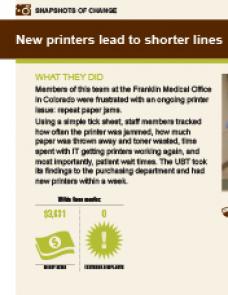
PPT: New Printers Lead to Shorter Lines

Format:
PPT

Size:
1 Slide

Intended audience:
LMP employees, UBT consultants, improvement advisers

Best used:
This PowerPoint slide features a Colorado UBT that saved money and reduced customer complaints by tackling a printer problem. Use in presentations to show some of the methods used and the measurable results being achieved by unit-based teams across Kaiser Permanente.

Related tools:

TOOLS

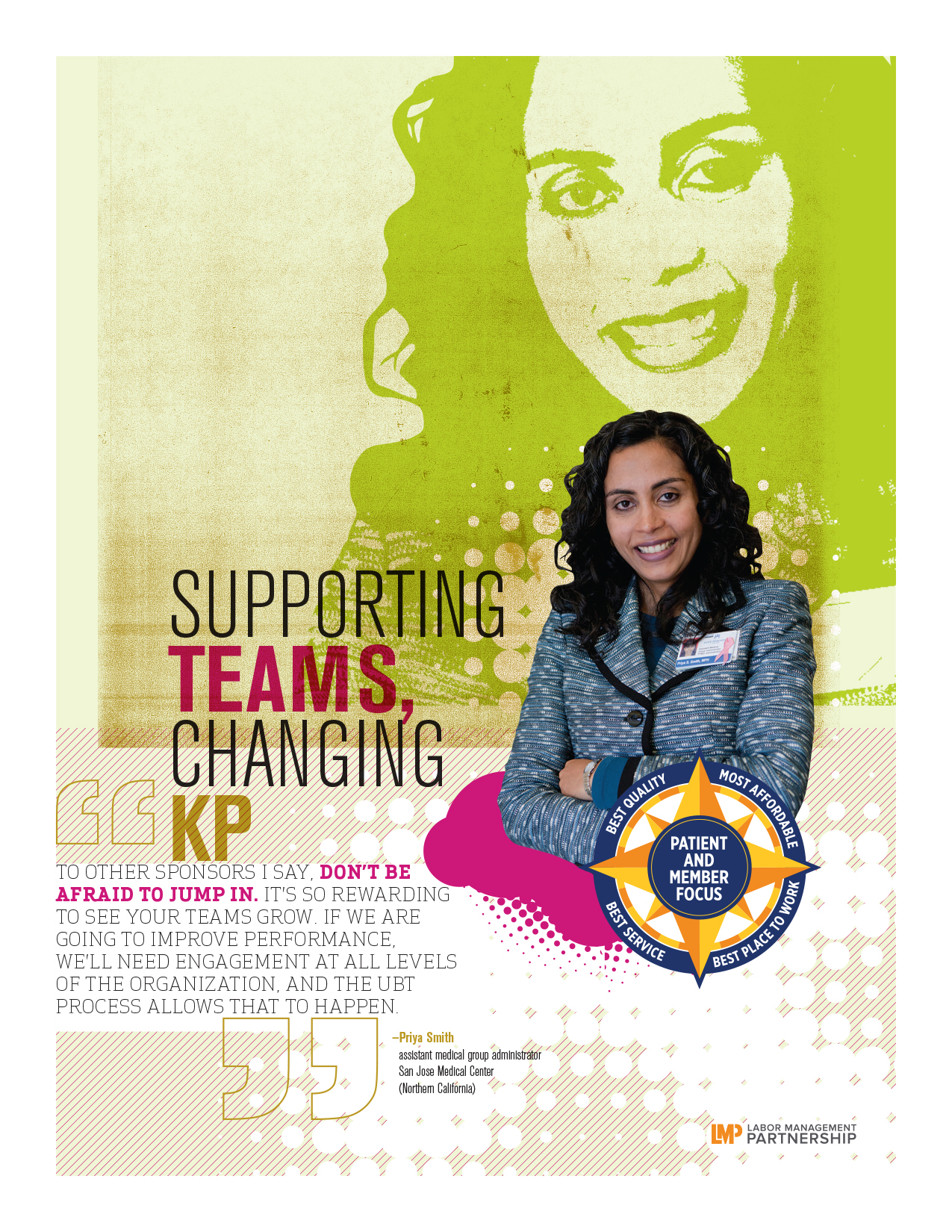
Poster: Supporting Teams, Changing KP

Format:
PDF (color and black and white)

Size:
8.5” x 11”

Intended audience:
Unit-based teams and UBT sponsors

Best used:
This poster features UBT sponsorship advice from Priya Smith, a sponsor in Kaiser Permanente's Northern California region. Post on bulletin boards, in break rooms and other staff areas.

Related tools:

TOOLS

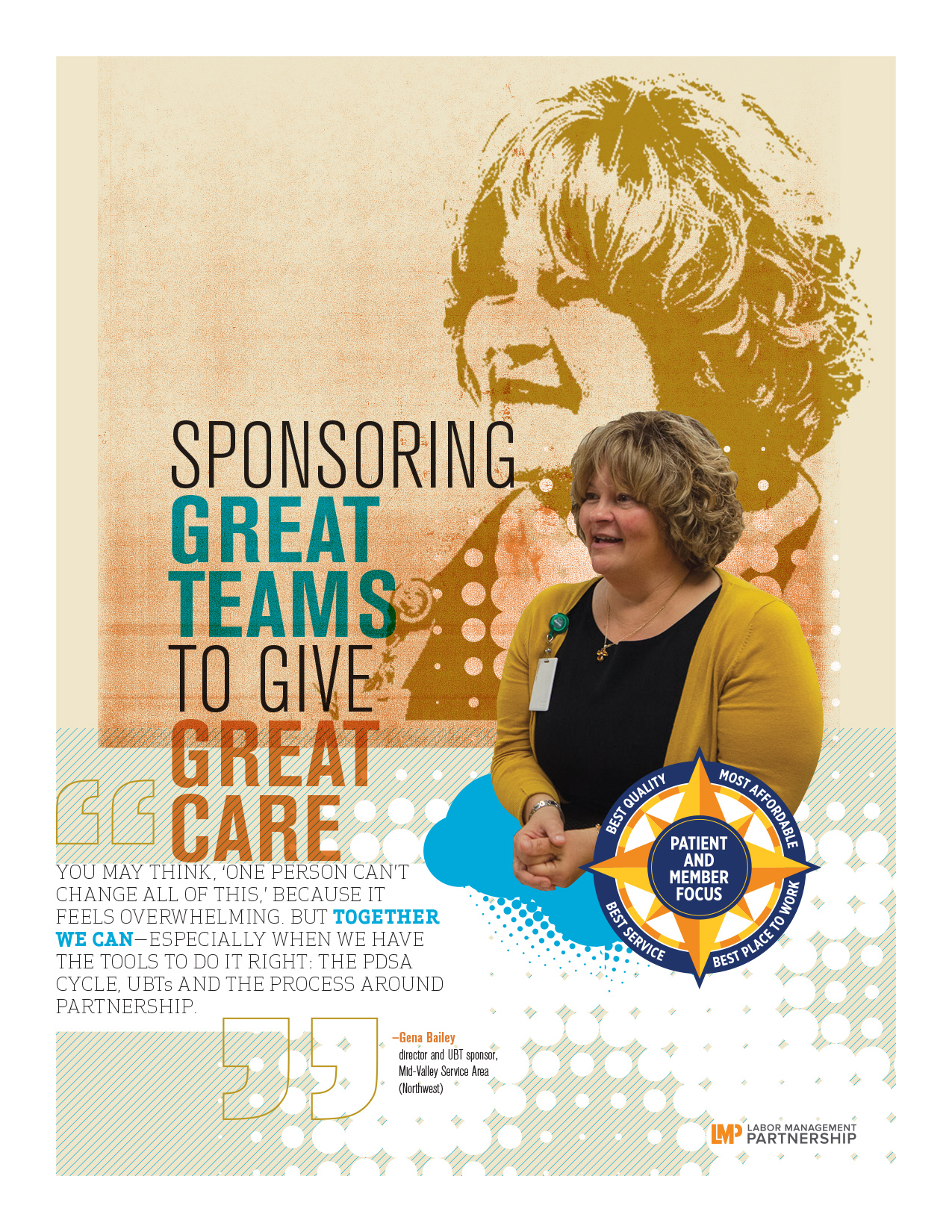
Poster: Sponsored Teams Give Great Care

Format:
PDF (color and black and white)

Size:
8.5” x 11”

Intended audience:
Unit-based teams and UBT sponsors

Best used:
This poster features UBT sponsorship advice from Gena Bailey, a sponsor in Kaiser Permanente's Northwest region. Posted on bulletin boards, in break rooms and other staff areas.

Related tools:

TOOLS

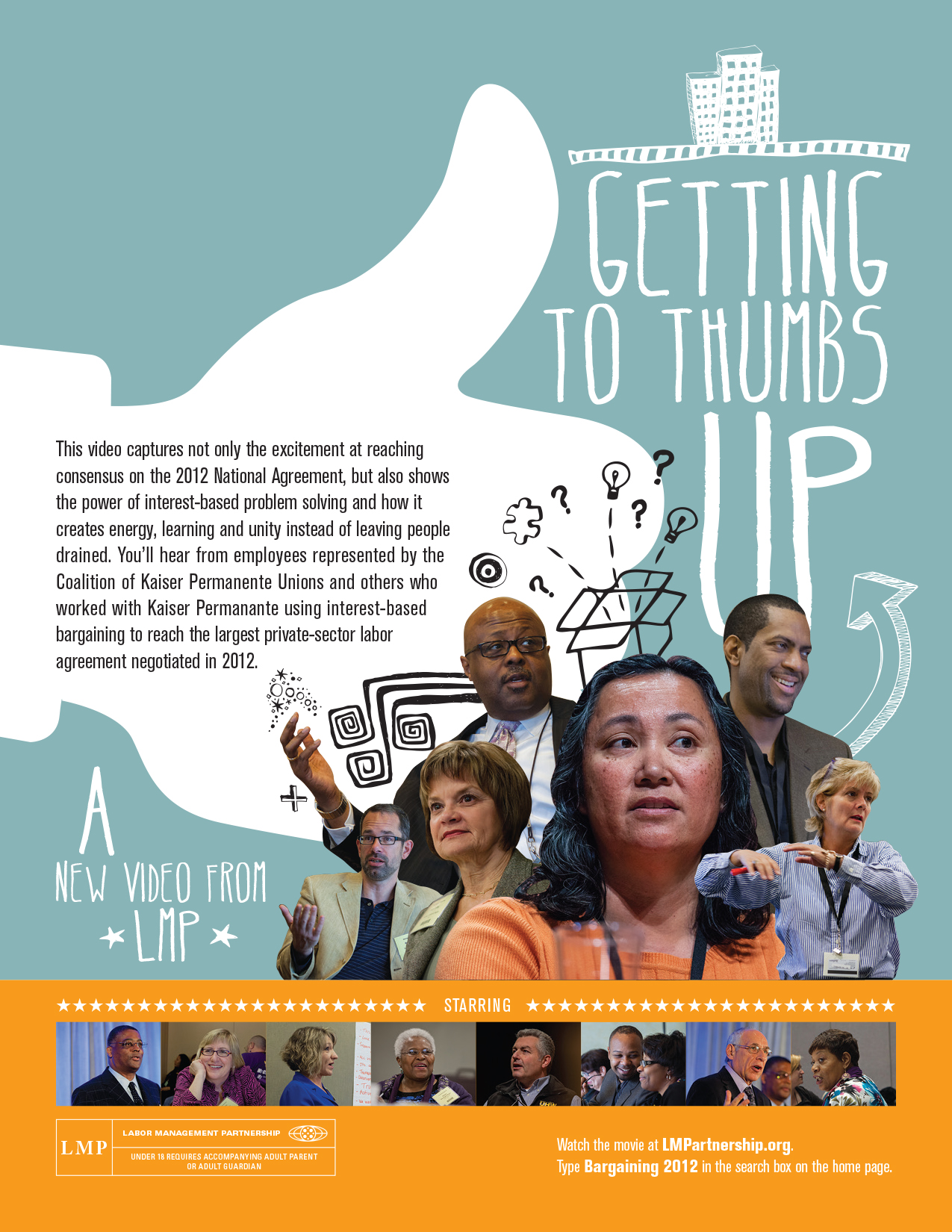
Poster: Getting to Thumbs Up

Format:
PDF (color and black and white)

Size:
8.5" x 11"

Intended audience:
Frontline employees, managers and physicians, and UBT consultants

Best used:
This poster promotes a powerful video that shows how interest-based problem solving creates energy, unity and consensus.

See the video:

Getting to Thumbs Up (video)

Related tools:

Want a Healthy Workforce? Try an Instant Recess

Deck: 
Exercise breaks reduce injuries, stress and sick days

Story body part 1: 

At 10:30 a.m. sharp, South Bay Medical Center appointment clerk Carolina Meza removes her telephone headset. She fires up what looks like the world’s tiniest iPod, attached to a portable speaker that’s not much bigger. She gathers four of her co-workers in a patch of open space near the coffee room. They do some neck rolls, march in place and then do a move Meza calls “the incredible hulk”—a shoulder stretch that brings welcome relief to those facing a computer screen for most of their day.

“When we go back to our stations, we feel refreshed,” says Meza, a member of SEIU UHW.

It’s called Instant Recess, and it’s the brainchild of Toni Yancey, MD, co-director of the UCLA Kaiser Permanente Center for Health Equity. It involves a quick, daily group exercise and is aimed at incorporating physical activity into a normal workday. It comes at a time when research is showing that workplace fitness initiatives targeting individual behavior (such as counseling and gym memberships) aren’t working. An organization’s whole infrastructure needs to be addressed, says Yancey. 

That’s what makes Instant Recess so appealing. It demonstrates KP’s commitment to Total Health—including for a healthy and safe work life for KP employees as well as the members and communities we serve. It’s consistent with KP’s Healthy Workforce push, and also seems to help reduce workplace injuries and improve attendance.

At the South Bay call center, for instance, annualized sick days fell almost one full day per full-time equivalent between 2010 and 2011, when the department began Instant Recess. The number of ergonomic injuries went from three to zero.  

Overcoming obstacles

While they are seeing results now, team members were wary when senior leaders at their medical center approached them about trying Instant Recess. “I was very skeptical,” says Darlene Zelaya, operations manager. “We can’t prevent the calls from coming in.” In fact, hold times for patients did go up when the team first implemented Instant Recess.

The unit-based team worked together with project manager Tiffany Creighton to adapt Instant Recess to their members’ needs. For instance, before calling a recess, team members check the reader board to assess how many agents can be off the phones at one time. They hold many small exercise bursts throughout the day instead of one or two longer ones. And they keep the music turned down low to avoid disturbing agents on the phone with patients.

Making it work locally

In the South Bay lab, Instant Recess looks and sounds totally different—but is getting similarly promising results. That department blasts a boom box for 10 full minutes during the Instant Recesses it incorporates into its huddles at shift change twice a day. Clinical lab scientist Nora Soriano steps away from her microscope to join in. She’s lost 43 pounds recently, and she partly credits Instant Recess. Soriano, a member of UFCW Local 770, says the initiative inspired her to exercise more at home. “My son got me an Xbox,” she says. “I don’t stop for half an hour, sometimes 45 minutes.”

Not all of Soriano’s co-workers were so enthused when they first heard about Instant Recess. “I was kind of negative,” admits Julia Ann Scrivens, a lab assistant and UHW member. “I thought, ‘I am so busy. You want me to do what?’ ” Area lab manager Dennis Edora says, “It was a shock. No one knew what to expect.” But the lab’s staff had just been through some stressful changes—including getting new equipment and moving to a new floor—and team members were hungry for something that would help rebuild morale.

“We collaborated with all the different job codes,” says Edora. “Everyone added their different flavor,” she says, noting that employees rotate as a leader, some choosing Hawaiian dance moves, others yoga-inspired stretches. “Instant Recess really got us together. It wasn’t just exercise.” Moreover, it was helping reduce injuries: the lab reported only one repetitive motion injury in 2011, after beginning Instant Recess in April. There were five such injuries in 2010.   

And Scrivens is sold as well. “It is fun,” she says. “It makes me happy.”

TOOLS

PPT: Team's Success Brings in $10 Million

Format:
PPT

Size:
1 slide

Intended audience:
LMP Staff, UBT consultants, improvement advisers

Best used:
This PowerPoint slide highlights a business services team that discovered a glitch, corrected it, and brought in $10 million in Medicare reimbursements. Use in presentations to show some of the methods used and the measurable results being achieved by unit-based teams across Kaiser Permanente.

Related tools:

TOOLS

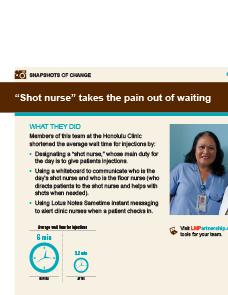
PPT: Hawaii Team Cuts Wait Times in Half

Format:
PPT

Size:
1 slide

Intended audience:
LMP staff, UBT consultants and improvement advisers

Best used:
This PowerPoint slide features a team at the Honolulu Clinic that reduced patient wait times by making one nurse responsible for giving injections each day. Use in presentations to show some of the methods used and the measurable results being achieved by unit-based teams across Kaiser Permanente.

Related tools:

Beyond Retail: Optician Saves Member’s Sight

Story body part 1: 

When Webster Parker brought his prescription glasses back to the clinic in Redlands (Southern California), he thought he just needed to replace a lens that had fallen out. But when Parker reported his eye was watering excessively, optician Alicia Rendon spotted a red flag in Parker’s Kaiser Permanente HealthConnect™ record and, within the hour, set up an eye-saving appointment with an ophthalmologist.

“The prescription was fine,” says Rendon, a Teamsters Local 166 member whose unit-based team recently embraced a new workflow, including use of KP’s electronic health record system, to troubleshoot their redos—instances where patients return eyewear purchases. “Once I looked into HealthConnect, there was this big stop sign.”

Her review of the record suggested that Parker, 85, might need a common surgical procedure to lower the intraocular pressure in his right eye, a condition often associated with glaucoma. An old eye injury exacerbated the problem, and Parker’s ophthalmologist had set up a flag in the system to watch for changes to the eye.

“I had surgery that week,” says Parker, a retired pharmacist who once ran a drugstore with his pharmacist wife. “The eye feels better. It feels normal. They did a wonderful job.”

Looking at the whole system

Focusing on redos not only saves KP in terms of the cost of materials and labor but also helps improve service scores. By bringing in ophthalmologists and optometrists, who examine eyes to treat disease as well as prescribe the lenses that opticians dispense, the team could better identify redos linked to eye-health problems rather than product defects—as in Parker’s case.

But opticians, used to handling paper charts and focusing on frame styles, were reluctant to try one of the team’s first tests of change: using KP HealthConnect to rule out medical reasons for unsatisfactory eyeglasses.

“We got buy-in” to overcome the initial resistance, says management co-lead Darren Smith, site supervisor for optical dispensing and a former optician. “It takes just two or three to really commit and spread the practice. Now, it’s not just a retail store where you come and buy something. Here, we are talking about your health.”

Educating patients and staff

To protect patient privacy, opticians' access in HealthConnect was mostly limited to conditions related to eyeglasses' prescriptions rather than a broader range of eye issues. Now the optometrists and ophthalmologists help the optical UBT members spot problems and counsel patients on practices that will protect their eyesight and enhance their eye care.

“Not everyone is going to be able to see 20/20,” says Trissy Bastin, business line manager for Vision Essentials. She directs the service area’s five optical clinics and serves as sponsor for the UBT. “The patients have to be reminded of that. You have to be able to see what kind of eye conditions they have.”

Parker has been a KP member for just seven years. But three decades in the health care industry fostered his appreciation for the electronic patient record—and cooperation and coordination among caregivers.

“What makes Kaiser special is that any doctor can have your complete record at his fingertips,” Parker says. “They can track problems and make recommendations.”

Pages

Subscribe to RSS - lmpartnership.org