Frontline Workers

Help Video

How to Find UBT Basics on the LMP Website

Learn how to use the LMP website:

LMP Website Overview

Learn how to use the LMP website:

How to Find How-To Guides

This short animated video explains how to find and use our powerful how-to guides

Learn how to use the LMP website:

How to Find and Use Team-Tested Practices

Does your team want to improve service? Or clinical quality? If you don't know where to start, check out the team-tested practices on the LMP website. This short video shows you how. 

Learn how to use the LMP website:

How to Use the Search Function on the LMP Website

Having trouble using the search function? Check out this short video to help you search like a pro!

Learn how to use the LMP website:

How to Find the Tools on the LMP Website

Need to find a checklist, template or puzzle? Don't know where to start? Check out this short video to find the tools you need on the LMP website with just a few clicks. 

Learn how to use the LMP website:

Lead From Where You Stand

Deck: 
Helping teams make sense of their data

Story body part 1: 

When it comes to metrics, even the best teams can get muddled.

At such times, a good team realizes it needs help—that it’s time to ask for assistance from someone with specialized skills. In the Northwest region, teams can turn to Ed Vrooman.

His enviable strength? An ability to crunch numbers, connect the dots and break down the complexity of the data so that unit-based teams get the information they need to do their work.

“It’s easy for teams to fall into analysis paralysis, where they dissect every data point. I work with them to know the why and the what,” says Vrooman, who started as a part-time phlebotomist 18 years ago at Portland’s now-long-gone Bess Kaiser Hospital. Today, he does double duty as a union partnership representative (UPR) for the Coalition of Kaiser Permanente Unions—he’s a member of SEIU Local 49—and as an improvement advisor.

A broad perspective

His atypical career path has given him an unusual outlook. In 2003, Vrooman took an extended leave of absence to work for Local 49, helping organize KP employees and other health care workers. After returning to KP, he became a labor partner and brought the coalition’s interests to the building of the new Westside hospital and other major regional projects.

“Partnership has allowed me to touch nearly every function within this organization,” Vrooman says. Working on the large initiatives got him more intrigued with the data side of the house—and led to his current position, which gives him an opportunity to use his skill with data and analytics. 

When he heard from the region’s UBT consultants that teams didn’t have the data they needed to work on projects, Vrooman became—along with the data analytics department and health plan leaders—a driving force in the creation of the region’s scorecards for teams. The STATIT scorecards (named after the electronic system that hosts them) enable teams to see their goals online and how they line up with the regional and PSP goals.

Co-leads’ gathering

Every year, Vrooman, along with the other two UPRs in the region—Bruce Corkum, RN, an OFNHP/ONA member, and Mariah Rouse of UFCW Local 555—present information on regional goals and budgets in one of the quarterly Steward Councils, which bring together the region’s UBT union co-leads and representatives from its four partnership unions. For the meeting on regional goals, the management co-leads are invited as well, providing a chance for team leaders to learn together how their teams can have an impact.

When he’s working directly with a team, Vrooman mentors and coaches its members on using improvement tools, from understanding the fundamentals such as SMART goals and entering projects into UBT Tracker to more advanced tools like process mapping. He asks his team members what they need to be successful.

“You don’t need a title to be a leader,” Vrooman tells them. “You lead from where you stand.”
The Best-Laid Plans

Deck: 
Getting back on track, after good work yields a bad side effect

Story body part 1: 

The Family Practice unit-based team at the Sunset Medical Office in the Northwest was thrilled that its work to get members to sign up on kp.org was a success. But team members quickly grew dismayed when the onslaught of new signups had an adverse effect on patients’ experience.

The challenge began in 2014, when the team launched several projects to increase the number of Kaiser Permanente members signed up on kp.org, knowing that people who use kp.org usually give KP higher satisfaction scores. The office is located in Hillsboro, Oregon, near one of Intel’s campuses. Intel offers Kaiser Permanente as a health plan option, so the effort to get more people online made perfect sense.

But, on the flip side, the increased number of messages coming in through kp.org wound up increasing turnaround times for return emails and phone calls.

More than two-thirds on kp.org

The department now receives between 450 to 650 email messages per week. Seventy-one percent of its patients—29,000 members—are signed up on kp.org. The team sought to improve its turnaround time on messages by reducing the number of times staff members and physicians touched each message. Instead of multiple people working a message, each one is now triaged one time by either an LPN or RN. At the same time, the team decreased its time spent on messages per week from 13.6 hours to 10.9 hours.

Ed Vrooman, an improvement advisor and union partnership representative, coached team members on how to test and implement their improvements.

“We learned how to use process mapping, so we could identify where the holes were in how we were approaching the work,” says Eliseo Olvera, the assistant department administrator and the UBT’s management co-lead. “Ed knew where we could get the data we needed and help us understand it, so we could do the work.”

Vrooman also introduced the team to the 6S tool—sort, simplify, set in order, sweep, shine, standardize—to improve its work processes. The team broke into different workgroups and each group identified tests of change. Some of the ideas were abandoned, some were refined and adopted, and some still are being adapted.

Staying on track

“I tended to focus too much on the information and the numbers,” says Rikki Shene, a licensed practical nurse and SEIU Local 49 member who is the team’s union co-lead. “Ed helped keep us organized and simplified the data so that we could keep moving forward and accomplish something in our 45-minute UBT meetings.”

Vrooman’s role in the team has been critical for the team. He attends the co-lead planning sessions and UBT meetings. He stays in the background until needed—and then he speaks up.

“He’s part of our community,” says Olvera. “His expertise with data has been critical. It’s a gift.”

Take action to get meaningful metrics

Here are the next steps for teams that are ready to leverage numbers to turbocharge performance: 

  • Make a clear plan about collecting data. Focusing only on the numbers you need will help reduce needless work.
  • Create a storytelling run chart.
  • Familiarize yourself with the names of the core metrics that KP relies on.


I'm in a UBT?

Deck: 
Mid-Atlantic States UBT consultants aim to boost awareness and create a team culture

Story body part 1: 

The Mid-Atlantic States region has approximately 220 unit-based teams with more than 5,200 members. 

One problem, though: Some of those who belong to UBTs don’t know it.

The region’s seven UBT consultants, who made a commitment to work together as a UBT themselves, are trying to change that.

“Employees can’t contribute to the success of the team if they don’t know they are part of the team,” says Tracy Schrader, one of KP’s UBT consultants in the region, who is also an improvement advisor and OPEIU Local 2 member. “They don’t realize they can speak up.” 

From their travels around the Capital Beltway to team meetings and huddles, the consultants—each of whom supports about 35 teams—knew there was a disconnect for some UBT members. So when they established their own team’s 2015 goals, they planned two main tactics: to host several UBT Fairs to raise the profile of UBTs, and to improve communications so all UBT members know they are on a team.

The fairs, which the consultants originally were planning to hold at the region’s largest centers over the summer, would showcase the work of the teams at that facility and highlight such LMP initiatives and priorities as Total Health, Workplace Safety and the Ben Hudnall Memorial Trust, which provides a variety of resources for career-advancing education.

“We wanted to hold fairs that would have a strong impact,” says Jennifer Walker, RN, a lead UBT consultant and improvement advisor.

Surprising news

Then—just as happens with frontline teams—they received some data that surprised them. The 2014 People Pulse results showed that some locations the consultants thought would score poorly on UBT-related questions scored well and vice versa. Armed with that data, the consultants decided to hold the first five fairs at the centers that had the most teams with more than 10 percent of members answering “no” when asked “are you in a UBT?”

“It was a real eye-opener,” says Preena Gujral, another MAS UBT consultant and improvement advisor who’s a member of OPEIU Local 2. “Data is very important. It’s perception versus reality.”

The data also led the consultants to combine their two tactics:  The fairs would be the method for communicating the message that all work group members are indeed part of a UBT.

Walker, one of the region’s lead consultants, says it can be difficult to get the message across, especially with large departments. Unlike small departments where everyone participates in UBT meetings, larger departments typically have a core group of employees who attend UBT meetings as representatives of everyone on staff. Employees who aren’t representatives don’t always realize that they are part of the team, too.  

The energy and attendance of the first UBT Fair that the consultants sponsored, held at the end of June at the Fair Oaks Medical Center in Fairfax, Virginia, was higher than they expected, with more than 150 employees stopping by.

“The participation was fantastic,” says Wendy Williams, RN, a UBT consultant and member of UFCW Local 27.

Irene Taliaferro, a gastroenterology nurse practitioner, attended the fair at Fair Oaks in late August. She hadn’t realized she was a UBT member.

“I came to find out more about UBTs. Before I came to the fair, I knew nothing about them,” says Taliaferro. “We have a representative who goes to meetings. I don’t know much about it.”

Providing incentive—and a model

Steve Pereira, UBT consultant and improvement advisor, hopes the blitz of UBT Fairs gives workers like Taliaferro a better understanding of the partnership and an incentive to be more involved.

“People want to know more than their 9-to-5 jobs,” Pereira says. “This is the opportunity for that.”

Because of their commitment to use the same tools as frontline UBTs, the consultants have been using the Plan, Do, Study, Act cycle of the Rapid Improvement Model in planning and holding the fairs.

So, Walker says, “We structured it so the fairs happen before the annual People Pulse is taken again, in September”—that way, the fairs serve as a test of change. Will the communication provided by the fairs improve the score on the “I’m in a UBT” question?

“We’ll look for the next People Pulse results to validate whether this was the best way to go,” she says.

Watch for an update on the consultants’ efforts next year on LMPartnership.org, after the 2015 People Pulse results are in.

Take action to get the help you need

No need to struggle on your own. There are lots of resources out there to guide teams along the Path to Performance:

  • Find out who your UBT consultants and union partnership representatives are. Go to the “regions” tab on LMPartership.org to find regional or facility LMP co-leads, who will have the most up-to-date information.
  • Get the training you need to build and strengthen your UBT. Visit our training page for links and contact information.
  • Find out if there is a UBT Fair coming up at your facility or one nearby and go to it. Soak up great ideas and inspiration from other UBT members!

Partnership Attitude Brings State-of-Art Test to Members

Deck: 
Neurology department in the Northwest improves ability to diagnose epilepsy

Story body part 1: 

“This whole project was a mere idea written on a piece of paper only a few months ago,” says Juan Piantino, MD, “and now it’s a reality.”

Shortly after Dr. Piantino, a neurologist, came to Kaiser Permanente in July 2014, he was approached by another member of the department—Debbie Newcomb, an electro-neurodiagnostic technologist and UFCW Local 555 member. Newcomb’s work includes performing electroencephalograms (EEGs), a test that monitors a patient’s brain waves and helps diagnose patients with epilepsy.

She was interested in implementing ambulatory EEGs (AEEGs), an advanced technology that is relatively new. Because the test is conducted over a longer time period than a routine EEG, it is more likely to capture events that provide the medical team with information needed for a good diagnosis. AEEGs also are less expensive than an inpatient telemetry EEG. But Newcomb needed a physician partner to move forward.

“I wasn’t intimidated about approaching him,” says Newcomb, who’s the labor co-lead of the neurology UBT. “The partnership has given me the confidence to speak up—and in fact, I consider it part of my role as a union steward.”

Swift implementation

Dr. Piantino had experience with the test with other health care systems—as did Newcomb—and was enthusiastic. The pair began figuring out how the test could be implemented in the Northwest region. Newcomb collaborated with the staff at the Stanford Comprehensive Epilepsy Center to understand the specific details of its program. She worked with KP Purchasing to identify the type and cost of the machines that would be needed.

Armed with information, Dr. Piantino met with leadership of the Northwest Permanente Medical Group—and within a few short months, in December 2014, the region was equipped to do continuous ambulatory EEGs.

So far this year, 16 patients have had their treatment guided by the ambulatory EEG as outpatients. Because the test is administered with a camera, the physician reading the results can see the patient in real time and correlate the brain activity to the physical movements of the patient. In addition, being able to conduct the test in the patient’s own environment avoids a potentially stressful and expensive hospital stay.

One adult patient had been in and out of the Emergency department five times in two weeks. Newcomb performed the ambulatory EEG on him; he had five events, all pseudo-seizures. “He is now seeing the proper doctor for his problems—no more trips to the ED,” Newcomb says.

By the end of July, the program already had paid for the cost of equipment. The benefits of an accurate diagnosis for the patient are immeasurable.

“It was the positive attitude and the willingness to improve patient care that made this happen in record time,” says Dr. Piantino.

Pediatric patients helped

Not all epilepsy is easily identifiable. One young, active child who was recently diagnosed was brought into the Neurology clinic because he was not meeting developmental milestones, and his parents and physician were concerned. The team turned to the ambulatory EEG.

“We got a really good study,” says Dr. Piantino. “This will guide his therapy.”

In another instance, neonatologists at Sunnyside Medical Center were able to control a newborn baby’s seizures within 48 hours when they turned to the ambulatory/continuous monitoring EEG test—after the routine EEG didn’t reveal any unusual brain activity.

“I have been a pediatric neuro-intensivist at two big centers, in Seattle and Chicago,” Dr. Piantino says, “and I can say with confidence that this child received state-of-the-art treatment.”


Videos

Portraits in Partnership: A union worker's point of view

Loading the player...

(2:30)

When Lab Assistant Cher Gonzalez talks, her manager and facility leaders listen. That's just one of the many benefits, she says, of working in the Labor Management Partnership at Kaiser Permanente. Watch this short piece to see a union worker's perspective of the LMP.


How Partnership Helped KP Reach the 10 Million Member Milestone

Deck: 
Union leaders, unit-based teams and frontline workers help attract and retain KP members

Story body part 1: 

“I was almost devastated,” says Karen Cardosa, a grocery clerk in Albany, Oregon, “when UFCW told us they were no longer offering Kaiser Permanente as an insurance option.”

Cardosa and her family had been KP members for years through the union’s Local 555 Employers Health Trust. That changed when a variety of issues resulted in KP losing the account, which covered many Local 555 members. The union continued to represent nearly 2,000 Kaiser Permanente pharmacy and radiology employees, who—as KP staff members—continued to have KP health care.

But today, Kaiser Permanente is again an option for up to 15,000 UFCW members and dependents in the Northwest region who are covered by the health trust.

New way to compete

An affordable price, high quality, a new hospital, expanded clinics and a new billing system helped win back this account. But something else was also at play.

Thanks to the Labor Management Partnership, the Coalition of Kaiser Permanente Unions and Kaiser Permanente take a joint approach to winning and keeping health plan members that is almost unheard of elsewhere in this country.

Bringing together union members and KP sales and marketing teams, the campaign helped win, expand, win back or retain 33 accounts covering 125,000 KP members in 2014, with a focus on public-sector accounts.

A broad reach

The effort spans almost every level of the organization and the unions.

Leaders of the local and international unions that belong to the union coalition play an active role in advocating for KP as the preferred health care provider when negotiating contracts or benefit programs with employers.

In addition, some 45 frontline union ambassadors spoke to 25,000 KP members and potential members at outside union and community events in 2014. “I have enjoyed working side by side with the sales and marketing representatives to promote Kaiser Permanente,” says Sera Jordan, a medical assistant, union ambassador and SEIU Local 49 member in the Northwest. “It has enabled me to share my firsthand knowledge of Kaiser Permanente and the care we provide.”

UBTs are a selling point

And unit-based teams, by giving frontline workers a voice in improving quality, service and affordability, are a big selling point for union purchasers of care. UBTs launched more than 8,000 performance improvement projects last year at every point on the KP Value Compass, including thousands of affordability projects that saved, on average, more than $40,000 per project.

“Working with our union partners, we’ve been able to come to the table with customer solutions that meet everybody’s needs—including the unions that aren’t part of KP, who have tremendous influence in purchase decisions,” says Kate Kessler, a Member Sales and Service Administration director. “We are unique in having a strong labor partnership in our own business, and we can speak that language.”

Find out why record membership matters to our current and future members on InsideKP.

It Took Courage

Deck: 
The birth of the Labor Management Partnership

Story body part 1: 

When I think about the Labor Management Partnership and Kaiser Permanente’s history, I can’t help but believe the creation of the LMP was inevitable—and that it’s been the linchpin to KP’s success after the financial challenges of the 1970s, ’80s and ’90s.

From the very beginning, Kaiser Permanente’s management and its unions shared a philosophy of engagement. This culture never went away entirely, but when the competition from for-profit HMOs mounted in the 1980s, it got pushed to the background. Kaiser Permanente did what many businesses do—it reduced its workforce and made other cost-cutting changes. Union members became frustrated, believing the changes undermined KP’s mission and eroded working conditions.

The unions responded with traditional work actions and strikes.

But I’d say four milestones changed the landscape.

First, in the early 1990s, the Industrial Union Department of the AFL-CIO created the KP Coordinated Bargaining Committee to improve the unions’ bargaining position. That committee, which included most of the major unions at Kaiser Permanente, became the Coalition of Kaiser Permanente Unions. We were charged with coordinating a full-scale “corporate campaign” against KP.

But we realized we might do permanent damage to the company and to our 57,000 coalition union members. So we opted to pursue an alternative strategy. In the mid-’90s, we approached KP with a bold new idea—partnership. Unlike other union-employer “cooperation” arrangements, where management would come to labor for help after decisions had been made, the proposed partnership called for labor’s integration into KP’s management and operations structure.

After almost a year of discussions, Kaiser Permanente agreed, and in 1997, the Labor Management Partnership was formed. The decision demonstrated courage on both sides. It placed a value on the knowledge possessed at every level of the organization, from the boardroom to the front line. Building on that, we broke away from traditional, reactionary problem solving and turned to interest-based problem solving and consensus decision making.

This led to the fourth milestone—the decision to conduct national bargaining using those same problem-solving methods and to include operational leaders and rank-and-file union representatives at the bargaining table.

Other factors have contributed to KP’s financial turnaround, but there can be no denying the impact the partnership made—and continues to make—in ensuring that Kaiser Permanente is the national leader in health care, with a great place to work and industry-leading salaries, wages and benefits. Its position did not come about by accident, but by the courage of leadership and the power of partnership.

Visit Kaiser Permanente's 70th anniversary mini-site.

TOOLS

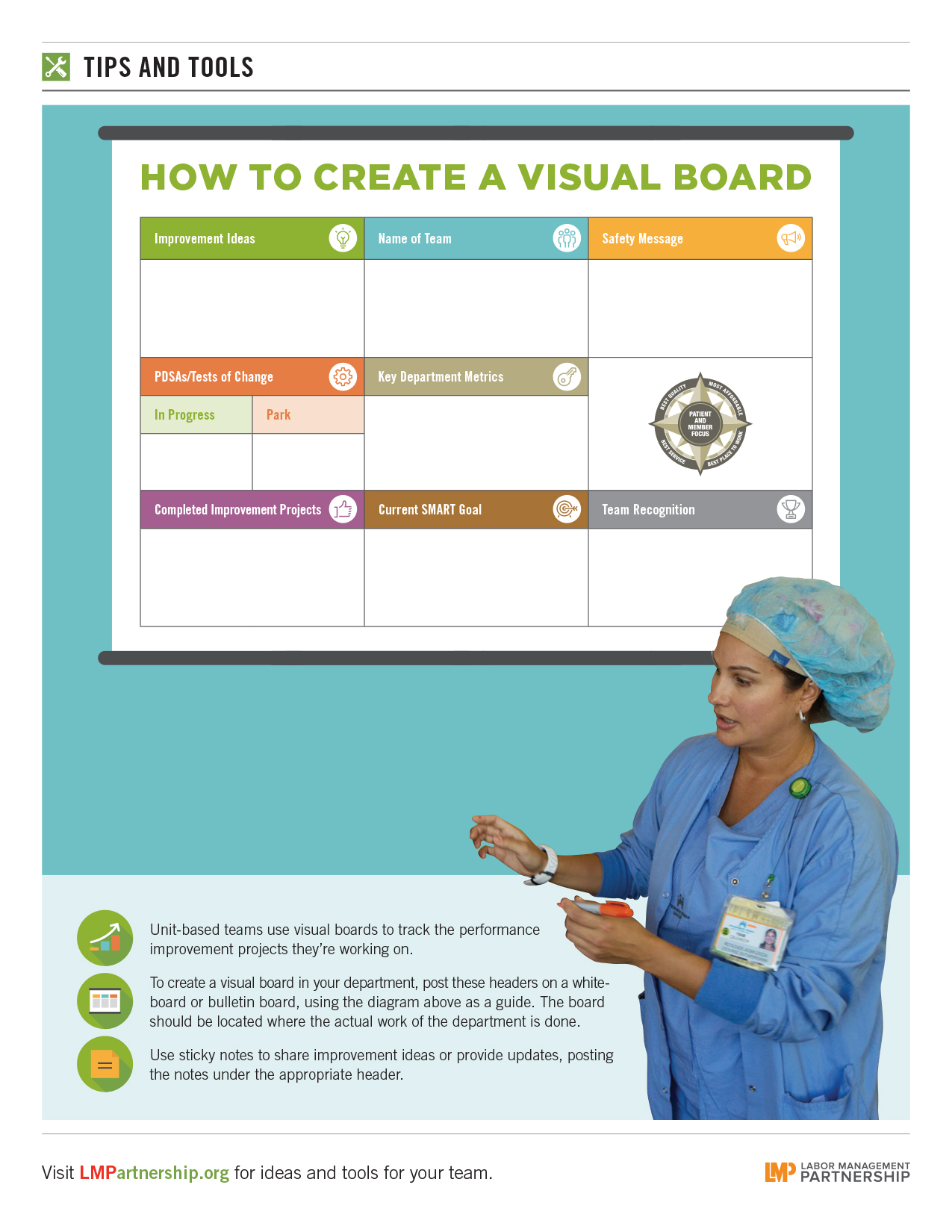
How to Create a Visual Board

Format:
8.5" x 11" PDF, plus headers (in color and black and white)

Intended audience: 
Unit-based team consultants and team co-leads

Best used:
This diagram is your guide to creating a visual board for your UBT's improvement projects, using a white board or bulletin board in a spot where your team can gather easily. Use these headers to organize your information.

You may also be interested in:
A Visual Board Is Worth 10,000 Words

Related tools:

KP, Coalition Reach Accord on Tentative 2015 National Agreement

Deck: 
If ratified by the unions and OK'd by the organization, contract to take effect Oct. 1

Story body part 1: 

Ten weeks of national bargaining between Kaiser Permanente and the Coalition of Kaiser Permanente Unions concluded Saturday, June 6, when 150 union and management representatives approved a tentative 2015 National Agreement. The agreement now goes to the 28 union locals that compose the coalition for ratification and to Kaiser Permanente senior leaders for approval.

The three-year tentative agreement is designed to help unionized workers and managers achieve quality, affordability and safety of care; prepare for jobs of the future; and develop innovative solutions to health care challenges. The agreement also will enable our 3,500 unit-based teams to better deliver award-winning care and service to Kaiser Permanente’s more than 10 million members and patients.

“This is an outstanding agreement that deepens our ability to provide affordable, high-quality care to our members and patients,” says Dennis Dabney, the senior vice president of National Labor Relations and Office of the Labor Management Partnership. “Kaiser Permanente leads the industry because it is a great place to work and a great place to receive care—and the two are inseparable.”

“We’re on year 18 of a remarkably successful strategy,” says Hal Ruddick, executive director of union coalition. “Our contract is better than ever, Kaiser Permanente’s quality and service scores are higher than ever, and the organization and unions are both healthy and growing. Partnership pays off for workers, consumers and mission-driven organizations like Kaiser Permanente.”

Agreement highlights

The agreement includes wage increases in each year of the agreement (see specifics below), provides operational flexibility and bolsters joint problem-solving capabilities. It builds on the successful 2012 National Agreement, strengthening provisions for workplace health and safety, providing additional funds for workforce training and development and ensuring the consistent application of partnership principles.

The new three-year tentative agreement includes:

  • Across-the-board wage increases in each year of the agreement: All employees in Northern and Southern California represented by a coalition union receive 3 percent increases in the first two years and 4 percent in the third year. Employees in the regions outside of California represented by a coalition union will receive a 2 percent increase each year of the three-year agreement. In addition, they will receive a 1 percent increase at the end of the third year.
  • Enhancements to benefits such as dental coverage, life insurance and tuition reimbursement. The tuition reimbursement was increased to $3,000 per employee per year. For the first time, tuition, dental coverage and life insurance are standardized for coalition union members across all regions.
  • A long-term solution that protects retiree medical benefits for current and future retirees, with no net increase to retirees’ out-of-pocket expenses, while reducing liabilities associated with those benefits.
  • Increased funding to the Ben Hudnall Memorial Trust and the SEIU UHW-West and Joint Employer Education Fund to ensure career development for Kaiser Permanente’s diverse workforce.
  • Improved methods for assessing unit-based team performance and for spreading and adopting successful practices.
  • Updates to our groundbreaking Kaiser Permanente Total Health Incentive Plan,  which rewards employees for healthy behavior and provides incentives for collective improvement.
  • Joint participation on community health projects by the coalition unions in KP’s local and regional Community Benefit programs.

Next steps

Our agreement is the largest private-sector contract in the United States this year. Once it is approved by Kaiser Permanente senior leaders and ratified by union members this summer, it will take effect Oct. 1, 2015, and be in effect through Sept. 30, 2018.

The impact of the agreement “goes beyond the words on paper,” says Jerry Vincent, the Northern California region’s director of Labor Relations. “It lays the foundation for us to continue to provide quality, affordable care for many years.”

“There were some tough moments,” Denise Duncan, RN, the executive vice president of UNAC/UHCP, says of the negotiations. “But people came back together. It was a reminder that our national agreement—and our partnership—is very strong, and we keep making it better. There’s nothing like it anywhere else.”

For more information, see www.bargaining2015.org.

Pages

Subscribe to RSS - Frontline Workers