
Frontline Workers

Help Video

How to Find UBT Basics on the LMP Website

Learn how to use the LMP website:

LMP Website Overview

Learn how to use the LMP website:

How to Find How-To Guides

This short animated video explains how to find and use our powerful how-to guides

Learn how to use the LMP website:

How to Find and Use Team-Tested Practices

Does your team want to improve service? Or clinical quality? If you don't know where to start, check out the team-tested practices on the LMP website. This short video shows you how. 

Learn how to use the LMP website:

How to Use the Search Function on the LMP Website

Having trouble using the search function? Check out this short video to help you search like a pro!

Learn how to use the LMP website:

How to Find the Tools on the LMP Website

Need to find a checklist, template or puzzle? Don't know where to start? Check out this short video to find the tools you need on the LMP website with just a few clicks. 

Learn how to use the LMP website:

Teams Collaborate to Ease Growing Workload

Deck: 
Two lab teams found a way to meet increased demand

Story body part 1: 

The Molecular and Cytology Lab unit-based teams in Stapleton, Colorado, were facing a challenging trifecta. Increased membership, changes in guidelines from the Centers for Disease Control and Prevention (CDC) and slow work processes made it tough to quickly process two widely used tests.

Membership in the Colorado region has grown by more than 60,000 members since 2013 in part because of the Affordable Care Act. Total membership in the region is now at its highest ever, with more than 600,000 members. The influx of new members is a strain on the system, and teams are digging in deeply to meet those members’ needs, from the first point of contact in the medical office to the last encounter as they pick up their prescriptions on the way out.

The lab teams are feeling the pressure, too—especially since they also process samples for the Georgia region, which is expected to grow, and they still do some work for facilities in the former Ohio region, which was sold to another health plan last year.

“We knew there would be an increase in the number of tests we would be doing. We also knew that our process was very labor intensive,” says Roxanne Whitesides, the Molecular and Specialty Testing manager. “Already this year, we’ve increased our workload 10 percent because of an increase in membership.”

Preventive care approach

The screens in question are for the human papillomavirus (HPV) and the Papanicolaou (Pap) test. Both detect disease at an early stage when treatment is highly effective, and so are central to Kaiser Permanente’s preventive care approach. As of June this year, the Molecular and Cytology teams—each of which has a role in processing the screens—already had processed 23,300 Pap screens and 16,800 HPV screens.

Meanwhile, CDC guidelines on HPV were revised in recent years and now recommend that women age 30 to 64 have an HPV screening and that girls as young as 11 receive the vaccine. The agency says HPV is the most common sexually transmitted infection in the United States. Some strains can cause cancer, and the CDC says about 21,000 of the HPV-related cancers each year could be prevented by the vaccine.

Because of the changed recommendations, even before the enrollment jump, the labs were seeing an increase in the number of HPV screens they processed. In 2012, the labs processed 650 HPV screens a month. By this spring, the monthly average had more than quadrupled: the average for March, April and May 2014 was 2,800 per month. In May alone, 3,354 samples were processed.

Labor-intensive processes

The final hurdle the teams faced was that their processes were labor intensive, requiring significant hands-on time from the technician. There was frequent back and forth between the Cytology and Molecular departments, which caused delays and interruptions. The complex work processes added to the pressure of the growing workload and caused frustration and tension.

The teams began an intensive study of what other labs were doing, including researching the latest technology. They visited other sites and vendors and decided to go with a cutting-edge Roche instrument. The pathologists—who work closely with the labs—supported getting the new equipment, and the lease was fast-tracked for installation. The instrument was in place within two months.

At that point, the teams set to work to figure out how their processes would change with the new equipment.

Cross-training provides insights

“We trained each other on the new equipment and on the processes within the two departments,” said Luann Martin, a cytology technologist, UFCW Local 7 member and co-lead of the Cytology unit-based team. “I could appreciate things going on in both departments.”

The collaboration between the Molecular and Cytology departments enabled them to improve their work processes and interactions—and ensured that as one problem was fixed, another wasn’t created.

“It’s important to keep talking. People have different expectations and comfort levels,” says Beth Fisher, a medical technologist, UFCW Local 7 member and co-lead of the Molecular UBT. “Be patient with one another,” says Melissa Baca, a cytologist lab assistant, SEIU Local 105 member and union co-lead of the Cytology UBT.

Most important, Fisher says, the new equipment is enabling the teams to meet the growing demand.

“The big payoff is that we're able to process all those HPV samples in less than half the time it used to take, so we've been able to absorb the workload increase with no new staff,” she says. “And we're able to identify the HPV strains that are most linked with cervical cancer as part of the initial screening. That saves money, because we don't have to send out all the positives for additional testing.”
Teen Interns Jump-Start UBTs

Deck: 
Using the Community Benefit program to school interns in performance improvement

Story body part 1: 

Summer interns often are put to work fetching coffee or making copies. But last year, UBT consultant Geoffrey Gamble wanted to create a more valuable experience for the teens of KP’s Summer Youth Employment Program at the Modesto Medical Center. So he trained a small army of performance improvement consultants to help support unit-based teams.

Despite initial skepticism from some team members and managers, the results were stunning. By the end of the summer, 12 of the 13 teams supported by the interns advanced at least one level on the Path to Performance. What’s more, four of the 19 projects carried out by the UBTs yielded savings or cost avoidance totaling $400,000. The program was such a success, it has returned to Modesto this summer and has spread to the Sacramento and San Jose medical centers. And in the process, the interns are gaining on-the-job training that translates to their studies and to the work world.

“I went in thinking we were going to do grunt work, but in reality it was like, ‘Wow, I’m actually doing something I can apply,’” says Nate Aguirre, who interned in Modesto’s Emergency Department last year. “It was a life-changing experience.”

The Community Benefit program has offered training and work experience to teenagers in underserved communities since 1968. In the past, that experience included clerical work or coaching on speaking in front of a large group. When Modesto’s internship coordinator retired in 2013, Gamble agreed to oversee the program as long as it supported his work developing UBTs.

Overcoming doubt with results

“When I first proposed the idea, directors were very skeptical,” Gamble recalls. “People would say, We’re struggling to do this with professionals—how do you expect to get momentum from a 16-year-old?’”

But Gamble saw the opportunity to offer teams a fresh perspective and the daily support many need to get started. He also wanted to show team members that performance improvement didn’t have to be complicated and could be incorporated in their daily work.

“I told managers that I was going to treat (interns) like adults and give them the skills I would give employees,” Gamble says. “If you hold them to that expectation, they will rise to the occasion.”

In the first few days of the eight-week program, Gamble trained the 16-year-old interns in basic performance improvement tools, including the Rapid Improvement Model, process mapping and Labor Management Partnership basics. By the second week, the youth were assigned to Level 1, 2 and 3 unit-based teams and started helping the teams launch projects and enter data into UBT Tracker.  

Rosemary Sanchez, Modesto’s Emergency Department supervisor, was one of the loudest doubters.

“At first I was like, ‘Ugh, one more thing to do.’ But then I thought, ‘OK, this could work and help us accomplish our goals and share our knowledge.’” 

Intern Nate Aguirre was crucial in helping the team on its project to streamline and standardize supplies in the treatment rooms.

“Nate was awesome,” Sanchez says. “He was so enthusiastic collecting data.”  

Getting the ball rolling

Aguirre also spent time talking to employees in the department to learn about their jobs and the challenges they face in their work.

Meghan Baker, an Emergency Department clerk and union co-lead for the UBT, says that sparked interest and support from UBT members—a shift from before, when they had struggled to get employees involved.

“People were into having their voice heard by someone,” says Baker, who's a member of SEIU-UHW. “Now people are talking and getting the ball rolling on things. And we’re making it known that people are being heard.”

At the start of the program, the Emergency Department UBT was ranked at Level 3. The team advanced to Level 4 after completing the work.

Michelle Smith, manager of Specialty Surgery Reception, appreciated the new perspective and support her team received from its intern for its project to reduce surgery no-shows and last-minute cancellations.

“It was nice to have someone get our project going,” she says, “because we were at a standstill.”

The team’s intern walked the UBT members through mapping out their process. New workflows emerged that included calling patients ahead of scheduled surgeries, which reduced no-shows and increased service scores.

When the teams were asked what they thought helped them advance, many said it was because of the interns coming to the departments every day to help push and support the work. 

“We would have eventually worked on the project, but having her come in and start us off in a positive way was great,” Smith says. “She taught us how to be a team, because we realized we all had to be part of the work.”

Safety on a Silver Platter

Deck: 
By standardizing common tasks, and having regular updates, you can help to reduce workplace injuries

Story body part 1: 

Want a safer workplace served up on a silver platter?

Then stop by the operating room at Kaiser Permanente’s West Los Angeles Medical Center in Southern California. Surgeons and the other health care workers there pass sharp instruments to one another on silver trays—rather than passing them hand to hand—which reduced injuries related to handling sharp instruments during procedures by 34 percent between September 2013 and May 2014.

“We can see the results,” says Lisa Duff, a surgical tech and workplace safety champion at the facility. This success is part of a new emphasis at the facility on task standardization—analyzing each step of an activity, identifying the potentially hazardous steps, coming up with a safer way of doing things and then ensuring everyone follows the new process the same way, every time.

How to reduce risk

“Injuries occur when there is not consistency,” says Tracy Fietz, chief administrative officer for Southern California Permanente Medical Group at West L.A.  “If you break [a task] apart on a fishbone diagram, you can identify where the risks are. It is about removing variation.”  

Standardizing practices also has helped several departments reduce—and in some cases eliminate—sharps-related injuries for up to 17 consecutive months. It’s also helped reduce injuries to EVS workers by 75 percent when they clean floors.

Another practice that is improving safety at West L.A. Medical Center is regular monthly meetings between senior leaders,  including Fietz, and the labor and management safety leaders of targeted departments. Departments that have special line-of-sight safety goals (see below) in the region’s Performance Sharing Program get special attention. The gatherings are a space to analyze processes, see what’s working—and what isn’t—and collect information to share with others.

How partnership helps

“I work with managers and the workplace safety champions, because it’s a partnership,” says Nor Jemjemian, the chief administrative officer for Kaiser Permanente Hospital/Health Plan at West L.A., who also leads those meetings. “I want the employees doing the tasks to be part of the solutions.”

Union-represented employees, for their part, appreciate the crystal-clear message top leadership is sending.

“You need management to back you up when you speak up,” says Duff, a member of SEIU-UHW. “Employees know that our managers will back them up 200 percent.”

Open communication, trust and partnership processes are the foundation of a safer workplace, says Jemjemian.

“When I was an employee, there were [hazardous] tasks I did that my manager didn’t know about,” he says. Today, in contrast, “UBTs create a venue and a forum to discuss the everyday work.”  

Communication Drives Success

Deck: 
Courier drivers in the Northwest improve routes after fixing communication and morale issues

Story body part 1: 

The Transportation department in the Northwest is coming out of a tumultuous time. A lack of trust between managers and employees created a barrier that affected morale—and made it difficult to focus on improving routes and processes.

The department uses a robust but complex process for optimizing its routes. For maximum efficiency, it has to integrate a variety of work streams and figure out where there are redundancies that can be eliminated. Because of the complexity of the process, however, it had been more than 15 years since the criteria and requirements for the transportation system from the customer’s point of view had been reviewed.

Eventually, the UBT worked out a thorough route-modernization plan based on data-driven service requirements and metrics that established parameters on how to revise and design its routes.

But before it got there, it had to fix its communication, which broke down so badly the team entered into an issue resolution. In the Northwest, the LMP Education and Training department is responsible for facilitating issue resolutions.

Blame-free solutions

“There was a lot of tension in the department, and people were nervous about losing their jobs as a result of our work around revamping routes. Poor communication was a problem,” says Greg Hardy, sponsor and manager of the department.

The issue resolution process uses interest-based problem solving, and that helped the team focus on a common goal: Serving its customers was the top priority and improving communication was a necessity. From there, other agreements came more easily, and the department was able to maintain staffing levels and improve processes as a result of its efforts.

Improved communication improves service

As a result of the improved communication, the team was able to improve service levels and achieve the efficiency and cost savings it had strived for.

“We have a group of dedicated workers who want things done the right way,” says logistics supervisor Chris Dirksen, the team’s management co-lead.

When it came to improving communication, the team members’ first step was to get a baseline measurement of what they were trying to improve. They created a survey that would measure not only communication but also morale and UBT effectiveness. Once they had that information, they created a SMART goal: to improve employee perception of communication, morale and UBT effectiveness by 15 percent within three months, raising the overall survey score from 2.55 to 2.93 by February 2014.

As the team began to investigate the issues, it discovered email was not a good form of communication. Fewer than 20 percent of the team members knew how to log on and use Lotus Notes. The team brainstormed ways get employees to use Lotus Notes email and frontline staffers began to instruct and coach one another.

Three months later, the team sent the survey out again and found it had met its goal. Perception of communication improved 48 percent, morale improved by 56 percent and UBT effectiveness improved by 21 percent. The team scored 3.4 on its survey, exceeding its stretch goal of 2.93, and anecdotal reports are that the communication success is continuing now that the team has successfully completely the issue resolution.

New ways to communicate

Team members use several means now for communicating with one another, including email. A communication board has been set up in the department’s headquarters, near dispatch, that includes information about the projects the team is working on, notes from UBT meetings and a copy of the department’s weekly e-newsletter, “Heads Up.”

In addition, the team has gone from a representative UBT to a general membership UBT and now has regularly scheduled meetings throughout the region, so that all employees are able to participate. “This has been our biggest success to share information,” says UBT union co-lead Nickolas Platt, a courier driver and member of SEIU Local 49.

“It’s cool to watch from meeting to meeting how more people show up each time,” Hardy says. “The engagement of the team has increased as we began to see improvement, and people could see change.”

Work With Patients to Ensure Follow-Up Appointments

Deck: 
Unit assistants help avoid costly readmissions

Story body part 1: 

Timely follow-up appointments can help prevent costly and stressful hospital readmissions.

But making these appointments can prove difficult during hectic hospital discharges, or after a patient has returned home.

Even when appointments are made, they aren’t always kept.

The Unit Assistants UBT at Redwood City Medical Center took on the challenge of increasing the number of follow-up appointments scheduled to occur within seven days after discharge.

Team members knew they could increase the likelihood of patients keeping these appointments by working with them and their family support members before they left the hospital.

“Obviously we can’t force a patient to go to an appointment, but we can try to make appointments when it’s suitable for them,” says union co-lead and senior unit assistant Judith Gonzales.

Starting with one hospital floor, unit assistants spoke with patients before they were discharged, taking notes on which days and times they preferred for appointments, and then passed the written information on to the staff members responsible for scheduling.

In eight weeks, the percentage of patients who kept their follow-up appointments jumped from 50 to 60 percent and soon the whole hospital was on board.

“We piloted in July 2013, and two months later we rolled it out to all the floors,” says management co-lead Amelia Chavez, director of operations, Patient Care Services. “Our percentages climbed and climbed. It was phenomenal.”

By January 2014, 86 percent of follow-up appointments at Redwood City were taking place in the seven-days, post-discharge window.

“The patients loved it; we included them in the process,” Gonzales says. “This improved our patient satisfaction scores as well.”

Driver as Receptionist? Why Not?

Deck: 
Kern County union and management leaders work out innovative solution

Story body part 1: 

Hundreds of Kaiser Permanente health plan members live in the rural communities of Kern County. Faced with driving yawning distances through winding, sometimes snow-covered mountain passes, many find it daunting to come to clinics for medical care. So in March 2012, KP leaders in the service area started to bring care to these members via a mobile health vehicle.

Great idea, right? But first, they had to figure out the details. How many providers and staff members could fit in the van? Who was going to do which tasks? Could medical office assistants collect co-payments and schedule appointments? Or would they be too tied up giving shots, checking HealthConnect for care gaps and performing other duties? And what would the van drivers do when they weren’t driving?

Rewriting the playbook

The old-fashioned playbook would call for the union to insist that KP hire a receptionist for the van and for the employer to exercise its prerogative to do whatever it wanted. But the Labor Management Partnership is strong in Kern County, so union and KP leaders worked out a solution that transforms care delivery and provides a model for how jobs of the future can be flexible, innovative and satisfying. On Kern’s two mobile health vans, the drivers take on reception tasks, such as collecting co-payments and booking appointments.

“I love member service,” says driver Alfredo Alvarez, a UFCW Local 770 member. “We are in contact with doctors, nurses and members.” He and fellow driver Javier Gonzalez spent several weeks receiving additional training in clinics and a call center. “I am getting paid, so why not stay busy and learn new things?” says Alvarez. Today, the clinic on wheels provides more than 500 doctor and nurse visits a month.

Keeping up with change

Holly Davenport, a UFCW Local 770 union representative who helped negotiate the innovative work agreement, says she sometimes hears resistance from union activists who wonder if this type of arrangement will lead to job losses. “We have to keep up with the way health care is changing,” says Davenport. “We did this in partnership. I heard what management had to say, they heard what I had to say, and we worked it out.” 

Davenport gives credit for the successful solution to her strong, trust-based relationship with Candace Kielty, an assistant medical group administrator in Kern. Says Kielty: “My role as a manager is to paint the big picture. We want to serve an underserved population, and we want to meet people where they are.”

However, Kielty says creative problem solving cannot rely solely on individual relationships, but must be built into the structure and culture of Kaiser Permanente through the Labor Management Partnership.  

“When I hire department administrators, in the orientation and mentoring, I talk about developing trust,” says Kielty. “It's an expectation.”

Joint Campaign Makes New Members Feel Welcome

Deck: 
Mid-Atlantic region and union partner to win and keep members in outreach campaign

Story body part 1: 

Close to 5,800 KP members in the Mid-Atlantic States get their Kaiser Permanente coverage through SEIU 32BJ, a regional union representing building service workers. Many of them speak English as their second language. To help this group get the most for their health care dollars, KP and 32BJ kicked off a campaign in April and May to educate and engage new 32BJ union members.

Maria Naranjo, deputy director, SEIU 32BJ Capital Area District, led the campaign with the help of Brenda Muñoz, labor liaison and analyst, KP Office of Labor Management Partnership. The field team included two 32BJ staff members and seven 32BJ members (four were bilingual). Of the seven 32BJ members, six already were KP members who could share their own experiences with KP.

“We want 32BJ members to be champions of health and KP in their workplace—and to do this, they need to understand their plan coverage and how KP works,” says Muñoz.

Team hits the field

The team visited close to 300 worksites and collected more than 1,100 names and phone numbers of members they spoke with. In addition, 32BJ sent 5,000 text messages and KP’s Regional Access Services staff placed more than 2,600 outreach calls to help members choose a physician, make appointments, identify health needs and learn about an upcoming heath fair. The goal was to provide as many touch points as possible by contacting members via mail, phone and in-person visits.

At the end of the campaign, Kaiser Permanente and 32BJ hosted a health fair at the D.C. Convention Center. It was the first time 32BJ partnered with a health plan to host a health fair. More than 100 32BJ members and family members attended and were offered free health screenings for blood pressure, BMI, glucose and total cholesterol.

Attendees also had a chance to meet with a KP physician, enroll in My Health Manager, select a primary care physician, make future appointments, ask questions and learn more about the KP system. Additional resources at the fair included workplace safety tips, healthy lunch tips and answers on health plan benefit questions. SEIU 32BJ was impressed with the health fair, which got positive feedback from attendees.

Creating value for members

Throughout the campaign, the team learned a lot about KP’s SEIU 32BJ members and their needs. The team identified several areas for improvement, and it is determining how to continue to engage these members through workshops, further education, health fairs and promotion of preventive health.

“SEIU 32BJ is a potential growth area,” Muñoz says. “In order to retain these members and encourage growth, we must provide the resources they need to show them that KP is not only committed to providing them with high-quality health care, but that we can provide culturally competent care.”

An earlier version of this story appeared in Inside KP Mid-Atlantic States, July 2, 2014.

Summits Supercharge Performance Improvement Efforts

Deck: 
In addition to the training they provide, the events build energy and communicate priorities

Story body part 1: 

Want to supercharge efforts to improve performance and help reach Kaiser Permanente’s strategic goals? Then bring unit-based team leaders together for a summit.

UBT consultants at several facilities in Southern California have organized summits that focused on Performance Sharing Program (PSP) goals, performance improvement strategies and affordability projects. All say they are seeing results in the forms of more robust UBT projects, clearer SMART goals, and stronger alignment between top medical center leadership and the work of UBTs.

After seeing teams improve service scores, reduce workplace injuries and save more than $160,000 in just four months in the San Diego service area, Sue Smith, a senior UBT consultant, concludes, “The overall experience was wonderful. Many teams had an exciting opportunity to network with other teams and learn new skills in a fun way.”

This spring, San Diego Medical Center hosted a UBT affordability summit, which brought together co-leads for a half-day to build the skills to tackle a new PSP goal for 2014 in the region: to increase the percentage of UBTs that successfully complete a project with hard dollar savings or improved revenue capture. (The projects are reviewed by finance departments to ensure they could lead to cost savings.)

Seated around large tables, UBT co-leads played a spirited game of “KP-opoly,” which offered a crash course in the organization’s finances. They heard from a UBT whose work resulted in cost savings. And they had time to work on driver diagrams and process maps for their own team’s affordability projects.

Co-leads gain PI skills

The year before, San Diego leaders—inspired by an event at the Riverside Medical Center—had held a more general, daylong UBT summit. That event brought UBT co-leads together for intensive training on performance improvement tools and created a space for them to refine their existing projects. Deadlines were set for finalizing driver diagrams and process maps, beginning tests of change and formulating sustainability plans.

The effort culminated in a UBT fair that showcased the projects that had begun as mere inklings at the summit: The ultrasound UBT demonstrated how it had gone injury-free for six months (it had been having at least one injury per month); the diagnostic imaging department boosted patient satisfaction scores from 87 percent in May 2013 to 93 percent in December.  

Leaders at the Woodland Hills Medical Center followed the same playbook, hosting an LMP summit in April that launched an array of of affordability projects to be showcased at a UBT fair scheduled for mid-July.

Mobilizing on PSP

At Fontana and Ontario medical centers, UBT staff used the summit model to mobilize the workforce around all of the region’s PSP goals. Top leaders from both management and the unions kicked off the day, then gave subject matter experts each 10 minutes to discuss the goal (whether it be service, workplace safety, attendance, etc.) and challenge co-leads to take on a performance improvement project to tackle it. A highlight was an impassioned and dramatic account from Roy Wiles, president of Steelworkers Local 7600, about a union member who did such a good job of saving up unused sick time that he recently retired with a five-figure nest egg in his Health Reimbursement Account.

The key to attracting co-leads to the summits, the consultants say, is to plan well in advance and to enlist top leadership to encourage participation. That lets managers and employees make plans for attending while ensuring their departments’ operational needs are met.

“This is part of their work,” says Priscilla Kania, senior UBT consultant at Ontario. “Your leaders are inviting you. People are excited to be in the room with top leaders.”

Has your facility or region held a summit? Let us know all about it!


TOOLS

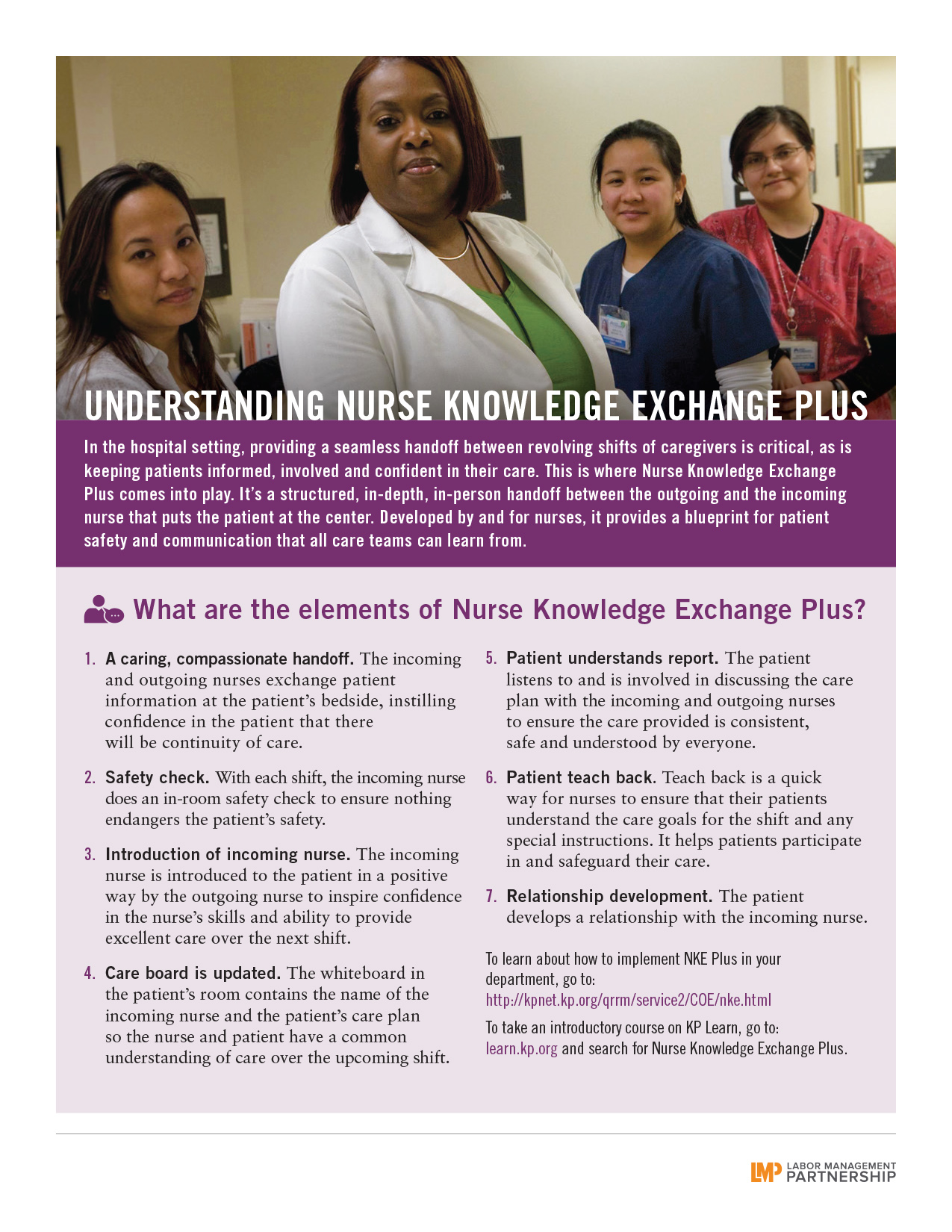
Poster: Understanding Nurse Knowledge Exchange

Format:
PDF

Size:
8.5” x 11”

Intended audience:
Frontline employees, managers and physicians

Best used:
This poster highlights the elements of the Nurse Knowledge Exchange Plan, and can be posted on bulletin boards, in break rooms and other staff areas.

Related tools:

Simple Tool Helps Teams Track Savings

Deck: 
Using this spreadsheet enabled a pharmacy team to see it saved three times more than expected

Story body part 1: 

As more and more unit-based teams answer the call to improve affordability for health plan members, they are finding new tools that can help manage their cost-improvement projects.

One such tool, a handy spreadsheet, can help teams track and report their cost savings.

Teams track own savings

Developed by UBT consultants and financial analysts in Colorado and later adopted by UBTs in the Northwest, the tool can help teams determine the economic benefits of a performance improvement project with little or no assistance from a consultant or sponsor.

“It’s a great add-on to teams’ reporting in UBT Tracker,” says Luanne Petricich, chief pharmacist, Pharmacy Professional Affairs, in Colorado and a sponsor of 12 UBTs in the region. “It can be a very impactful way for co-leads to show their teams and others what their savings were and how they achieved them.”

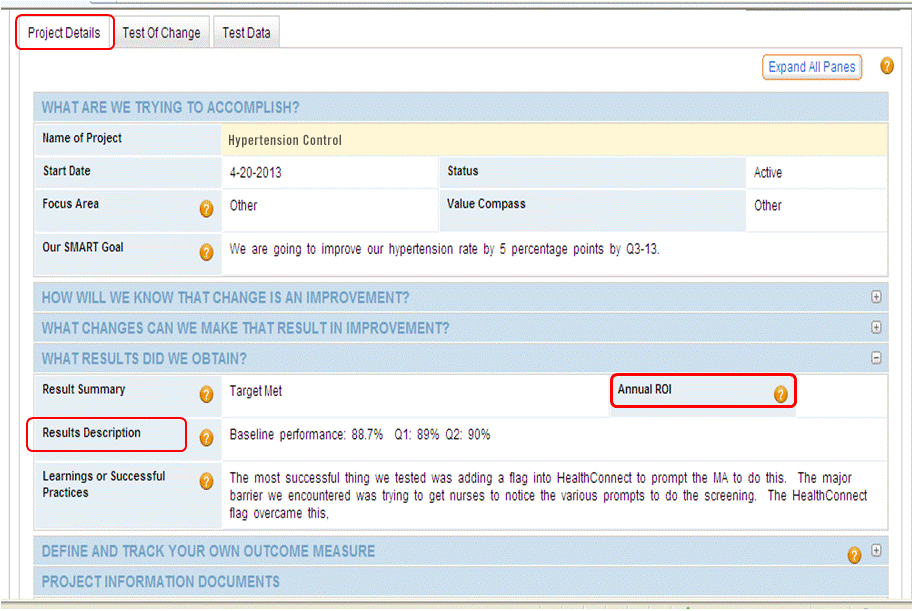
In addition, teams can now record their financial results directly into UBT Tracker thanks to a new data field, Annual ROI, that allows teams to share how much money a project saved or generated. The field can be found under the Project Details tab (see graphic below).

Tool use spreads

Petricich sends the spreadsheet to any of her teams working on a cost-reduction or efficiency project to help them document their results.

One team that used the tool was the pharmacy UBT at Baseline Medical Offices in Boulder. The team had completed an inventory-reduction project that far surpassed its goal—which was to reduce its drug inventory by 10 percent, or $50,000, in three months. By adjusting order quantities to better match usage and returning overstocked medication to the mail order pharmacy for use before the expiration date, the team saved $143,000—nearly three times its original goal.

“It’s important to track your results, and this tool can help teams do that in a simple way,” says Don Larson, Baseline’s pharmacy supervisor. “It’s something we would use the next time we do a similar project.”

Pages

Subscribe to RSS - Frontline Workers