All Roles

Help Video

How to Find UBT Basics on the LMP Website

Learn how to use the LMP website:

LMP Website Overview

Learn how to use the LMP website:

How to Find How-To Guides

This short animated video explains how to find and use our powerful how-to guides

Learn how to use the LMP website:

How to Find and Use Team-Tested Practices

Does your team want to improve service? Or clinical quality? If you don't know where to start, check out the team-tested practices on the LMP website. This short video shows you how. 

Learn how to use the LMP website:

How to Use the Search Function on the LMP Website

Having trouble using the search function? Check out this short video to help you search like a pro!

Learn how to use the LMP website:

How to Find the Tools on the LMP Website

Need to find a checklist, template or puzzle? Don't know where to start? Check out this short video to find the tools you need on the LMP website with just a few clicks. 

Learn how to use the LMP website:

TOOLS

2018 KP-Alliance National Agreement Summary

Format:
PowerPoint

Size:
8.5 x 11"; 13 pages

Intended audience:
Workers represented by the Alliance of Health Care Unions, their managers, and physicians who work with them

Best used:
Get an overview of key provisions of the agreement.

Related tools:

How Unit-Based Teams Make Kaiser Permanente a Better Place to Work

Deck: 
Positive results for KP members, patients and workers

Story body part 1: 

Do teams get better results when frontline workers are engaged, free to speak and can influence decisions? Yes, say the people who know best — Kaiser Permanente workers and managers themselves.

Recent People Pulse surveys confirm that unit-based teams get positive results for health plan members and patients, the organization and workers themselves.

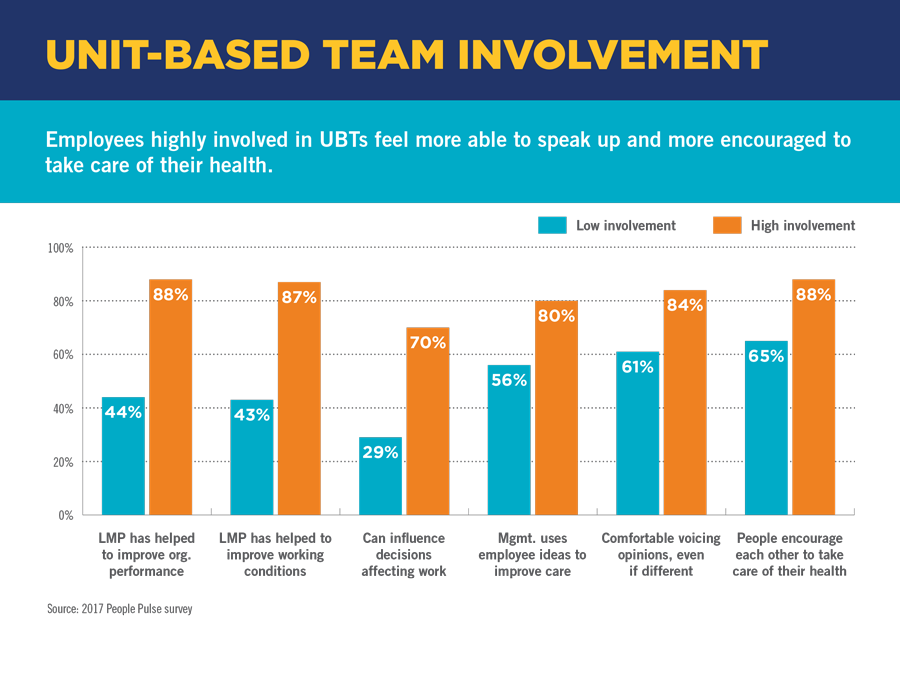
For instance, the 2017 People Pulse survey of more than 155,000 KP employees showed that when union-represented employees are highly involved in UBT activities, they get 29 percent higher scores on measures of their willingness to speak up — a key driver of patient and workplace safety and satisfaction. They also get 33 percent higher scores on questions regarding workplace health and wellness.

Improved safety and satisfaction

Further analysis, included in the 2016 People Pulse survey, showed that teams with high employee involvement have:

  • 18 percent fewer workplace injuries
  • 13 percent fewer lost work days
  • 4 percent higher patient satisfaction

“Our findings show that employees who are highly involved in their unit-based teams feel more able to speak up and more encouraged to take care of their health,” says Nicole VanderHorst, principal research consultant with KP Engagement & Inclusion Analytics. “That makes them more likely to have better performance outcomes.” 

A better way to work

Workers’ greater propensity to speak up and look after their health when they’re involved in team activities covers several questions (see chart below). For example, workers who are highly involved in their UBTs are far more likely to say:

  • The Labor Management Partnership has helped improve organizational performance and working conditions.
  • They can influence decisions affecting their work.
  • They’re comfortable voicing differing opinions.
  • Management uses their ideas to improve care.
  • They’re encouraged, and encourage others, to take care of their health.
Unit-Based Team Involvement

Click to enlarge.

Roots of workforce engagement

All these factors contribute to a better employee experience as well as performance. And UBTs reflect KP’s unique history with the labor movement.

“Henry Kaiser was perhaps the 20th century’s most worker-friendly industrialist. He supported organized labor and knew that people step up when allowed to exert their job experience, as they do with UBTs,” says KP archivist and historian Lincoln Cushing.  “He trusted employees to make decisions that benefitted themselves and their organizations.”

If you belong to a unit-based team — and most union-represented employees do — talk with a team co-lead about ways to get more involved.

Tips for Flu Prevention

Deck: 
How to protect yourself and our members from this virus

Story body part 1: 

When flu season arrives, it’s important to stay well. As a matter of patient and workplace safety and professional pride, we can take steps to protect ourselves, our families, co-workers, and members and patients from flu and other infectious diseases. Here’s how. 

Vaccinate yourself and others

  • If you don’t get the flu, you won’t pass it on. The vaccine reduces the chance you will get the flu. Encourage others to get vaccinated, too.

Keep flu out of the air

  • Limit the time patients with suspected flu spend in open waiting rooms; separate them from others.
  • Offer surgical masks to people who are coughing or sneezing and encourage them to cover their coughs. Supply tissues, trash cans and hand sanitizer in waiting areas.
  • Place patients with flu in a private room.
  • Avoid unnecessary transport of infectious patients — and have them wear surgical masks outside their rooms.

Keep flu off of yourself. Follow standard and droplet precautions

  • Wear eye protection, gown and gloves.
  • Wear respiratory protection when in the room with the patient and until the air has cleared after the patient has left the room (about one hour), or if you are doing procedures that may aerosolize infectious particles.
  • Wash your hands often. Use hand sanitizer or wash with soap and water before and after all patient care.
  • Avoid touching your face, clothing or mask with your hands.

Keep the environment clean

  • Focus cleaning on high-contact surfaces: door knobs, elevator buttons, reception desks, exam tables, pharmacy furniture. 

TOOLS

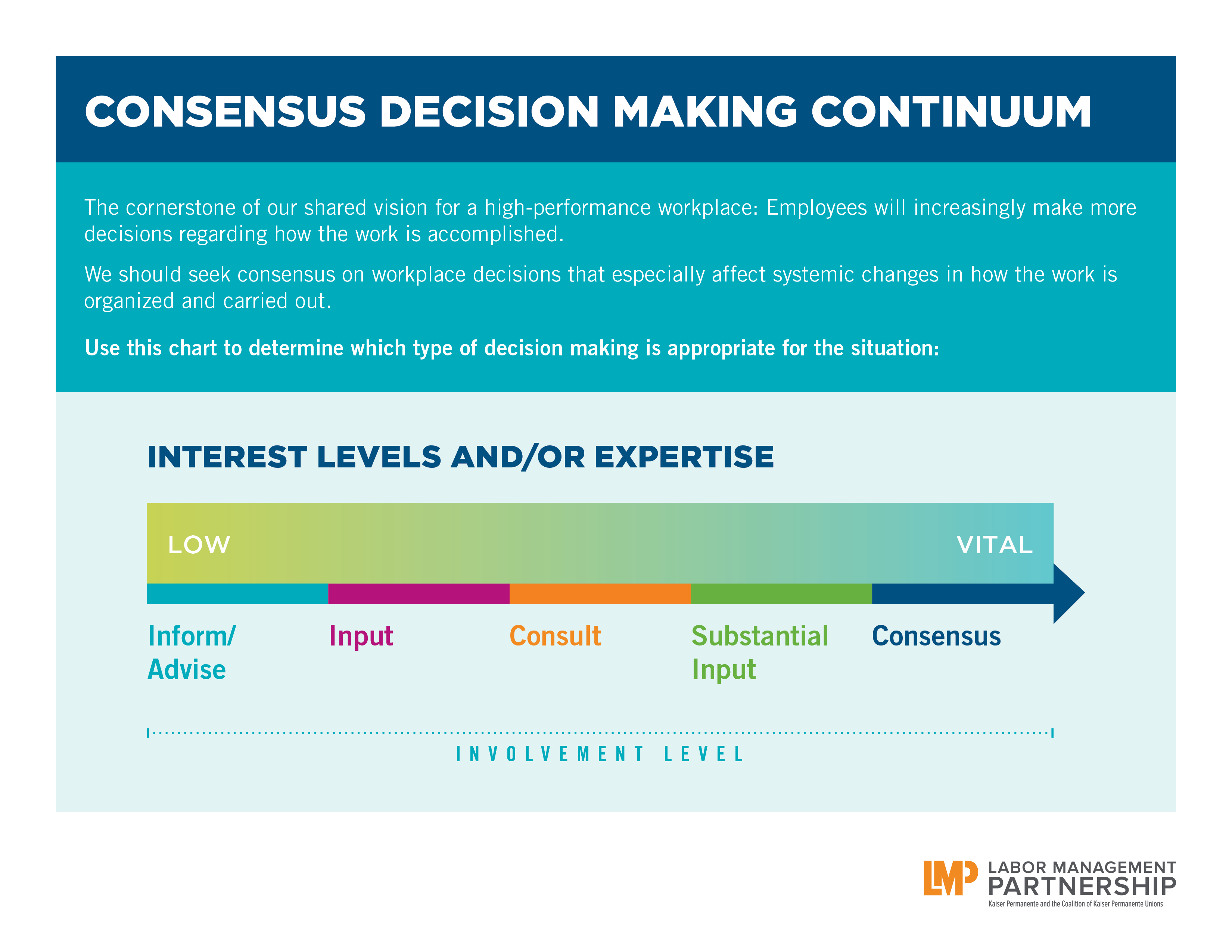
Consensus Decision Making Continuum

Format:
PDF and PPT slide

Size:
8.5" x 11"

Intended audience:
Leaders at any level who need to articulate what process will be used to make a decision. 

Best used:
Hand out at meetings or use in presentations when discussing consensus decision making and interest based problem solving. 

Related tools:

From the Desk of Henrietta: A Tale of Two Ankles

Story body part 1: 

I have a friend who loves to play softball. In 1999, she tore her left Achilles tendon while sliding into first base. Her surgery involved getting cut open and then stitched up, which was painful and created a risk of infection. It put her in a heavy cast for six months, left a five-inch scar and was an all-around miserable experience.

Four years later, while playing racquetball, she (you guessed it) tore her right Achilles tendon. In just those few years, surgical technology had improved so much that she could get her leg patched up with laser surgery. She still had to wear a cast — but for only three months this time, and there was no scar. There was hardly any pain. “It was like night and day,” she says. 

When someone says, “I don’t want to learn the new way. The old way works just fine,” I tell them about this friend.

Imagine that her doctor and care team had not bothered to learn about the laser surgery. Their patients would have suffered with a longer and tougher recovery than necessary. Caregivers want the best for their patients. That wouldn’t have been the best.

In everything we do, we put the patient and member at the center. Developing the skills of our workforce is no different. We learn new treatment methods to help our patients get better faster. We learn new software programs to help them get their medications more quickly and efficiently. We figure out the new technological gizmos so we can have virtual visits with our members, saving them the time, effort and sometimes discomfort of getting to our brick-and-mortar offices. We invent new ways of doing old jobs, or create entirely new jobs, to meet new needs.

Giving up the old way of doing things is scary, but also liberating. Learning new things can be difficult, but also fun. We’re navigating our way into the future together, supporting one another all along the way. 

Pages

Subscribe to RSS - All Roles