All Roles

Help Video

How to Find UBT Basics on the LMP Website

Learn how to use the LMP website:

LMP Website Overview

Learn how to use the LMP website:

How to Find How-To Guides

This short animated video explains how to find and use our powerful how-to guides

Learn how to use the LMP website:

How to Find and Use Team-Tested Practices

Does your team want to improve service? Or clinical quality? If you don't know where to start, check out the team-tested practices on the LMP website. This short video shows you how. 

Learn how to use the LMP website:

How to Use the Search Function on the LMP Website

Having trouble using the search function? Check out this short video to help you search like a pro!

Learn how to use the LMP website:

How to Find the Tools on the LMP Website

Need to find a checklist, template or puzzle? Don't know where to start? Check out this short video to find the tools you need on the LMP website with just a few clicks. 

Learn how to use the LMP website:

From the Desk of Henrietta: Relieve Stress With ‘Yes, and’

Story body part 1: 

The chances are good you are a person who deals—directly or indirectly—with life and death every day. You might be an EVS worker who keeps patient rooms germ-free to reduce the odds of infection, or an ER nurse helping a baby with a high fever. If you are not on the clinical front lines, you likely support this honorable work from behind the scenes.

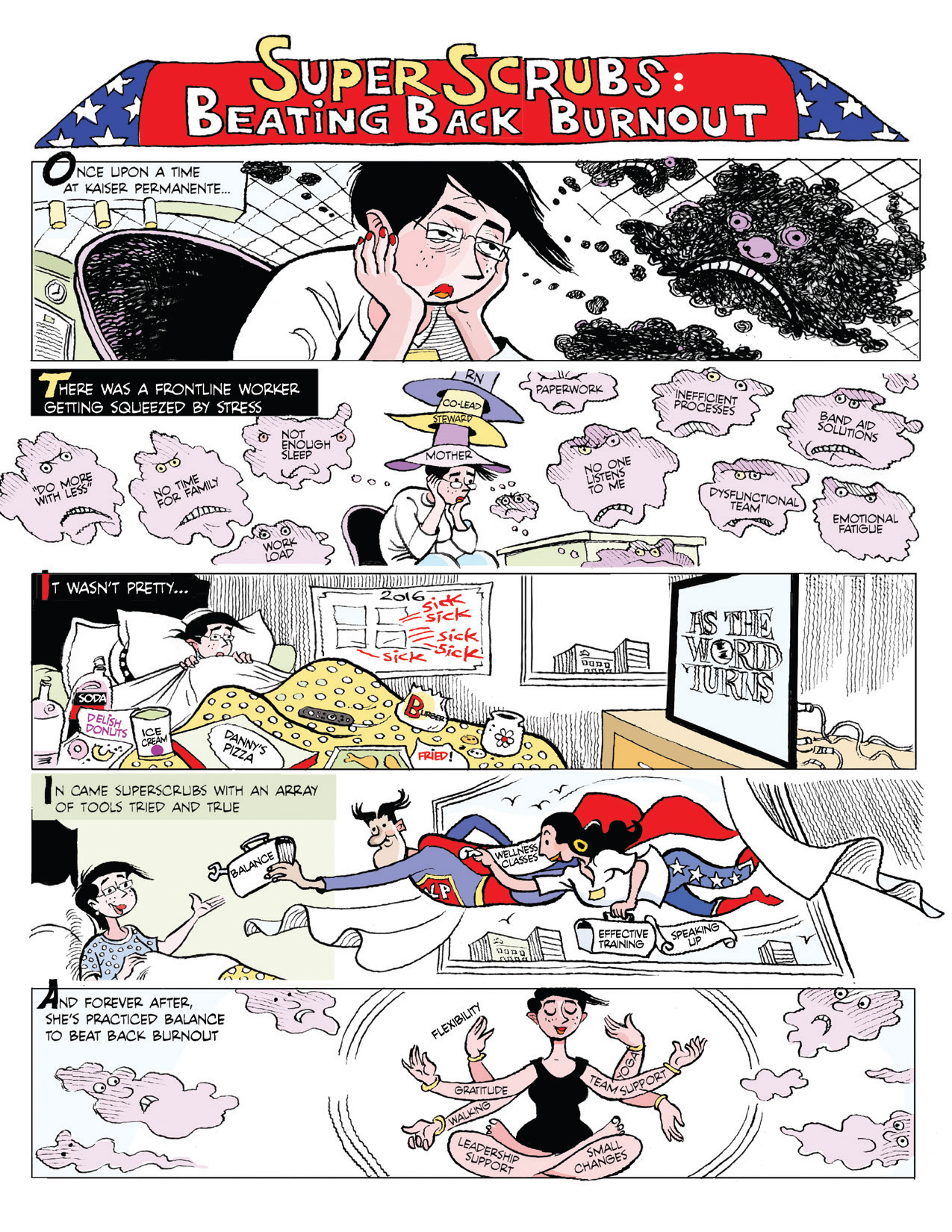
We put others first. We give everything to give the best care to our patients. But far too frequently, we don’t leave anything in reserve. We neglect to take care of ourselves. This imbalance undermines the admirable ethic of our modern health care system.

One survey showed 60 percent of health care providers are burned out. In this issue of Hank, we provide practical tips and tools that individuals, leaders and teams can use to reduce workplace stress.

But more than that, we challenge the notion that the responsibility for preventing burnout lies solely with one of these groups. Let’s call it the “yes, and” approach. Yes, individuals need to eat better, exercise more and cultivate a positive outlook to reduce their own stress. And, leaders need to ensure safe staffing levels and create a solution-oriented workplace culture.

Our Labor Management Partnership gives us a third “yes, and”: Yes, individuals and leaders matter. And, our unit-based teams can fix inefficient processes that cause unnecessary stress and interpersonal conflict.

Every day, Kaiser Permanente’s 3,500 UBTs use performance improvement tools that make our work go more smoothly. Moreover, those tools and the foundation of trust and openness fostered by partnership give everyone a voice in making improvements.

And that also reduces our stress.
TOOLS

LMP Newsletter Templates

Format: DOC

Size: 8.5" x 11" 

Intended audience: UBT consultants, sponsors and co-leads

Best used: Three different pre-formatted Word DOC newsletter templates in three versions: teal and orange, orange only and teal only. Keep all your team members and stakeholders in the loop! Use these templates to create eye-catching newsletters quickly. No special design skills or software needed. Just pop in your own text and photos.


Related tools:

This Plan Was Made for You and Me

Deck: 
A whirlwind tour of KP and union history

Story body part 1: 

1933-1945: ‘There is no such thing as labor relations’

The health care program now known as Kaiser Permanente began in the Mojave Desert when Dr. Sidney Garfield, fresh out of medical school, opened a clinic for 5,000 Colorado River Aqueduct workers in 1933. Dr. Garfield soon found his practice foundering because insurance companies were sending the most serious—and most profitable—cases to Los Angeles hospitals. He developed a prepaid plan with a focus on safety and illness prevention, and it worked. The hallmarks of what would become the Kaiser Permanente Health Plan—prepayment, prevention and group practice—were forged here, but it would be 12 years before members of the public could join.

In 1938, Henry J. Kaiser and his son Edgar persuaded Dr. Garfield to create a similar medical program for workers building the Grand Coulee Dam in Washington.

The resulting industrial health plan was so popular, the unions insisted dam workers’ families be included. That feature carried over when Dr. Garfield built the largest civilian medical care program on the World War II home front, covering almost 200,000 Kaiser workers in California, Oregon and Washington.

With the traditional labor pool—young, healthy white males—serving in the military, thousands of African Americans and other people of color migrated to the shipyards, securing good union jobs after the long hurt of the Great Depression. Women came out in force, too. The Permanente Foundation Health Plan, both the on-the-job care and the broad coverage of the 50-cent-a-week supplemental plan, was extremely successful.

For the first time in their lives, ordinary people could count on affordable medical care.
 

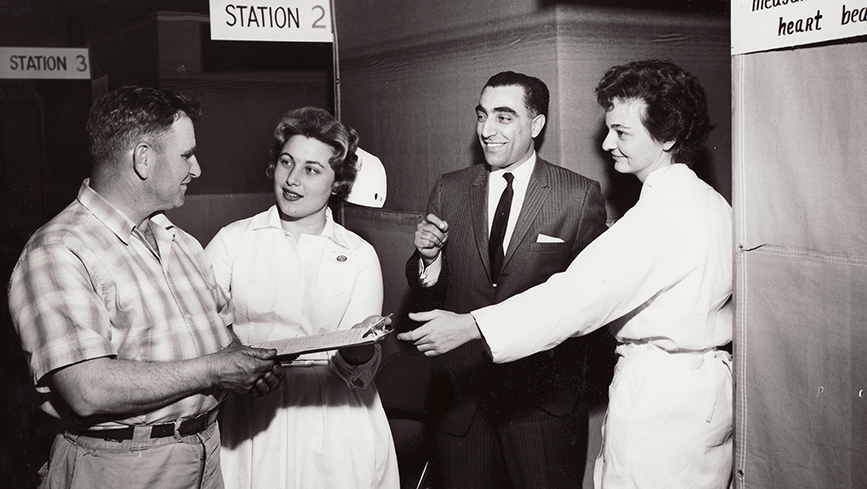
A longshore worker signing up for a "multiphasic" exam, which provided a comprehensive health assessment, in 1963.

1946-1989: ‘If not for organized labor’

On July 21, 1945, with the war in Europe over and the shipyards beginning to close, the Permanente Foundation Health Plan opened to the general public. A year later, on Aug. 1, 1946, Dr. Garfield signed the Permanente Foundation’s first union contract, with the CIO-affiliated Nurses’ Guild. The contract, in a first for Alameda County hospitals, established a 40-hour workweek, down from 48 hours.

Key support for the Permanente health plan came from unions. Harry Bridges, president of the International Longshoremen and Warehousemen’s Union, was an early advocate. He defended the plan against attacks by professional medical associations, whose members called prepaid group practice unethical, and brought all 6,000 ILWU members on the West Coast into the plan. Almost 15,000 members of the Retail Clerks Union in Los Angeles, a large and prominent union led by Joe DeSilva, joined in 1951.

But by the mid-1960s, financial pressures began creating divisions. In 1966, registered nurses in Northern California, represented by the California Nurses Association, became the first nurses in the state to conduct a work action. Major strikes erupted in 1968 in both Northern and Southern California. The strife simmered, and in 1986, a seven-week strike by SEIU Local 250 had some 9,000 clerks, certified nursing assistants and technicians walking the picket line at 14 Kaiser Permanente facilities in California. The action didn’t prevent a two-tier wage restructuring plan, but there was one positive outcome: The first Joint Conference on Service Issues, a precursor to the Labor Management Partnership agreement.
 

TOOLS

SuperScrubs: Together Another 70 Years

Format:
PDF (color or black and white)

Size:
8.5" x 11"

Intended audience:
Anyone with a sense of humor.

Best used: 
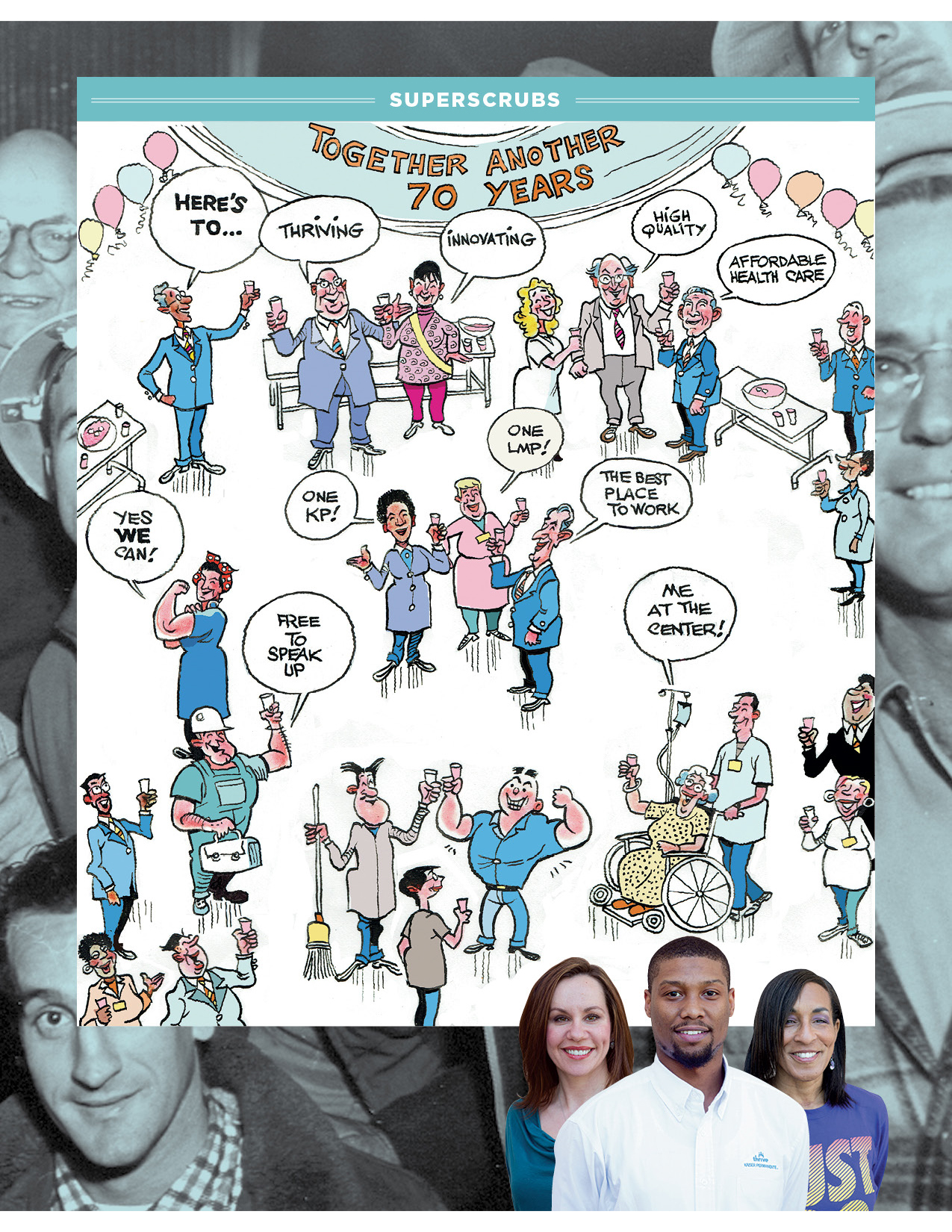
This full-page comic celebrates 70 years of Kaiser Permanente.  Post on bulletin boards, in break rooms and other staff areas.

Related tools:

Boost Your Borrowing

Deck: 
It’s tempting to think that your team needs its own special solutions. But more often than not, adapting an idea from elsewhere is the fastest way to a win.

Story body part 1: 

When Marianne Henson, RN, left her position as clinical operations manager of the Burke Primary Care team in Virginia, she took something with her—a plan.

In 2011, Henson helped launch a project at the Burke Medical Center that boosted the percentage of patients with their blood pressure under control. Instead of creating a brand-new plan to solve the same problem at her new facility in Falls Church, Virginia, she became a copycat.

“Why reinvent the wheel?” Henson says. “We already knew what worked.”

When Henson was in her role at Burke, other clinical operations managers and physicians from the 10 Northern Virginia medical centers held regular area-wide meetings that allowed teams faced with similar issues to learn from one another. As a result, other facilities began adopting Burke’s practice of having clinical assistants call members with hypertension to ask them to come in for more frequent blood pressure checks. Burke had already discovered that members ignored requests sent via mass mail, so the other centers didn’t waste time or money repeating that experiment.

“We have members waiting only five to 10 minutes,” says Andrea Brown, a clinical assistant at Falls Church and member of OPEIU Local 2. “We let them know over the phone that this will be a quick visit and they will be on their way.”

Brown and the other clinical assistants try to call at least five members each day to see if they can pop in for a check while at the pharmacy or when they have an appointment with a specialist. And each day, depending on the weather, between three and five patients take advantage of the mini-blood pressure appointments. “This brief visit is cost effective, saves time and helps us make sure the member is on the right track,” Brown says.

Brown says members have given her positive feedback because of the convenience.

“It made sense because the whole region was expected to bring hypertension control up to better levels,” Henson says. “We standardized what we do.”

TOOLS

SuperScrubs: Interest-Based Harmony

Format:
PDF (color or black and white)

Size:
8.5" x 11"

Intended audience:
Anyone with a sense of humor.

Best used:
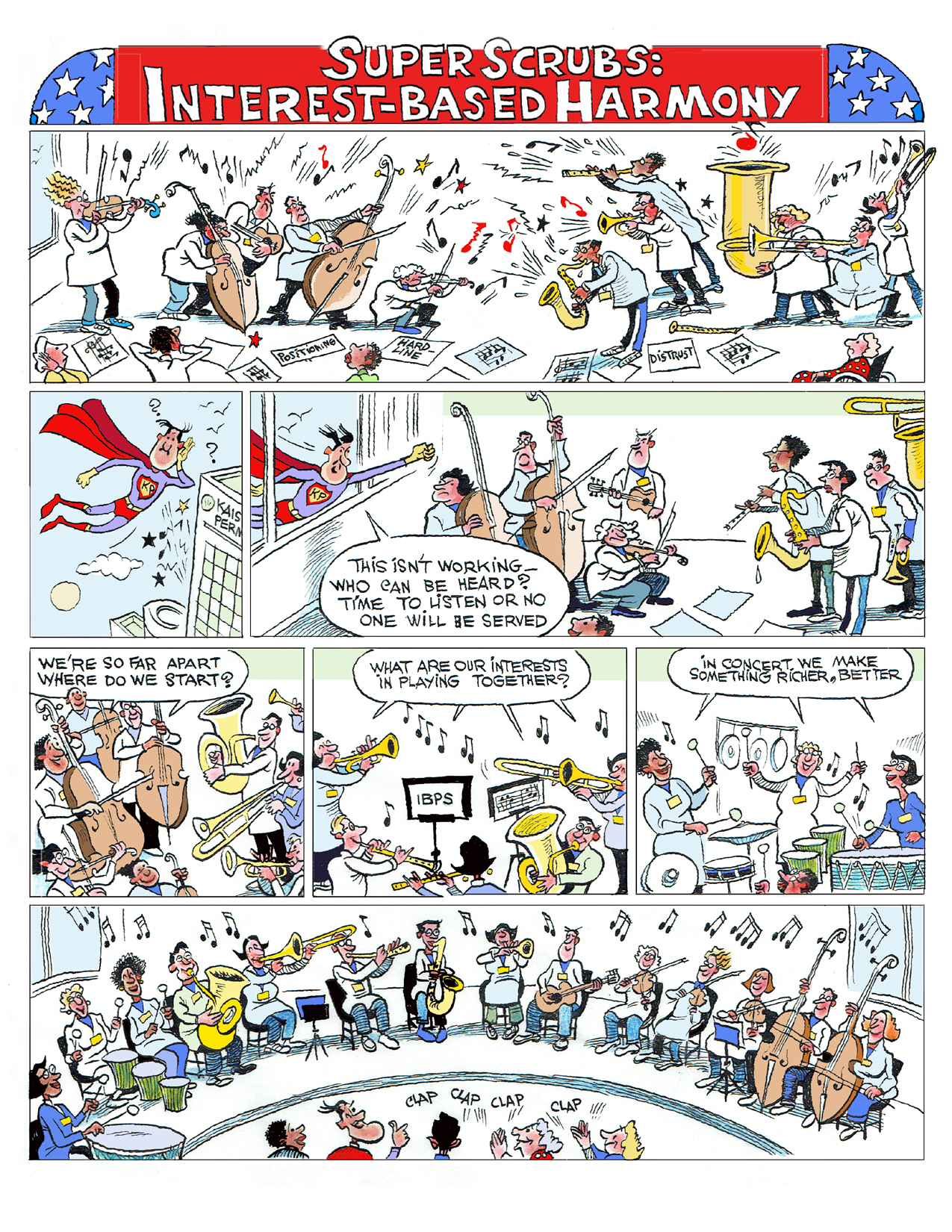
This full-page comic features Manny helping orchestrate harmony by encouraging everyone to discover their common interests. Enjoy, and appreciate the value of interest-based problem solving.

Related tools:

TOOLS

LMP PowerPoint Templates

Format:
PowerPoint

Intended audience:
Anyone needing to create an LMP-related presentation

Best used:
Click on the buttons at right to download a PowerPoint template with a cover and inside page. Each template is designed for a different audience: all LMP audiences; KP-LMP-Alliance; and KP-LMP-Coalition. 


Related tools:

TOOLS

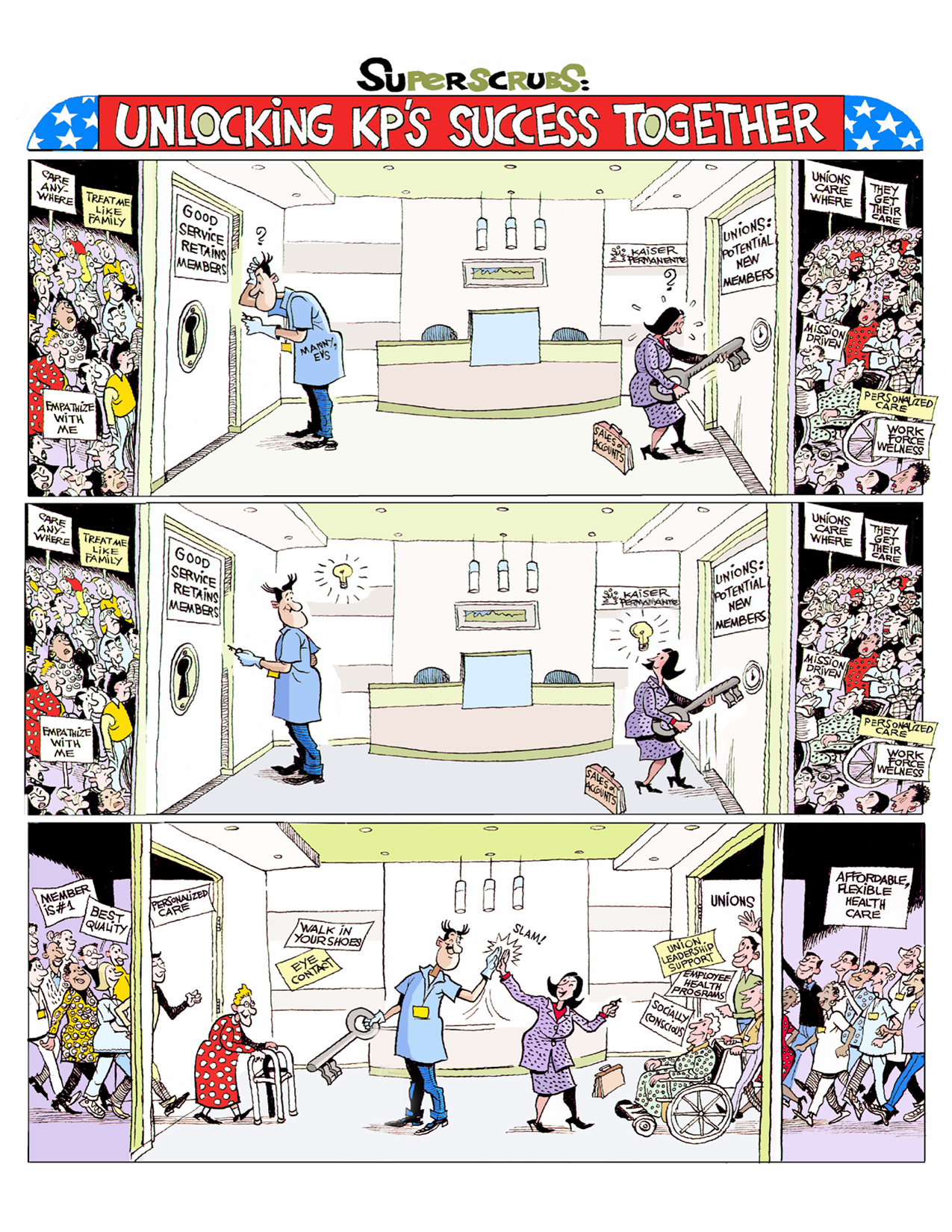
SuperScrubs: Unlocking KP's Success Together

Format:
PDF (color or black and white)

Size:
8.5" x 11"

Intended audience:
Anyone with a sense of humor

Best used:
This full-page comic features two people working together to unlock the doors to KP's success. Enjoy, and be reminded that when we work together, we all contribute to KP's success.

Related tools:

Pages

Subscribe to RSS - All Roles