UBT Sponsors

Help Video

How to Find UBT Basics on the LMP Website

Learn how to use the LMP website:

LMP Website Overview

Learn how to use the LMP website:

How to Find How-To Guides

This short animated video explains how to find and use our powerful how-to guides

Learn how to use the LMP website:

How to Find and Use Team-Tested Practices

Does your team want to improve service? Or clinical quality? If you don't know where to start, check out the team-tested practices on the LMP website. This short video shows you how. 

Learn how to use the LMP website:

How to Use the Search Function on the LMP Website

Having trouble using the search function? Check out this short video to help you search like a pro!

Learn how to use the LMP website:

How to Find the Tools on the LMP Website

Need to find a checklist, template or puzzle? Don't know where to start? Check out this short video to find the tools you need on the LMP website with just a few clicks. 

Learn how to use the LMP website:

Tips for Tracking Financial Impact

Deck: 
Teams that save money keep KP affordable for members and patients

Story body part 1: 

Our members and patients count on Kaiser Permanente for affordable, quality care — and more unit-based teams than ever are focusing on ways to improve efficiency as well as service and quality. In fact, service or quality care improvements often lead to more cost-effective care, which benefits KP, our workforce and, most of all, our members and patients. Use these tips to jump-start your team’s thinking about the financial impacts of your improvements.

  1. Think about potential financial impact from the start of your project. This will help you identify early on the data to collect and monitor so the financial impact can be calculated later. Keeping the financial impact in mind can also help refine your SMART goal.
  2. Get a good grasp of what you’re trying to improve. Then think about the cost associated with that thing. For instance, if your goal is to streamline scheduling, think about the potential costs, such as excessive overtime, associated with an inefficient schedule.
  3. Have a clear understanding of your baseline metric. Once you know what your goal is, determine the associated costs before any changes are made. This will help you translate the improvement into money saved.
  4. Work with your local finance team. If you don’t have a relationship with your local finance department, ask your UBT consultant or improvement advisor to connect you with the right person to help you determine the dollar value of a project.
  5. Find out if there’s a team in your facility or service area that is working on something similar.
  6. Another team may already have figured out ways to calculate the financial impact your project might have or may have different ideas for measuring its financial benefit.
  7. Look beyond the hard dollar savings. “Soft dollars” can be equally important. These are avoided costs or improvements that don’t reduce the money spent but allow us to do more with the resources we have. Examples include improvements in re-admission rates, number of no-show appointments or time spent looking for supplies.
  8. Value the financial impact of small improvements. If an improvement and its estimated financial impact seem small, remember to figure out the potential savings over time or add up what happens if the practice spreads to other departments or facilities.
 

Tips for Spreading Effective Practices

Deck: 
Found a solution that works? Share the success with others!

Story body part 1: 

Unit-based teams are getting results — and are finding ways to share their learning with their peers face to face, online or in print. Talk with your team about how to use these and other ideas to share your learning and spread success.

  1. Track your progress. UBT Tracker is a web-based tool that helps unit-based teams and consultants collect and report information about their performance improvement work. 
  2. Tell your story. Storytelling is one of the best ways  to explain partnership and show others your results. Use our storytelling workbook to share best practices. 
  3. Step right up. UBT fairs and PSP paloozas are dynamic forums for spreading effective practices face to face. Hosting your own virtual PSP palooza lets you reach beyond the walls  of your facility.
  4. Lights…camera…take action. Kaiser Permanente’s Care Management Institute uses video ethnography— interviewing KP patients at the care site—to help teams share ideas and keep patients at the centerof performance improvement. To learn more, visit CMI’s Video Ethnography & Storytelling page [KP intranet].
  5. Write all about it. Use fliers, posters and newsletters to keep others informed and engaged in your team’s projects. Post your results in the break room. Invite another unit to your huddle for a progress report. Use these templates to create your next newsletter.

Tips for Sponsors

Deck: 
How to support, guide and inspire teams

Story body part 1: 

Sponsors are the go-to people for UBT co-leads, providing resources, guidance and oversight for teams — and effective sponsorship is one of the most important ingredients for a high-performing unit-based team. If you’re a sponsor, provide your teams with the support they need to create an environment where UBT members are always learning, always improving, always innovating.

  1. Make it a priority to be involved. Provide feedback and hold teams accountable for action plans.
  2. Coach and mentor co-leads; connect them with opportunities to develop needed skills or knowledge. Developing strong team members will ease your work in the long run.
  3. Take time for face time. Walk the floor with team members and occasionally attend UBT meetings.
  4. Share expectations up front with your co-sponsor and team co-leads. Define how you’ll make decisions and how you’ll communicate and how often.
  5. Help team members build their problem-solving skills by having them develop solutions, but if there are barriers outside the co-leads’ or team’s scope, get busy breaking them down.
  6. Educate your teams about local work plans and regional performance priorities so they can work on the right projects. Be sure, too, that things team members care most about get addressed.
  7. Celebrate and highlight successes, both large and small, by rewarding individuals and teams in a way that is meaningful to them — whether it’s an email, party, lunch or a parking spot for a month.
  8. Secure the resources your teams need to get work done, such as time for regular trainings or meetings and access to data that will help benchmark their performance.
  9. Establish a baseline Path to Performance rating. Assist teams in understanding the rating and connect them with resources or successful practices that will help them become high performing.
  10. Ensure teams are documenting their work regularly, accurately and concisely in UBT Tracker.


Tips for Improving Attendance

Deck: 
Being here for our patients and members

Story body part 1: 

Unit-based teams encourage employees to make wise use of the National Agreement's sick-leave provisions, which help ensure that individuals have income in the event of a long-term illness or disability. Absences can also create hardship on other employees and affect member service and care. Here are some tips for improving attendance in your department: 

  1. Survey your unit or department to determine if there’s confusion about the use of sick time. If needed, find ways to educate staff on sick leave, tardiness and clocking in and out.
  2. Create an “attendance star” board to recognize staff members with great attendance.
  3. Encourage colleagues to schedule routine appointments during off-hours or in conjunction with lunch or breaks when possible.
  4. Track call-outs and use anonymous surveys to test for reasons why they are occurring.
  5. Use cause-and-effect tools such as fishbone diagrams to address unforeseen circumstances, morale, physical environment, workload or personal reasons.
  6. Engage staff with frequent conversations and be alert for — and respond to — indications of unhappiness or tension.
  7. Recruit an attendance champion to be on the lookout for opportunities to coach others on the importance of banking sick leave.
  8. Help employees track sick-leave usage by printing out and distributing the attendance calendar.
  9. Use the attendance scorecard to learn about the six essentials of good attendance and to see how your team rates. Then  develop small tests of change to address the weak spots identified by the scorecard.

TOOLS

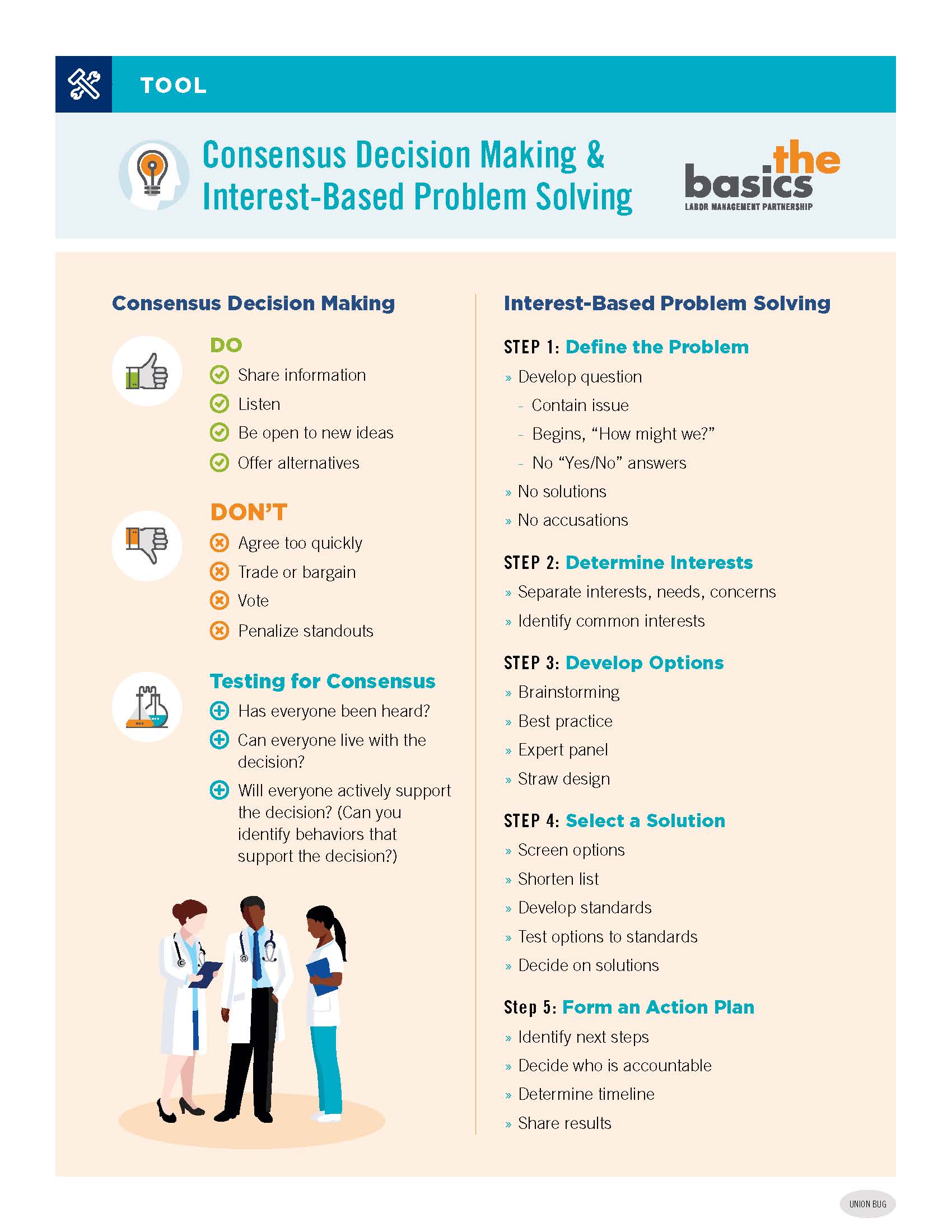
Interest-Based Problem Solving and Consensus Decision Making

Format:
PDF

Size:
8.5" x 11" and 4" x 6"

Intended audience:
Anyone leading or coaching teams with difficult issues that need to be resolved. 

Best used:
Download and print out so team members can follow the processes of interest-based problem solving and consensus decision making step by step. Use the smaller 4" x 6" version as a two-sided postcard. 

Related tools:

12 Tips for Building Your Team

Deck: 
Take one action for every month of the year

Story body part 1: 

Want to take your team to the next level? Make good things happen for yourself, your co-workers and your members and patients? Collaboration is one of the four critical skills needed to meet future challenges with ease. Use these 12 team-building tips to make every month count.

1. Par-tay

Celebrate your team’s successes and acknowledge — even celebrate — failures. Failures are great opportunities for learning if you focus on where the process (not the person) needs improvement. After each test of change, recognize and reward contributing team members at huddles and meetings. Use small wins to keep the momentum going.

2. In and out

Help employees track their sick days and time off by printing out and distributing our colorful, always popular attendance calendar.

3. Follow the money

Learn your department’s budget as a team and get everyone’s ideas on how to reduce costs. Sign up for a business literacy training. 

4. Track it in tracker

Document your team’s work regularly, accurately and concisely in UBT Tracker. It will let others see and learn from your team’s accomplishments.

5. Stop the line

Ask for help or call a stop to the work when you see an imminent danger or need help to safely complete a task. Then look for system improvements and root causes of problems — ask not just what happened, but why.

6. Grow leaders

Rotate responsibilities for leading meetings and managing improvement projects among all team members. This will build your team’s skills and strengths.

7. Two words

Huddle daily. It works. Watch the video “Huddle Power” and use the tools there to get you started huddling with your team.

8. Clean up your act

Become supply savvy. Make a full assessment of supplies — track inventory, tidy up storage areas and streamline ordering. Simple changes can save thousands of dollars. Download our 6S tool to make this work a snap. 

9. Take a (waste) walk on the wild side

Perform a waste walk. Impartially observe a work area or work process to identify waste or inefficiency. Get walking with our online Waste Walk toolkit

10. Save a tree

Go paperless. Don’t print out agendas and documents. Send them out via email or use a projector instead.

11. Get online

Help patients sign up on kp.org. Remind them they can securely view their medical records and most lab results, email their doctors, schedule appointments and refill prescriptions online. Bonus tip: Encourage tech-savvy members to download the kp.org app so they can access these features on their phones. Check out how one team got 90 percent of its patients signed up.

12. Spread and borrow

Did something work for your team? Spread the word to others. Need inspiration for your next improvement project? Look for other teams that have succeeded. Work with your UBT consultant or union partnership representative to spread your successes. Visit our Team-Tested Practices section to get ideas you can try with your team!

Facilitation Skills Workshop (classroom)

Story body part 1: 

Course description

Participants will learn core facilitation practices and will practice these skills and receive feedback from instructors. The participants will determine how facilitation skills are used when leading a UBT.

Path to Performance

Level 3, 4, 5 

Duration

2 days


Who should attend

This course is intended for anyone facilitating unit-based teams. Job categories who should attend include physician, management, labor, unit-based team consultants and union partnership representatives.

Course requirements

None

Effective Stakeholding (classroom)

Story body part 1: 

Course description

This course is designed to improve the methods of a representative or “stakeholder” by providing tools and scenarios that will improve communication and teach how to manage issues.

Path to Performance

Level 2

Duration

8 hours


Who should attend

This course is intended for labor participants only. Job categories who should attend are labor (co-leads, stewards and sponsors).

Course requirements

Labor Management Partnership Orientation (LMPO)

UBT Sponsor Training (classroom, virtual)

Story body part 1: 

Course description

It is critical for steward sponsors and management sponsors to invest in the development of the unit-based team, which will have a long-term impact on the organization, and to learn about tools and resources available to them in their sponsor role. This course is designed to help union, physician and management sponsors discover the benefits of effective sponsorship and how it can help them develop successful, sustainable unit-based teams.

Union and management sponsors will gain an awareness of how their role is critical to the transformation of how the work at Kaiser Permanente is done.
 

Path to Performance

Level 2

Duration

4 hours

Who should attend

This course is intended for participants who are unit-based team labor, management or physician sponsors 

Course requirements

Labor Management Partnership Orientation (LMPO)

Interest-Based Problem Solving (web-based)

Story body part 1: 

Course description

Interest-Based Problem Solving offers labor and management partners a method to solve problems using a non-adversarial process. This module guides the four-step interest-based problem-solving process and a simulation exercise that allows participants to practice the process.

Path to Performance

Levels 1, 2 

Duration

  • 30 minutes (online)

Who should attend

People engaged in problem solving at the unit-based team level up to regional Labor Management Partnership committees should attend this training, along with any union and management staff members working on issue resolution and corrective action. Job categories who can take this class are labor, management and physician members of a unit-based team, Labor Management Partnership and unit-based team consultants, improvement advisers and Union Partnership Representatives.


Pages

Subscribe to RSS - UBT Sponsors