UBT Consultants & UPRs

Help Video

How to Find UBT Basics on the LMP Website

Learn how to use the LMP website:

LMP Website Overview

Learn how to use the LMP website:

How to Find How-To Guides

This short animated video explains how to find and use our powerful how-to guides

Learn how to use the LMP website:

How to Find and Use Team-Tested Practices

Does your team want to improve service? Or clinical quality? If you don't know where to start, check out the team-tested practices on the LMP website. This short video shows you how. 

Learn how to use the LMP website:

How to Use the Search Function on the LMP Website

Having trouble using the search function? Check out this short video to help you search like a pro!

Learn how to use the LMP website:

How to Find the Tools on the LMP Website

Need to find a checklist, template or puzzle? Don't know where to start? Check out this short video to find the tools you need on the LMP website with just a few clicks. 

Learn how to use the LMP website:

TOOLS

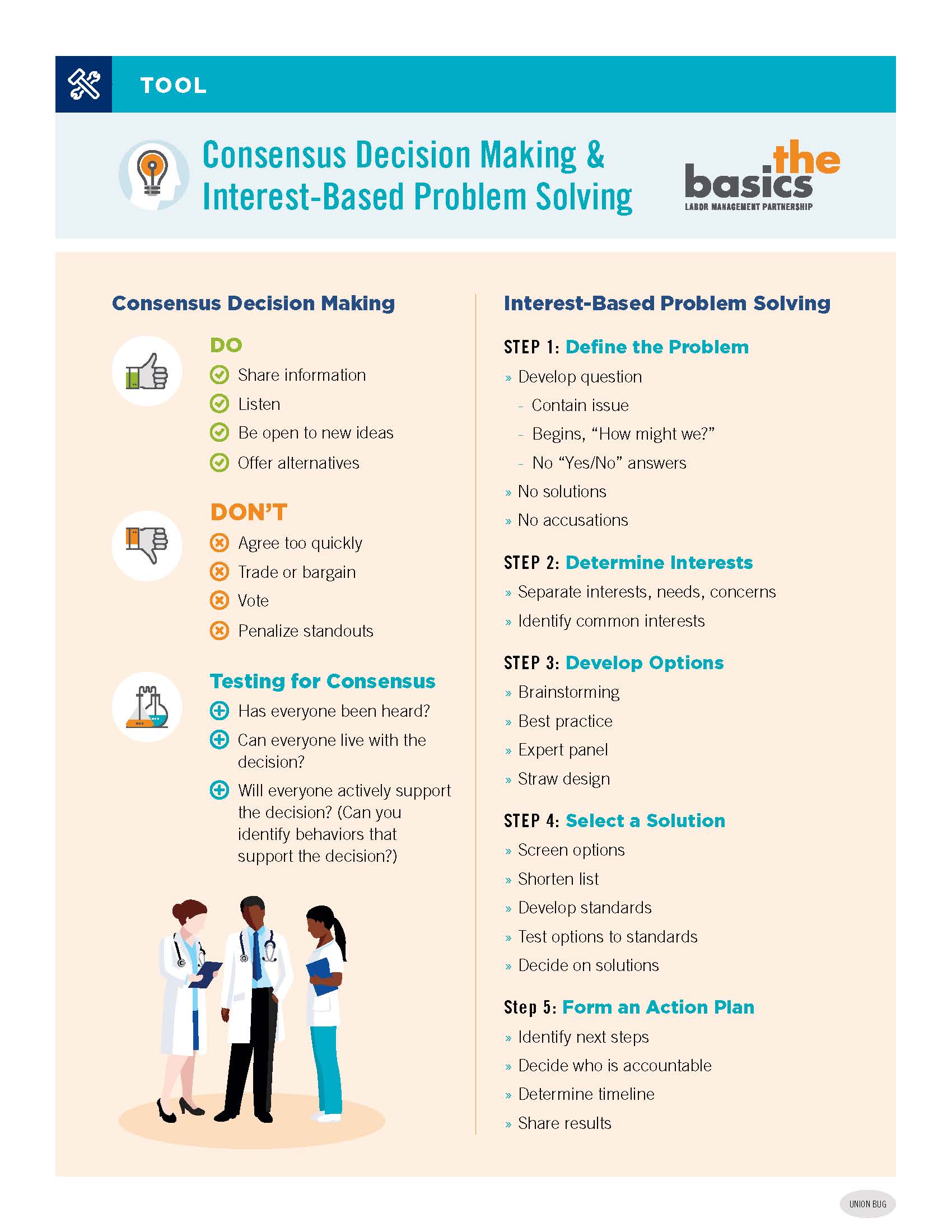
Interest-Based Problem Solving and Consensus Decision Making

Format:
PDF

Size:
8.5" x 11" and 4" x 6"

Intended audience:
Anyone leading or coaching teams with difficult issues that need to be resolved. 

Best used:
Download and print out so team members can follow the processes of interest-based problem solving and consensus decision making step by step. Use the smaller 4" x 6" version as a two-sided postcard. 

Related tools:

12 Tips for Building Your Team

Deck: 
Take one action for every month of the year

Story body part 1: 

Want to take your team to the next level? Make good things happen for yourself, your co-workers and your members and patients? Collaboration is one of the four critical skills needed to meet future challenges with ease. Use these 12 team-building tips to make every month count.

1. Par-tay

Celebrate your team’s successes and acknowledge — even celebrate — failures. Failures are great opportunities for learning if you focus on where the process (not the person) needs improvement. After each test of change, recognize and reward contributing team members at huddles and meetings. Use small wins to keep the momentum going.

2. In and out

Help employees track their sick days and time off by printing out and distributing our colorful, always popular attendance calendar.

3. Follow the money

Learn your department’s budget as a team and get everyone’s ideas on how to reduce costs. Sign up for a business literacy training. 

4. Track it in tracker

Document your team’s work regularly, accurately and concisely in UBT Tracker. It will let others see and learn from your team’s accomplishments.

5. Stop the line

Ask for help or call a stop to the work when you see an imminent danger or need help to safely complete a task. Then look for system improvements and root causes of problems — ask not just what happened, but why.

6. Grow leaders

Rotate responsibilities for leading meetings and managing improvement projects among all team members. This will build your team’s skills and strengths.

7. Two words

Huddle daily. It works. Watch the video “Huddle Power” and use the tools there to get you started huddling with your team.

8. Clean up your act

Become supply savvy. Make a full assessment of supplies — track inventory, tidy up storage areas and streamline ordering. Simple changes can save thousands of dollars. Download our 6S tool to make this work a snap. 

9. Take a (waste) walk on the wild side

Perform a waste walk. Impartially observe a work area or work process to identify waste or inefficiency. Get walking with our online Waste Walk toolkit

10. Save a tree

Go paperless. Don’t print out agendas and documents. Send them out via email or use a projector instead.

11. Get online

Help patients sign up on kp.org. Remind them they can securely view their medical records and most lab results, email their doctors, schedule appointments and refill prescriptions online. Bonus tip: Encourage tech-savvy members to download the kp.org app so they can access these features on their phones. Check out how one team got 90 percent of its patients signed up.

12. Spread and borrow

Did something work for your team? Spread the word to others. Need inspiration for your next improvement project? Look for other teams that have succeeded. Work with your UBT consultant or union partnership representative to spread your successes. Visit our Team-Tested Practices section to get ideas you can try with your team!

Facilitation Skills Workshop (classroom)

Story body part 1: 

Course description

Participants will learn core facilitation practices and will practice these skills and receive feedback from instructors. The participants will determine how facilitation skills are used when leading a UBT.

Path to Performance

Level 3, 4, 5 

Duration

2 days


Who should attend

This course is intended for anyone facilitating unit-based teams. Job categories who should attend include physician, management, labor, unit-based team consultants and union partnership representatives.

Course requirements

None

Interest-Based Problem Solving (web-based)

Story body part 1: 

Course description

Interest-Based Problem Solving offers labor and management partners a method to solve problems using a non-adversarial process. This module guides the four-step interest-based problem-solving process and a simulation exercise that allows participants to practice the process.

Path to Performance

Levels 1, 2 

Duration

  • 30 minutes (online)

Who should attend

People engaged in problem solving at the unit-based team level up to regional Labor Management Partnership committees should attend this training, along with any union and management staff members working on issue resolution and corrective action. Job categories who can take this class are labor, management and physician members of a unit-based team, Labor Management Partnership and unit-based team consultants, improvement advisers and Union Partnership Representatives.


Consensus Decision Making (web-based)

Story body part 1: 

Course description

During this lesson, you will learn about effective decision-making techniques focusing on making decisions through consensus.

Path to Performance

Level 1, 2

Duration

30 minutes (web-based)

Learning outcomes

  • Overview of the elements needed in reaching a decision by consensus, what roles individuals, groups and standouts play.
  • Identify and follow consensus guidelines.
  • Gain an understanding on how to test for consensus.

Who should attend

Anyone seeking a basic overview and understanding of consensus and how the consensus decision-making process works. This includes labor, management and physician members of a unit-based team, Labor Management Partnership and unit-based team consultants, improvement advisors and union partnership representatives

Course requirements

Labor Management Partnership Orientation (LMPO)

Interest-Based Conversations and Reaching Consensus 


How-To Guide: Host a UBT Sponsor Summit

Consistent, visible sponsorship is one of the key elements in helping unit-based teams succeed. Sponsors support the work of the team, remove barriers when necessary, coach and mentor co-leads, and help connect their teams to the resources they need. 


Holding a UBT Sponsor Summit will help your facility's or region's sponsors get the tools and information they need to be strong sponsors. 


This guide will help you plan a successful, productive summit. 

Embracing Change Helps Team Save Thousands of Dollars

  • Reviewing the Emergency Department’s patient intake procedure and documenting the number of forms used
  • Brainstorming ways to reduce multiple forms and frequency of contact between clerks and patients
  • Educating clerks and staff on the new technology, including the use of electronic signature pads

What can your team do to leverage technology to save money and improve the patient experience? What else could you do to help keep KP affordable for our member and patients?


Better Coordination Spells R-e-l-i-e-f for Telemetry Team

  • Reviewing the department budget and using performance improvement tools to determine the causes of overtime
  • Revamping the department workflow and coordinating with each other to schedule a relief RN to cover those on break
  • Educating and reminding staff about the importance of clocking in and out on time
  • Encouraging nurses to notify their managers two hours before the end of shift if they expect to work overtime.

Humans of Partnership:

Labor Management Partnership 20th Anniversary Logo

Twenty years ago, I was in the fifth grade pretending to be a Power Ranger!!! I always knew I wanted to do something medical related or something that involved teaching people. As a senior UBT consultant, I get the best of both worlds. I can help improve health care while teaching my peers about the LMP. The LMP has helped many people to understand their role here at Kaiser Permanente. It helps the front line to develop their leadership skills and really take ownership and accountability over how their department performs. It’s empowering to know that this model not only improves the member experience, but also helps to grow and nurture future leaders.

, ()

Pages

Subscribe to RSS - UBT Consultants & UPRs